seamus dubhghaill

Promoting Irish Culture and History from Little Rock, Arkansas, USA


Leave a comment

The Curragh Incident

curragh-incident

The Curragh Incident occurs in the Curragh, County Kildare, on March 20, 1914. The Curragh Camp is the main base for the British Army in Ireland, which at the time forms part of the United Kingdom of Great Britain and Ireland. Ireland was about to receive a measure of devolved government, which included Ulster.

In early 1912, the Liberal British government of H. H. Asquith introduces the Third Home Rule Bill for Ireland, which proposes the creation of an autonomous Irish Parliament in Dublin. Unionists have objected to being under the jurisdiction of the proposed Dublin Parliament. Ulster Unionists found the Ulster Volunteers (UVF) paramilitary group in 1912, aided by a number of senior retired British officers, to fight against the British government and/or against a future Irish Home Rule government proposed by the Bill.

In September 1913, with Irish Home Rule due to become law in 1914, the Chief of the Imperial General Staff (CIGS) Sir John French expresses his concerns to the government and to the King that the British Army, if ordered to act against the UVF, might split. The British Cabinet contemplates some kind of military action against the Ulster Volunteers who threaten to rebel against Home Rule. Many officers, especially those with Irish Protestant connections, of whom the most prominent is Hubert Gough, threaten to resign rather than obey, privately encouraged from London by senior officers including Major-General Henry Hughes Wilson.

Although the Cabinet issues a document claiming that the issue has been a misunderstanding, the Secretary of State for War J.E.B. Seely and French are forced to resign after amending it to promise that the British Army will not be used against the Ulster loyalists.

The event contributes both to unionist confidence and to the growing Irish separatist movement, convincing Irish nationalists that they cannot expect support from the British army in Ireland. In turn, this increases renewed nationalist support for paramilitary forces. The Home Rule Bill is passed but postponed, and the growing fear of civil war in Ireland leads on to the British government considering some form of partition of Ireland instead, which eventually takes place.

The event is also notable in being one of the few incidents since the English Civil War in which elements of the British military openly intervene, as it turns out successfully, in politics.

Leave a comment

Birth of Cardinal Joseph MacRory in County Tyrone

cardinal-joseph-macrory

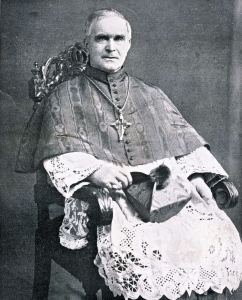
Joseph MacRory, an Irish Cardinal of the Roman Catholic Church who serves as Archbishop of Armagh from 1928 until his death in 1945, is born in Ballygawley, County Tyrone, on March 19, 1861.

MacRory is one of ten children of Francis MacRory, a farmer, and his wife, Rose Montague. He studies at St. Patrick’s College, Armagh, and St. Patrick’s Pontifical University, Maynooth. He is ordained to the priesthood on September 13, 1885, and serves as the first president of St. Patrick’s Academy, Dungannon from 1886 to 1887. MacRory teaches Scripture and Modern Theology at St. Mary’s College, Oscott in England until 1889, when he is appointed Professor of Scripture and Oriental Languages at his alma mater of Maynooth College. In 1906, he co-founds the Irish Theological Quarterly. In 1912, he is made Vice-President of Maynooth.

On August 9, 1915, MacRory is appointed Bishop of Down and Connor by Pope Benedict XV and receives his episcopal consecration on November 14 from Cardinal Michael Logue. During his tenure, his life is threatened repeatedly due to the turbulent atmosphere in Belfast. He is a member of the Irish Convention from 1917 to 1918.

MacRory is promoted to Archbishop of Armagh and thus Primate of All Ireland on June 22, 1928, in succession to Patrick O’Donnell. He is elevated to the cardinalate on December 16, 1929, by Pope Pius XI.

MacRory is the papal legate at the 1933 laying of the foundation stone of Liverpool Metropolitan Cathedral in England. He also serves as one of the cardinal electors who participate in the 1939 papal conclave which ultimately selects Pope Pius XII.

MacRory is a strenuous opponent of social injustice, National Socialism, Protestantism, and the Partition of Ireland. It is MacRory who suggests to Eoin O’Duffy that he raise an Irish Brigade to aid Generalissimo Francisco Franco during the Spanish Civil War. In 1940, he voices strong objections to conscription in the North.

MacRory is a supporter of the Gaelic League. Errigal Ciarán GAC, one of the most famous GAA clubs in Ireland, plays at Cardinal MacRory Park in Dunmoyle, County Tyrone, which is built in 1956 in his honour.

After a brief illness, Cardinal MacRory dies on October 13, 1945, at the age of 84 from a heart attack at Ara Coeli, the residence in Armagh. He is interred in St. Patrick’s Cathedral Cemetery, Armagh.