seamus dubhghaill

Promoting Irish Culture and History from Little Rock, Arkansas, USA


Leave a comment

Death of Columba, Founder of the Monastery of Iona

Columba (or Colum Cille), Irish abbot and missionary evangelist credited with spreading Christianity in what is today Scotland at the start of the Hiberno-Scottish mission., dies on June 9, 597.

He is born into the Cenél Conaill, a branch of the Northern Uí Néill, then Ireland’s most powerful dynasty. His place of birth is reputedly Gartan in modern day County Donegal, though there is no contemporary evidence for this.

His is the son of Fedlimid, who is said to be a great-grandson of Niall Nóigiallach, and his wife Eithne. The Irish form of his name, Colum Cille, has been taken to mean ‘Dove of the Church’. He is fostered and baptised by a priest named Cruithnechán, who lives near his birthplace. It is reputed that he undergoes schooling in bardic studies. His biographer, Adomnán (c. 624–704), states that he receives monastic training under a bishop whom he names variously as Findbarr or Finnio, who can most likely be identified as Finnian of Movilla. Otherwise little is known of his early life.

Adomnán states that Columba leaves Ireland in his forty-second year. Later tradition records that his departure is an act of penitence for instigating the battle of Cúl Dreimhne in 561, supposedly because he surreptitiously copies a Psalter lent to him by his former master, Finnian. Adomnán simply states, however, that he leaves Ireland to become a “pilgrim for Christ.” He probably also wishes to sever himself from the secular concerns arising from his family connections. Whatever the reason, he remains in Scotland for the rest of his life, returning to Ireland only on a few occasions.

His choice of Iona, an island off the Ross of Mull on the western coast of Scotland, as a monastic refuge is influenced by the contacts that his family has with the kingdom of Dál Riata and its rulers. Certainly it is under Dál Riata patronage that he subsequently founds the island monasteries of Campus Lunge (on Tiree) and Hinba, which more recent opinion takes to have been the island of Colonsay. He also founds churches in Inverness, probably following on his meeting with and likely conversion of Bridei I, king of the Picts. All of Iona’s foundations, on both sides of the Irish Sea, are under the headship of the abbot of the mother-house, and many of the abbots of the most important houses of the paruchia of Iona are of Columba’s kin-group. Although many foundations elsewhere in Scotland and in Northumbria are later attributed to him, it is doubtful whether Iona evangelises outside of Ireland, Dál Riata and Pictland. Yet there can be no doubt of his political influence. He “ordains” Áedán king of Dál Riata, and his influence and connections enable him to strengthen the alliance between the Uí Néill and Dál Riata.

One of the few, if not the only, times he leaves Scotland is toward the end of his life, when he returns to Ireland to found the monastery at Durrow.

According to traditional sources, Columba dies in Iona on Sunday, June 9, 597, and is buried by his monks in the abbey he created. However, Dr. Daniel P. McCarthy disputes this and assigns a date of 593 to Columba’s death. The Annals record the first raid made upon Iona in 795, with further raids occurring in 802, 806 and 825. Columba’s relics are finally removed in 849 and divided between Scotland and Ireland.

Colmcille is one of the three patron saints of Ireland, after Patrick and Brigid of Kildare. He is the patron saint of the city of Derry, where he founded a monastic settlement in c. 540. The Catholic Church of Saint Colmcille’s Long Tower, and the Church of Ireland St. Augustine’s Church both claim to stand at the spot of this original settlement. The Church of Ireland Cathedral, St. Columb’s Cathedral, and the largest park in the city, St. Columb’s Park, are named in his honour. The Catholic Boys’ Grammar School, St. Columb’s College, has him as Patron and namesake.

St. Columba’s National School in Drumcondra is a girls’ school named after the saint.

St. Colmcille’s Primary School and St. Colmcille’s Community School are two schools in Knocklyon, Dublin, named after him, with the former having an annual day dedicated to the saint on June 9.

The town of Swords, Dublin is reputedly founded by Colmcille in 560 AD. St. Colmcille’s Boys’ National School and St. Colmcille’s Girls’ National School, both located in the town of Swords, are also named after the Saint as is one of the local Gaelic teams, Naomh Colmcille.

The Columba Press, a religious and spiritual book company based in Dublin, is named after Colmcille.

Aer Lingus, Ireland’s national flag carrier has named one of its Airbus A330 aircraft in commemoration of the saint (reg: EI-DUO).

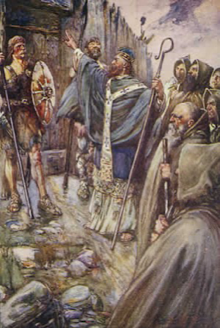
(Pictured: Columba banging on the gate of Bridei, son of Maelchon, King of Fortriu)

Leave a comment

Birth of St. Columba

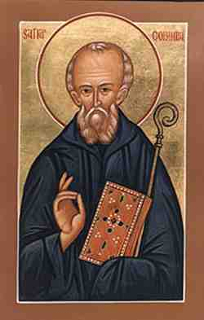
St. Columba, also called Colum or Columcille, Irish abbot and missionary Evangelist is born on December 7, 521, in Tír Chonaill (mainly modern County Donegal) in the north of Ireland. He is credited with spreading Christianity in what is today Scotland at the start of the Hiberno-Scottish mission. He also founds the important abbey on Iona, which becomes a dominant religious and political institution in the region for centuries. He is the Patron Saint of Derry and is highly regarded by both the Gaels of Dál Riata and the Picts. Today he is remembered as a Catholic saint and one of the Twelve Apostles of Ireland.

Columba studies under Saints Finnian of Movilla and Finnian of Clonard and is ordained into the priesthood around 551. He founds churches and the famous monasteries Daire Calgaich, in Derry, and Dair-magh, in Durrow.

Columba and his twelve disciples erect a church and monastery on the island of Iona (c. 563) as their springboard for the conversion of Scotland. It is regarded as the mother house and its abbots as the chief ecclesiastical rulers even of the bishops. Columba gives formal benediction and inauguration to Áedán mac Gabráin of Dunadd as king of Dál Riata.

Columba accompanies Aidan to Ireland in 575 and takes a leading role in a council held at Druim Cetta, which determines the position of the ruler of Dál Riata in relation to the king of Ireland. The last years of Columba’s life are apparently primarily spent in Iona, where he is already revered as a saint. He and his associates and successors spread the gospel more than any other contemporary group of religious pioneers in Britain.

Columba dies on Iona and is buried in 597 by his monks in the abbey he created. In 794 the Vikings descend on Iona. Columba’s relics are finally removed in 849 and divided between Scotland and Ireland. The parts of the relics which go to Ireland are reputed to be buried in Downpatrick, County Down, with St. Patrick and St. Brigid or at Saul Church neighbouring Downpatrick.

Three Latin hymns may be attributed to Columba with some degree of certainty. Excavations in 1958 and 1959 revealed Columba’s living cell and the outline of the original monastery.

St. Columba’s Feast Day, 9 June, has been designated as International Celtic Art Day. The Book of Kells and the Book of Durrow, great medieval masterpieces of Celtic art, are associated with Columba.


Leave a comment

St. Columba Encounters Monster in Loch Ness

columba-and-loch-ness-monster

St. Columba is said to have encountered the Loch Ness Monster on August 22, 565.

Columba is trained by Irish monks. However, his youthful Christianity is skin-deep while his passions are strong. He is partly responsible for the battle of Cul-drebene in which many men lose their lives. Repentant, he sails to Britain as “a pilgrim for Christ” and founds the monastery of Iona, from which Christianity spreads across North Britain. He himself travels and preaches, establishing several churches and monasteries.

Revered as a saint, his life is written by Adomnán. In reporting Columba’s life, Adomnán gives what appears to be the first written account of the Loch Ness Monster.

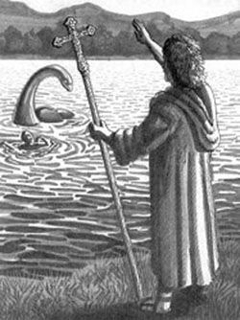
Traveling in Scotland, Columba has to cross the Loch Ness. On its banks, he sees some of the Picts burying a man who had been bitten by a water monster while swimming. The body had been pulled from the loch with the aid of a hook by rescuers who had come to his assistance in a boat.

Despite the danger, Columba orders one of his followers to swim across the loch and bring back a boat that is moored on the other side. This man’s name was Lugne Mocumin. Without hesitation, Lugne strips for the swim and plunges in.

The monster, robbed of its earlier feast, surfaces and darts at Lugne with a roar, its jaws open. Everyone on the bank is stupefied with terror, everyone except Columba, that is. A firm believer in the authority of the crucified Christ, he raises his hand, making the sign of the cross. Invoking the name of God, he commands the beast, saying, “You will go no further, and won’t touch the man; go back at once.”

At the voice of the saint, the monster flees as if terrified, “more quickly than if it had been pulled back with ropes,” says Adomnán. The heathens are amazed. Everyone who witnesses the sight gives glory to the God of the Christians.

The authenticity of this event remains in doubt. To begin with, Adomnán’s account is written over a hundred years after the alleged events. Furthermore, different versions of the story disagree with one another. One has Columba raising the monster’s first victim from the dead by laying his staff across his chest.

This is only one of many extraordinary events in Adomnán’s account. According to him, Columba drips with prophecies and predictions that come true. He makes water into wine like Jesus, draws water from a rock like Moses, calms a storm at sea, provides a miraculous draught of fishes, multiplies a herd of cattle, drives a demon out of a milk pail, and cures the sick. A book owned by Columba could not be destroyed by water. Through his prayers he kills a wild boar, stops serpents from harming the inhabitants of a certain island. Angels and manifestations of divine light attend him throughout his life. Adomnán’s account has so many incredible tales that it is unbelievable.

(From “Columba Encountered Loch Ness Monster” by Dan Graves, MSL published on Christianity.com)


6 Comments

The Battle of Moira

battle-of-moira

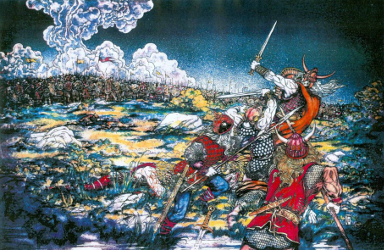
The Battle of Moira, known archaically as the Battle of Magh Rath, is fought on June 24, 637, near the Woods of Killultagh, just outside the village of Moira in what becomes County Down. The battle pits the Gaelic High King of Ireland Domnall II against his foster son King Congal of Ulster, supported by his ally Domnall the Freckled (Domnall Brecc) of Dál Riata.

The battle is allegedly the largest battle ever fought on the island of Ireland, and results in the death of Congal and the retreat of Domnall Brecc. The battle is caused as a result of the invading Gaels spreading out from Galway Bay. The Gaels have fled France and Spain to escape the Roman invasion of those areas. The Gaels are later to be known as Irish but are not native to the island. The native people of Ulster have been pushed into an area the size of two counties in what is now Antrim and Down.

Congal first establishes his power base in Dál nAraidi, where he becomes King before being recognised as King of Ulster in 627. His ambitions soon come into conflict with Domnall II, who becomes High King of Ireland in 628. Ironically, Domnall II rises to such a position because Congal has defeated and killed the previous High King, Suibne Menn, in a previous battle.

Domnall continues to press the rivalry with Congal very quickly. In 629 the two kings engage each other at the Battle of Dún Ceithirn in what is now County Londonderry. On that occasion Congal is defeated and Domnall is left unchallenged as the High King.

Throughout the 630s, Domnall continues to wage war on his rivals in the Uí Néill clan. In 637, however, Congal once again rises to challenge the Ard Rí, and enlists the help of Dál Riata to do so. The two forces meet just east of Lough Neagh.

Little is known about the actual battle itself. The armies of both Domnall II and Congal are primarily made up of warriors native to Ireland. However, Domnall I of Dál Riata brings a more varied force to the fight. His army included Scots, Picts, Anglo-Saxons, and Britons (Welshmen). At least one side has a substantial cavalry force.

There is reason to believe that the battle might have lasted a week, at the end of which the defeated force flees towards the woods of Killultagh. The forces of Ulster and Dál Riata are defeated, with Domnall of Dál Riata forced to flee north to his kingdom’s holdings. Congall is killed in the course of the battle.

The scale of the battle is confirmed in the 19th century when the railway line in Moira is being constructed. Thousands of bodies of men and horses are excavated. When one considers that the survivors probably numbered quite considerably more, then the reputation of the scale of the battle becomes obvious.