
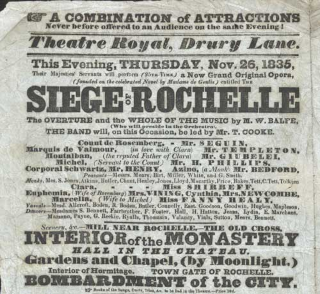
Irish composer Michael William Balfe‘s opera The Siege of Rochelle is first performed at the Drury Lane Theatre in London on October 29, 1835.
The opera is originally prepared for the English Opera House but for some reason the theatrical manager, Samuel James Arnold, does not want it. Instead, Alfred Bunn, the manager of Drury Lane Theatre, seizes the opportunity and begins what is a very fruitful collaboration with Balfe that lasts a decade. Balfe is to become the mainstay of English Opera for almost the next 30 years with a succession of popular operas.
The opera runs for 70 nights on its initial run and is revived in the following three seasons with Balfe singing the role of Michel. Queen Victoria sees the opera on November 15, 1837, her first state visit to a theatre during her reign. In 1836, the opera is reported as staged in Leeds, York, Sheffield, Manchester, Liverpool, Bath and Dublin with Abigail Betts as Clara. John Wilson, who sings in the initial run of the opera, also sings in, at least, some of these. Madame Balfe chooses the opera for her benefit in 1841, and Bunn opens his 1843 season with it on September 30. Emma Romer uses it to open her 1853 season at the Surrey Theatre, although it is being described by then as “somewhat hacknied.”
October 1875 sees a revival of the opera by the Carl Rosa Opera Company at the Princess’s Theatre, and it is then included in the company’s repertoire that tours to Manchester in 1875, Liverpool in 1876, Birmingham in 1877 and Dublin in 1879. The Turner Company tours it in 1893. This is possibly the opera’s last performance until the Wexford Festival Opera performances in 1963. The overture and songs from the opera, such as “When I beheld the anchor weigh’d” continue to retain a place in the concert hall and the home into the 20th century.
In 1838, the opera is performed by the Caradori-Allan troupe at the Park Theatre in New York but fails although it appears to be retained in the repertory. In 1839, it is performed again in Dublin with Balfe as Michel and in Sydney in 1848.
The opera’s production sparks an acrimonious argument between a correspondent in The Examiner accusing Balfe of plagiarism from Luigi Ricci‘s 1832 opera, Chiara di Rosemberg, and, in defence, Frederick Beale, from Balfe’s publishers, and Balfe. The matter seems to be settled in Balfe’s favour when the score of Chiara di Rosemberg is displayed at music publisher Cramer, Beale and Co. so that people can compare the two for themselves. While Edward Fitzball probably uses Ricci’s libretto as the basis for his, it does not seem to have been a straight translation, as some allege, but similarities would help to feed the accusations of plagiarism, bolstered by the Italian training and approach of both composers and the fact that Balfe had sung in Chiara di Rosemberg in Italy in 1834.
Balfe is said to have been paid £5 a night by Bunn and 400 guineas for the score by the publishers Cramer, Beale and Co. In 1871, the Bury and Norwich Post (April 11, 1871) report that the copyright has sold for £156 and just over ten years later the Aberdeen Evening Express (May 8, 1883) notes that the copyright has been sold again for approximately £20, adding “So much for Balfe’s ‘popularity.”

 seamus dubhghaill