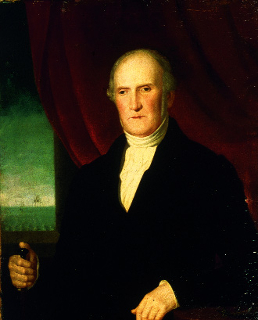
Mitchell’s family moves to Belfast while he is a child. He receives his formal education at Belfast Academy where he excels in mathematics. He begins to notice that his eyesight is failing. By the age of 16 he can no longer read and by the age of 22 he is completely blind.
Undeterred, Mitchell borrows £100 and starts up a successful business making bricks in the Ballymacarrett area of Belfast. This enables him to start building his own houses and he completes approximately twenty in the city. It is during this period that his talent for inventing comes to the fore and he fabricates several machines for use in brickmaking and the building trade.
Mitchell patents the screw pile in 1833, for which he later gains some fame. The screw-pile is used for the erection of lighthouses and other structures on mudbanks and shifting sands, including bridges and piers. His designs and methods are employed all over the world from the Portland, Mainebreakwater to bridges in Bombay. Initially it is used for the construction of lighthouses on Maplin Sands in the Thames Estuary in 1838, at Fleetwood Lancashire (UK) Morecambe Bay in 1839 and at Belfast Lough where his lighthouse is finished in July 1844.
In May 1851 Mitchell moves to Cobh to lay the foundation for the Spit Bank Lighthouse. The success of these undertakings leads to the use of his invention on the breakwater at Portland, the viaduct and bridges on the Bombay, Baroda and Central India Railway and a broad system of Indian telegraphs.
Mitchell dies at Glen Devis near Belfast on June 25, 1868, and is buried in the old Clifton graveyard in Belfast. His wife and daughter predecease him.
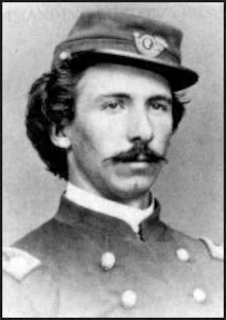
Guiney is the second and eldest surviving son of James Roger Guiney, who is descended from Jacobites, and Judith Macrae. His father, impoverished after a failed runaway marriage, brings with him on his second voyage to New Brunswick his favourite child Patrick, not yet six years old. After some years, his mother and younger brother, William, rejoin her husband, recently crippled by a fall from his horse. They settle in Portland, Maine. The young Guiney works as a wheel boy in a rope factory, and at the age of fourteen apprenticed to a machinist in Lawrence, Massachusetts, but stays only a year and a half before returning to Portland.
Guiney hopes to better himself through education and attends the public grammar school. He matriculates at the College of the Holy Cross in Worcester, Massachusetts. His depleting finances cause him to leave after about a year, despite the fact that the college president offers to make some arrangement for him to stay, which his honor would not allow him to accept. His book-loving father having meanwhile died, he goes to study for the Bar under Judge Walton, and is admitted in Lewiston, Maine, in 1856, taking up the practice of criminal law.
Familiar with the manual of arms, Guiney enlists for example’s sake as a private, refusing a commission from GovernorJohn A. Andrew until he has worked hard to help recruit the 9th Massachusetts Infantry Regiment. By June 1861, he is a captain. In July 1862, the first colonel having died from a wound received in action, Lieutenant Colonel Guiney succeeds him to the command. He wins high official praise, notably for courage and presence of mind at the Battle of Gaines’ Mill in Hanover County, Virginia. Here, after three successive color-bearers had been shot down, he himself reportedly seizes the flag, throws aside coat and sword-belt, rises white-shirted and conspicuous in the stirrups, inspires a final rally, and turns the fortune of the day.
The 9th Massachusetts is present at Gettysburg, Pennsylvania, in second brigade first division V Corps on July 1, 1863. Col Jacob B. Sweitzer the brigade commander, detaches Guiney’s regiment for picket duty. Consequently, the regiment misses the second day’s fighting at the Battle of Gettysburg.
In 1864, through the Battle of the Wilderness, Guiney frequently has been in command of his brigade, the second brigade, first division, V Corps. After many escapes from dangerous combats without serious injury, he is shot in the face by a sharpshooter at the Battle of the Wilderness on May 5, 1864. The Minié ball destroys his left eye, and inflicts, it is believed, a fatal wound. During an interval of consciousness, however, he insists on an operation which saves his life. He is honorably discharged and mustered out of the U.S. Volunteers on June 21, 1864, just before the mustering out of his old regiment.
On February 21, 1866, PresidentAndrew Johnson nominates Guiney for the award of the honorary grade of brevetbrigadier general, to rank from March 13, 1865, for gallant and meritorious services during the war. The U.S. Senate confirms the award on April 10, 1866.
Kept alive for years by nursing, Guiney runs unsuccessfully for the United States Congress on a sort of “Christian Socialist” platform, is elected assistant district attorney (1866–70), and acts as consulting lawyer (no longer being able to plead) on many locally celebrated cases.
Guiney’s last exertions are devoted to the defeat of the corruption and misuse of the Probate Court of Suffolk County, Massachusetts, of which he had become registrar (1869–77). He dies suddenly on March 21, 1877, in Boston and is found kneeling against an elm in the little park near his home. General Guiney is Commandant of the Loyal Legion, Major-General Commandant of the Veteran Military League, member of the Charitable Irish Society of Boston, and one of the founders and first members of the Catholic Union of Boston. He also publishes some literary criticism, a few graphic prose sketches and some verse.
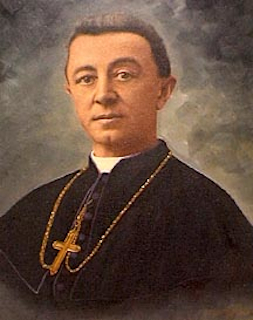
James Augustine Healy, American Roman Catholic priest and the second bishop of Portland, Maine, is born on April 6, 1830, in Macon, Georgia to a multiracial slave mother and Irish immigrant father. He is the first bishop in the United States of any known African descent. When he is ordained in 1854, his multiracial ancestry is not widely known outside his mentors in the Catholic Church.
Healy is the eldest of ten siblings of Michael Morris Healy, an Irish immigrant planter from County Roscommon, and his common law wife Eliza Smith (sometimes recorded as Clark), a multiracial enslaved African American. He achieves many “firsts” in United States history. He is credited with greatly expanding the Catholic church in Maine at a time of increased Irish immigration. He also serves Abenaki people and many parishioners of French-Canadian descent who were traditionally Catholic. He speaks both English and French.
Beginning in 1837, like many other wealthy planters with mixed-race children, Michael Healy starts sending his sons to school in the North. James, along with brothers Hugh and Patrick, goes to Quaker schools in Flushing, New York, and Burlington, New Jersey. Later they each attend the newly opened College of the Holy Cross in Worcester, Massachusetts. He graduates as valedictorian of the college’s first graduating class in 1849.
Following graduation, Healy wishes to enter the priesthood. He cannot study at the Jesuit novitiate in Maryland, as it is a slave state. With the help of John Bernard Fitzpatrick, he enters a Sulpicianseminary in Montreal. In 1852, he transfers to study at Saint-Sulpice Seminary in Paris, working toward a doctorate and a career as a seminary professor. After a change of heart, he decides to become a pastor. On June 10, 1854, he is ordained at Notre-Dame de Paris as a priest to serve in Boston, Massachusetts. He is the first African American to be ordained a Roman Catholic priest although at the time he identifies as and is accepted as white Irish Catholic.
When Healy returns to the United States, he becomes an assistant pastor in Boston. He serves the archbishop, who helps establish his standing in the church. In 1866 he becomes the pastor of St. James Church, the largest Catholic congregation in Boston. In 1874 when the Boston legislature is considering taxation of churches, he defends Catholic institutions as vital organizations that help the state both socially and financially. He also condemns certain laws that are generally enforced only on Catholic institutions. He founds several Catholic charitable institutions to care for the many poor Irish immigrants who had arrived during the Great Famine years.
Healy’s success in the public sphere leads to his appointment by Pope Pius IX to the position of second bishop of Portland, Maine. He is consecrated as Bishop of Portland on June 2, 1875, becoming the first African American to be consecrated a Catholic bishop. For 25 years he governs his large diocese, supervising also the founding of the Diocese of Manchester, New Hampshire, when it is split from Portland in 1885. During his time in Maine, which is a period of extensive immigration from Catholic countries, he oversees the establishment of 60 new churches, 68 missions, 18 convents, and 18 schools. During that period, he also serves his Abenaki and French-Canadian parishioners.
Healy is the only member of the American Catholic hierarchy to excommunicate men who joined the Knights of Labor, a national union, which reaches its peak of power in 1886.
Mitchell is born in Dublin on April 13, 1780. His family moves to Belfast while he is a child. He receives his formal education at Belfast Academy where he excels in mathematics. He begins to notice that his eyesight is failing. By the age of 16 he can no longer read and by the age of 22 he is completely blind.
Undeterred, Mitchell borrows £100 and starts up a successful business making bricks in the Ballymacarrett area of Belfast. This enables him to start building his own houses and he completes approximately twenty in the city. It is during this period that his talent for inventing comes to the fore and he fabricates several machines for use in brickmaking and the building trade.
Mitchell patents the screw-pile in 1833, for which he later gains some fame. The screw-pile is used for the erection of lighthouses and other structures on mudbanks and shifting sands, including bridges and piers. His designs and methods are employed all over the world from the Portland, Mainebreakwater to bridges in Bombay. Initially it is used for the construction of lighthouses on Maplin Sands in the Thames Estuary in 1838, at Fleetwood Lancashire (UK) Morecambe Bay in 1839 and at Belfast Lough where his lighthouse is finished in July 1844.
In May 1851 Mitchell moves to Cobh to lay the foundation for the Spit Bank Lighthouse. The success of these undertakings leads to the use of his invention on the breakwater at Portland, the viaduct and bridges on the Bombay, Baroda and Central India Railway and a broad system of Indian telegraphs.
Alexander Mitchell dies at Glen Devis near Belfast on June 25, 1868, and is buried in the old Clifton graveyard in Belfast. His wife and daughter predecease him.

 seamus dubhghaill