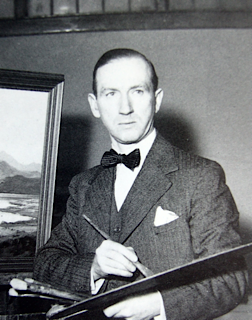
McKelvey is second among six children and second of three sons of William McKelvey, painter and decorator, originally from Roseville, Craigavad, County Down, and his wife Mary, daughter of Frank Baird, farmer, from Ballywee, County Antrim. He is baptised at Saint Matthew’s Parish Church.
McKelvey attends Mayo Street national school in Belfast. When he is sixteen he became a lithographer apprentice to the firm David Allen & Sons. They produce postcards, posters and notices. He enrolls in the Belfast School of Art part-time by attending evening classes until he leaves his employment in 1911 to study full-time. Alfred Rawlings Baker, his art master, has great influence on him during his time at art college. He receives numerous awards for his artwork including the Sir Charles Brett Prize, the Fitzpatrick Prize, and the Taylor Art Competition.
McKelvey returns to David Allen & Sons in 1917 for a short period of time before he begins to focus on painting and opens his own studio in 1920. The studio is located in Rea’s Building, Royal Avenue, Belfast.
By 1918 McKelvey’s work is exhibited at the Royal Hibernian Academy (RHA) and in 1921 he is elected a member of the Belfast Art Society. He is appointed an associate of the RHA in 1923, being granted full membership in 1930. During his career he is considered on a par with Paul Henry and James Humbert Craig, two of the most successful Irish landscape painters of the time. He is elected as one of the first academicians of the Ulster Academy of Arts when it is founded in 1930. He dies in Belfast on June 30, 1974.
James Kennedy, a Northern Irish songwriter and lyricist, dies in Cheltenham, Gloucestershire, England on April 6, 1984. In a career spanning more than fifty years, he writes some 2,000 songs, of which over 200 become worldwide hits and about 50 are all-time popular music classics. Until the duo of John Lennon and Paul McCartney, Kennedy has more hits in the United States than any other Irish or British songwriter.
Kennedy is born near Omagh, County Tyrone, Northern Ireland. His father, Joseph Hamilton Kennedy, is a policeman in the Royal Irish Constabulary, which exists before the partition of Ireland. While growing up in Coagh, Kennedy writes several songs and poems. He is inspired by local surroundings such as the view of the Ballinderry river, the local Springhill house and the plentiful chestnut trees on his family’s property, as evidenced in his poem Chestnut Trees. Kennedy later moves to Portstewart, a seaside resort.
While awaiting a Colonial Service posting to the colony of Nigeria, Kennedy embarks on a career in songwriting. His first success comes in 1930 with The Barmaid’s Song, sung by Gracie Fields. Fellow lyricist Harry Castling introduces him to Bert Feldman, a music publisher based in London‘s “Tin Pan Alley,” for whom Kennedy starts to work. In the early 1930s he writes a number of successful songs, including Oh, Donna Clara (1930), My Song Goes Round the World (1931), and The Teddy Bears’ Picnic (1933), in which he provides new lyrics to John Walter Bratton‘s tune from 1907.
In 1934, Feldman turns down Kennedy’s song Isle of Capri, but it becomes a major hit for a new publisher, Peter Maurice. He writes several more successful songs for Maurice, including Red Sails in the Sunset (1935), inspired by beautiful summer evenings in Portstewart, Northern Ireland, Harbor Lights (1937) and South of the Border (1939), inspired by a holiday picture postcard he receives from Tijuana, Mexico, and written with composer Michael Carr. Kennedy and Carr also collaborate on several West End theatre shows in the 1930s, including London Rhapsody (1937). My Prayer, with original music by Georges Boulanger, has English lyrics penned by Kennedy in 1939. It is originally written by Boulanger with the title Avant de Mourir in 1926.
During the early stages of World War II, while serving in the British Army‘s Royal Artillery, where he rises to the rank of Captain, Kennedy writes the wartime hit, We’re Going to Hang out the Washing on the Siegfried Line. His hits also include Cokey Cokey (1945), and the English lyrics to Lili Marlene. After the end of the war, his songs include Apple Blossom Wedding (1947), Istanbul (Not Constantinople) (1953), and Love Is Like a Violin (1960). In the 1960s he writes the song The Banks of the Erne, for recording by his friend from the war years, Theo Hyde, also known as Ray Warren.
Jimmy Kennedy dies in Cheltenham on April 6, 1984, at the age of 81, and was interred in Taunton, Somerset. In 1997 he is posthumously inducted into the Songwriter’s Hall of Fame.