
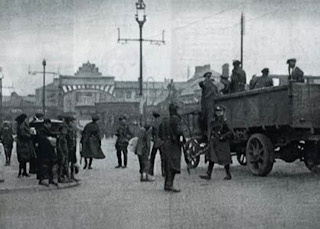
On the morning of August 8, 1922, the National Army of the Irish Free State launches a decisive seaborne assault on Cork, County Cork, the Free State’s second largest city, which is held by anti-Treaty Irish Republican Army (IRA) forces. The operation begins at Passage West, a ferry port and fishing village on the estuary of the River Lee, where the steamship Arvonia docks. The anti-Treaty IRA garrison in Cobh across the bay opens fire with three machine guns, but the National Army troops on deck respond with silence, surprising the sentry who had fired a warning shot.
Over 200 pro-Treaty soldiers disembark, quickly securing the town. The Arvonia is unloaded with 450 troops, an 18-pounder field gun, and several armoured cars. Simultaneously, landings are made at Youghal in east County Cork and Union Hall near Skibbereen in west County Cork, disgorging another 350 troops. This is part of Michael Collins’s plan to seize Cork and end the Irish Civil War swiftly.
Cork is a flashpoint of the Treaty split. While the majority of IRA fighters in the county oppose the Anglo-Irish Treaty, the majority of civilians support it. There are also strong neutral tendencies and peace calls within Cork’s civil and military communities. The Free State’s move aims to break the “Munster Republic” stronghold and force a rapid political settlement.
The landing marks the start of the Battle for Cork, which intensifies over the next days. National Army forces advance toward Cork city, encountering fierce resistance from anti-Treaty IRA positions in areas like Rochestown, Oldcourt Wood, and Garryduff. The fighting is brutal, with estimates of up to 20 fatalities and many wounded. The conflict also produces poignant moments, such as the death of Free State soldier Flood, shot by a former Irish War of Independence comrade, Frank O’Donoghue.
The August 8 landings are the decisive military stroke of the Irish Civil War. They re-take Cork for the Irish Free State, dismantle the Munster Republic, and end the conventional phase of the conflict, paving the way for a prolonged guerrilla war until the anti-Treaty side’s defeat. The event remains a key moment in Irish revolutionary history, remembered for its scale, the use of armoured units, and the deep divisions it exposes in Cork.

