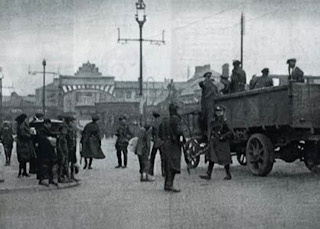
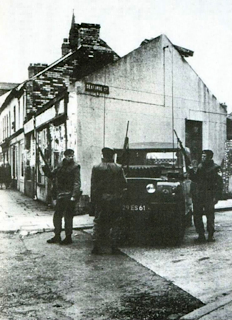
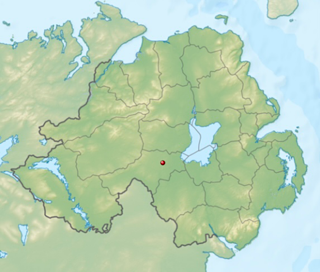
On the morning of August 8, 1922, the National Army of the Irish Free State launches a decisive seaborne assault on Cork, County Cork, the Free State’s second largest city, which is held by anti-Treaty Irish Republican Army (IRA) forces. The operation begins at Passage West, a ferry port and fishing village on the estuary of the River Lee, where the steamshipArvonia docks. The anti-Treaty IRA garrison in Cobh across the bay opens fire with three machine guns, but the National Army troops on deck respond with silence, surprising the sentry who had fired a warning shot.
Over 200 pro-Treaty soldiers disembark, quickly securing the town. The Arvonia is unloaded with 450 troops, an 18-pounder field gun, and several armoured cars. Simultaneously, landings are made at Youghal in east County Cork and Union Hall near Skibbereen in west County Cork, disgorging another 350 troops. This is part of Michael Collins’s plan to seize Cork and end the Irish Civil War swiftly.
Cork is a flashpoint of the Treaty split. While the majority of IRA fighters in the county oppose the Anglo-Irish Treaty, the majority of civilians support it. There are also strong neutral tendencies and peace calls within Cork’s civil and military communities. The Free State’s move aims to break the “Munster Republic” stronghold and force a rapid political settlement.
The landing marks the start of the Battle for Cork, which intensifies over the next days. National Army forces advance toward Cork city, encountering fierce resistance from anti-Treaty IRA positions in areas like Rochestown, Oldcourt Wood, and Garryduff. The fighting is brutal, with estimates of up to 20 fatalities and many wounded. The conflict also produces poignant moments, such as the death of Free State soldier Flood, shot by a former Irish War of Independence comrade, Frank O’Donoghue.
The August 8 landings are the decisive military stroke of the Irish Civil War. They re-take Cork for the Irish Free State, dismantle the Munster Republic, and end the conventional phase of the conflict, paving the way for a prolonged guerrilla war until the anti-Treaty side’s defeat. The event remains a key moment in Irish revolutionary history, remembered for its scale, the use of armoured units, and the deep divisions it exposes in Cork.
By mid-July 1922, the Free State has re-taken counties Limerick and Waterford, but the IRA still controls counties Cork and Kerry, as well as much of the west under Liam Lynch’s command. A purely land-based advance into these areas risks long, attritional battles. Dalton’s plan is to create a second front by landing troops along the County Kerry and County Cork coasts, isolating republican strongholds like Tralee.
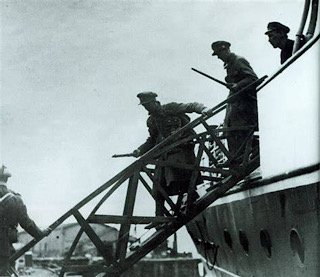
The SS Lady Wicklow carries 450 soldiers of the Dublin Guardbrigade under Paddy Daly, along with a field gun and an armoured car nicknamed the Ex-Mutineer. The Dublin Guards are considered the most disciplined and politically reliable unit in the Army, and Daly is one of Michael Collins’ trusted lieutenants. The landing is intended to secure Fenit as a base for an amphibious assault on Tralee, a key republican stronghold.
The surprise attack catches the IRA forces off guard, taking their left flank in the rear. The Free State quickly advances, and by the following days, much of County Kerry is freed from republican control. The operation is part of a broader offensive that culminates in the capture of Tralee on August 2, one of the bloodiest single days of combat for the National Army.
While the initial landings are successful, the IRA mounts counterattacks over August and September, regaining some ground. However, the Free State’s superior resources, better equipment, and lack of popular support for the republicans allows them to consolidate control in County Kerry over time. The Fenit landing is a turning point, shifting the momentum in favour of the Free State and contributing to the eventual republican defeat in the Irish Civil War.
In summary, the August 2, 1922, naval landing at Fenit is a bold, surprise amphibious operation that disrupts republican defenses, opens County Kerry to Free State advance, and alters the course of the Irish Civil War.
(Pictured: Free State troops landing at Fenit, County Kerry, on August 2, 1922)
At the start of the Irish Civil War in June 1922, the Free State controls only Dublin. Anti‑Treaty forces, forming the so‑called Munster Republic, hold Cork, Limerick, and Waterford, along with much of the west. Waterford’s republican garrison has fortified the city, dismantled the drawbridge’s control equipment, and isolated the port by removing wireless and other communications.
On July 16, republican forces learn that Free State troops ae moving toward Waterford. They raise the drawbridge early and move vessels from the Kilkenny side to the Waterford side. On July 18, Prout’s column is spotted from Sallypark Hill, prompting republican machine gun and rifle fire. A Free State volunteer, Costeloe, is wounded and later dies.
From July 19, sniping continues across the River Suir. On July 19, the Free State brings the 18‑pounder artillery into position overlooking the city, bombarding republican positions. The republicans hold key buildings such as the Adelphia Hotel, Country Club, and Reginald’s Tower.
By July 21, Free State forces cross the River Suir downstream at Gyles Quay, enter the city, and drive out republican troops from their positions. The drawbridge on Redmond Bridge is lowered by hand, and republican reinforcements from Cork and Tipperary either withdraw or do not engage. The Free State takes Waterford on July 21, 1922, ending the republican hold on the city.
Two anti‑Treaty volunteers, Maurice McGrath and John “Bonny” Boyle, are killed. Two Free State soldiers, Sergeant James Howlett and Michael Costelloe, are killed. At least six civilians are killed, including Joseph Dwan, William Long, and a 10‑year‑old girl. Many civilians are wounded.
The fall of Waterford marks a key Free State victory in the conventional phase of the Irish Civil War, contributing to the re‑capture of major southern cities and paving the way for the later guerrilla phase.
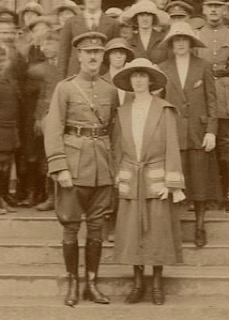
(Pictured: John T. Prout at his wedding to Limerick native Mary Conba at St. John the Evangelist Church (O’Loughlin Memorial Church), Kilkenny, July 12, 1922)
The unrest was triggered by the Orange Order’s permission to march its traditional route through the Garvaghy Road in Portadown, County Armagh, a Catholic/nationalist area, as part of the annual Drumcree parading dispute. The Orange Order, a Protestant fraternal organization, has marched this route since 1807 to commemorate the Battle of the Boyne. For decades, Catholic residents object to the route, seeing it as a sectarian provocation.
The decision to allow the march comes after death threats from loyalistparamilitaries to target Catholics if the parade is stopped. This concession outrages nationalists, who also resent the Royal Ulster Constabulary (RUC)’s aggressive policing of protesters.
On July 6, around 1,000 Orangemen march under a sealed-off Garvaghy Road, with about 1,500 RUC and British Army personnel present. The next day, mass protests erupt in areas like North Belfast, Lurgan, and west Belfast’s Lenadoon district. Rioters hurl stones, petrol bombs, and other projectiles at security forces, while Republican paramilitaries engage in gun battles with police.
Security forces responded with plastic bullets and other riot control measures, firing over 2,500 plastic bullets at rioters. A 13-year-old boy is critically injured after being struck by one. Hundreds of vehicles are hijacked, set on fire, and used to block roads in Belfast, Newry, Armagh, and Dungannon. The RUC and British Army have to withdraw entirely from some nationalist areas of Belfast.
One civilian is killed in the rioting and over 100 people are injured, including 62 RUC officers and at least three soldiers. One hundred seventeen arrests are made and some armoured vehicles are either damaged or destroyed. An indirectly related incident sees a loyalist Ulster Defence Association (UDA) member killed by a pipe bomb he is handling.
The riots highlight the fragility of peace efforts and deepen divisions over parading rights. The episode leads Secretary of State for Northern IrelandMo Mowlam to urge Orange leaders to reroute future marches. For the Provisional Irish Republican Army, the riots are its last major action in a 27-year campaign. It declares its final ceasefire on July 19, 1997.
The 1997 riots are the last widespread sectarian violence in Northern Ireland before the Good Friday Agreement, underscoring the unresolved nature of the Drumcree dispute and the challenges of achieving lasting peace.
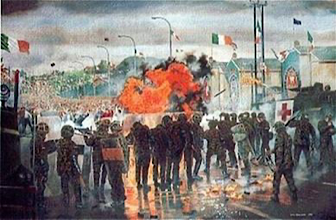
(Pictured: “Drumcree, The Garvaghy Road July 1997” by military artist David Rowlands, oil on canvas, owned by the 1st Battalion (The Cheshires) The Mercian Regiment which depicts British soldiers during the rioting on Garvaghy Road)
The Battle of St. Matthew’s, also known as the Battle of Short Strand, is a gun battle that takes place on the night of June 27-28, 1970, in Belfast, Northern Ireland. It is fought between the Provisional Irish Republican Army (IRA), and Ulster loyalists in the area around St. Matthew’s Roman Catholic church. This lies at the edge of the Short Strand, a Catholic enclave in a mainly-Protestant part of the city. Violence erupts there, and in other parts of Belfast, following marches by the Orange Order. The battle lasts about five hours and ends at dawn when loyalists withdraw. The British Army and police are deployed nearby but do not intervene. Three people are killed and at least 26 wounded in the fighting, while another three are killed in north Belfast.
The battle is the Provisional IRA’s first major action during the Troubles, and a propaganda victory for the Irish nationalist organization. It presents itself as successfully defending a vulnerable Catholic enclave from armed loyalist mobs. Loyalists, however, argue that the IRA lured them into a carefully prepared trap.
During the Northern Ireland riots of August 1969 in Belfast, Catholic Irish republicans clash with Protestant Ulster loyalists and the mainly-Protestant Royal Ulster Constabulary (RUC), Northern Ireland’s police force. Catholics believe that they are about to become “victims of a Protestant pogrom” and Protestants believe they are on the “eve of an IRA insurrection.” Hundreds of Catholic homes and businesses are burned out and more than 1,000 families, mostly Catholic, are forced to flee. The Irish Republican Army (IRA) has few weapons or members and is unable to adequately defend the Catholic areas. The rioting ends with the deployment of British troops. In December 1969, the IRA splits into the Official Irish Republican Army and the Provisional Irish Republican Army—with the Provisionals vowing to defend Catholic areas in future.
The Short Strand is a Catholic/nationalist enclave in East Belfast, a mainly Protestant/Ulster unionist part of the city. In the early years of the Troubles, Catholics in Short Strand number about 6,000, while their Protestant neighbours total about 60,000.
On Saturday, June 27, 1970, a large march by the Orange Order takes place in west Belfast, which is joined by loyalist bands from other parts of the city. Violence breaks out as the march enters the Catholic Springfield Road area on its way to Whiterock Orange Hall. Missiles are thrown by both sides, a bakery is set ablaze, and the British Army fires CS gas to disperse crowds. The riot sparks violence in other parts of Belfast.
In north Belfast, another Orange march proceeds along the Crumlin Road, the boundary between the Catholic Ardoyne and the Protestant Shankill areas. According to Crown prosecutors, a crowd emerges from Ardoyne throwing bottles and stones. As the riot descends into a gun battle, the IRA—who according to Gerry Adams were “ready and waiting”—kill three Protestants: William Kincaid (28), Daniel Loughins (32) and Alexander Gould (18). Others are wounded, including a Royal Navypetty officer who is shot in the jaw while driving a field ambulance. Earlier in the month, British troops divert an Orange march away from Ardoyne, leading to serious rioting by Protestants in the Shankill.
In the predominantly Protestant east of the city, an Orange parade also takes place along the Newtownards Road. At the bottom of the road is the Catholic enclave of the Short Strand, and here a gun battle breaks out between the IRA and Protestants, though the cause of it is disputed by both sides.
Violence erupts at St. Matthew’s Catholic church on the evening of June 27. It begins after a loyalist band and supporters march through the area on their return from the main parade. Rival groups gather, taunting leads to stone-throwing, and eventually, shots are fired.
As the situation worsens, Catholic residents fear that the gathering crowds of loyalists will attempt to invade the Short Strand and burn them from their homes. Local IRA members retrieve weapons from arms dumps. A young resident, Jim Gibney, recalls, “I saw neighbours, people I knew, coming down the street carrying rifles. I was just dumbstruck by this experience. I’d never seen such a thing before.”
The battle begins at about 10:00 p.m. and continues for the next five hours. Loyalists begin attacking the church and surrounding property with petrol bombs. A small house on the church grounds, where the sexton lives with his family, is set ablaze. A nearby Catholic pub is also looted and burned.
A small group of IRA members and members of the Citizens’ Defence Committee take up positions in the church grounds and in adjoining streets. The IRA members are armed with M1 carbines and are led by Billy McKee, commander of the IRA’s Belfast Brigade. Also present is Billy Kelly, commander of the Belfast Brigade’s 3rd Battalion. The IRA members fire at the loyalists, some of whom are positioned on the roofs opposite. Jim Magee, a local loyalist, sees wounded people lying on the road and asks the police (RUC) for help. According to Magee, “[they] said ‘if you have anything, get it out and protect your people.’ So we got an old rifle and went into Frazer Street and started firing back.”
The security forces are deployed in the area at the time but do not intervene to end the fighting. Shortly after the shooting begins, StormontMPPaddy Kennedy goes with Short Strand residents to the local RUC base and demands protection for their homes. Across the River Lagan, in the Markets area, other IRA members assemble and prepare to reinforce the Short Strand should it be invaded. British soldiers eventually arrive in armoured vehicles and cordon off the roads around the Short Strand, which denies the IRA “any hope of reinforcement.” At the time, the British Army says that its soldiers fired no shots because “owing to the confused situation, it was impossible to identify targets.” British Army Colonel Mike Dewar later says, “The whole incident had taken its course because the Army was so chronically overstretched that night in Belfast. The one spare platoon in the whole of west Belfast was not able to get through rioting Protestants to the Short Strand.” JournalistTony Geraghty writes that sometimes “The gunfire eased long enough to allow an occasional British Army personnel carrier (a ‘Pig‘) to whine past, illuminated by the flames in a token gesture of law-and-order.”
Another journalist who witnesses the battle, Peter Taylor, later says, “The shooting intensified but the soldiers still declined to intervene and separate the two sides – either because they felt they were not numerically strong enough or because they did not wish to get caught up in the middle of a sectarian fight, in the darkness, with shots being fired by both sides.”
Liz Maskey, who is a volunteer nurse that night, says that the Short Strand is surrounded by loyalists and claim they attacked her ambulance as it tried to leave the area.
The loyalists withdraw after about five hours, as dawn breaks. IRA leader Billy McKee claims that his unit had fired 800 rounds during the battle.
Three people are killed in the fighting. At least 26 are wounded, including Billy McKee, who is shot five times.
Robert Neill, a 38-year-old Protestant, died instantly when a shot fired from the church bounced off the pavement and hit him in the spine.
James McCurrie, a 34-year-old Protestant, is shot dead on Beechfield Street.
Henry McIlhone, a 33-year-old Catholic, is helping to defend Short Strand when he is accidentally shot from the republican side. He dies on June 29. However, McKee maintains that McIlhone is shot by loyalists. Tírghrá, the IRA’s official list of its fallen, lists McIlhone as a “volunteer” but adds “although not a member of the IRA, Henry McIlhone was included in the republican roll of honour as a mark of respect for this great Irishman by republican comrades he fought alongside.”
Republicans and loyalists disagree over who started the violence and fired the first shots. Republicans claim that the violence was started by a mob of loyalists returning from an Orange march. They say that the loyalists tried to set the church alight and invade Short Strand, with the intention of burning the residents from their homes. Hence, republicans argue that they were defending the Short Strand from a loyalist attack. Loyalists claim the violence was begun by republicans, allegedly when the returning Orangemen and supporters were attacked on Newtownards Road. They argue that republicans attacked Protestants to lure them into “a carefully prepared trap.”
The following day, loyalists expel 500 Catholic workers from the nearby Harland & Wolff shipyard. Shortly after, the British government’s representative at Stormont says that the decision to allow Orange marches to go ahead on that day was “the greatest single miscalculation I have ever seen made in the course of my life.”
Many Catholics and nationalists believe that the IRA had been unable to defend them during the August 1969 riots. However, it is argued that the IRA’s defence of Short Strand redeemed it in the eyes of many Catholics and nationalists. Prior to the gun battle, the IRA had been waiting for an opportunity to portray themselves as defenders of the Catholic community. Among republicans, the battle is seen as a key event in the growth of the Provisional IRA.
Less than a week later, the British Army seizes a large haul of Official IRA weapons during a three-day operation in west Belfast. Nationalists see this as a confiscation of their defences.
Since the beginning of its campaign in 1970, the Provisional IRA has carried out many improvised land mine and roadside bomb attacks on British forces in the region. In September 1972, three British soldiers are killed when their armoured vehicle is blown up by an IRA land mine at Sanaghanroe, near Dungannon. In March 1974, two IRA members are killed on the Aughnacloy Road near Dungannon when a land mine they are planting explodes prematurely.
The Dungannon attack occurs just months after the Warrenpoint ambush on August 27, 1979, where the IRA kills eighteen British soldiers with roadside bombs in south County Down — the deadliest single attack on British forces during The Troubles.
On December 16, 1979, two armoured British Army Land Rovers are driving along Ballygawley Road, about two miles outside Dungannon. A unit of the IRA had planted a 600–1,000-pound (270–450 kg) improvised land mine in a culvert under the road at Glenadush. When the second vehicle reaches the culvert, the land mine is detonated by remote control from a concealed location, showcasing their evolving tactics in guerrilla warfare and ambush strategy. The blast is powerful enough to launch the armoured Land Rover into the air and killing four soldiers from the Royal Regiment of Artillery outright: William Beck (23), Keith Richards (22), Simon Evans (19), and Allan Ayrton (23).