seamus dubhghaill

Promoting Irish Culture and History from Little Rock, Arkansas, USA


Leave a comment

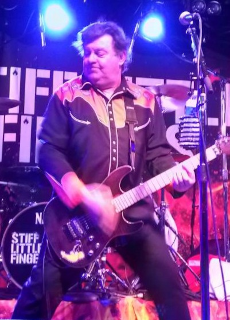
Birth of Jake Burns, Frontman of Stiff Little Fingers

John “Jake” Burns, singer and guitarist best known as the frontman of Stiff Little Fingers, is born on February 21, 1958, in Belfast, Northern Ireland. He also records with Jake Burns and the Big Wheel, 3 Men + Black, and as a solo artist.

Burns grows up in Joanmount in Ballysillan. His mother is a seamstress, and his father is a machinist in a textile machinery factory/steel foundry, where he is a shop steward, and his socialist views are an influence on his son. Prior to punk, Burns’s musical influences include Rory Gallagher, Dr. Feelgood, Graham Parker, and Bob Marley.

Burns starts off his career at Belfast Boys’ Model School with a rock covers band, Highway Star, which consists of Burns, Gordon Blair, Henry Cluney, and Brian Faloon. Blair subsequently leaves the group to join Rudi, and Ali McMordie joins at about the time the band discovers punk.

The band is briefly named the Fast, but as there is already a group of that name, they change it to Stiff Little Fingers, taken from the song of the same name that had appeared on Pure Mania, the 1977 album by the Vibrators. Apart from a five-year gap from 1983 to 1987, Stiff Little Fingers has been active since 1977 to the present day and have released ten studio albums.

In 1981, Burns makes his acting debut in an episode of the BBC‘s Play for Today series entitled Iris in the Traffic, Ruby in the Rain, written by Belfast-born poet and playwright Stewart Parker, which also features the rest of Stiff Little Fingers effectively playing themselves as “The Band.”

After the breakup of Stiff Little Fingers in 1983, Burns forms Jake Burns and the Big Wheel. The band consists of Burns on vocals and guitar, Steve Grantley on drums, Sean Martin on bass guitar, and Pete Saunders on keyboards. Big Wheel records a total of three singles, “On Fortune Street,” “She Grew Up” and “Breathless.” A compilation album, also called On Fortune Street, is released in 2002 after the band’s demise.

In 1987, Burns disbands Big Wheel, and Stiff Little Fingers reforms, because they are “skint and wanted to make a bit of cash to get back to Ireland for Christmas.”

From about 2001 to 2005, Burns is involved in a side project with Pauline Black of the Selecter, called 3 Men and Black. This involves Black touring with three male artists from the late 1970s and early 1980s doing acoustic versions of songs they are famous for and talking a little about how they came to write the songs. The lineup for the concerts is fairly fluid, and includes such people as Bruce Foxton, Jean-Jacques Burnel, Eric Faulkner and Nick Welsh.

On March 27, 2006, Burns releases a solo album titled Drinkin’ Again.

In 2009, Burns forms a Chicago punk rock supergroup called the Nefarious Fat Cats to raise money for local charities. Notable members include John Haggerty (Pegboy, Naked Raygun), Joe Haggerty (Pegboy), Joe Principe (Rise Against), Scott Lucas (Local H), Herb Rosen (Beer Nuts, Right of the Accused) and Mark DeRosa (Dummy). Burns also contributes guitar and vocals on a track of the Black Sheep Band charity record for Children’s Memorial Hospital, A Chicago Punk Rock Collaboration for the Kids, Vol 1.

In 2016, Burns joins an acoustic “supergroup” formed by Kirk Brandon of Spear of Destiny, called Dead Men Walking which also includes David Ruffy and John “Segs” Jennings, both of Ruts DC.

Burns lives in London for over ten years from 1978 after Stiff Little Fingers relocates there. His first wife lives in Newcastle upon Tyne, and after their marriage, he moves to Newcastle, where he lives for 16 years, becoming a supporter of Newcastle United F.C. He is also an avid supporter of the Northern Ireland national football team.

Burns’s second wife, Shirley, is American and they have lived in Chicago since 2004. Burns eventually becomes a U.S. citizen, partially so he can help vote out Donald Trump.

(Pictured: Jake Burns, performing with Stiff Little Fingers in 2019)


Leave a comment

Death of Keyboardist Lou Martin

lou-martin

Louis Michael “Lou” Martin, piano and organ player from Belfast, dies in Bournemouth, Dorset, on August 17, 2012. He is most famous for his work with the London-based band Killing Floor and with fellow Irish musician Rory Gallagher.

Martin is born in Belfast on August 12, 1949. He starts learning the piano at the age of six and joins his first professional band, Killing Floor, in April or May 1968. In 1969 Martin and Stuart McDonald are recruited by 17-year-old Darryl Read who forms a band for Emperor Rosko‘s brother, Jeff Pasternak, called Crayon Angels. Read assembles the band and plays drums while Rosko acts as manager. Martin later leaves Killing Floor to play alongside Gallagher, and is featured on several of Gallagher’s albums, including Blueprint, Tattoo, Irish Tour ’74, Against the Grain, Calling Card, Defender and Fresh Evidence. He also plays rhythm guitar on one track, “Race the Breeze” from Blueprint.

After leaving Gallagher’s band, Martin and drummer Rod de’Ath form Ramrod, after which Martin plays with Downliners Sect and Screaming Lord Sutch. He also tours with Chuck Berry and Albert Collins.

Martin plays in the Nickey Barclay band in London in the 1980s, alongside Barclay on keyboards, with John Conroy and Dave Ball on lead guitar. The band plays across London on the blues rock circuit during the 1980s at venues such as The White Lion, Putney, The Star and Garter on Lower Richmond Road, The Golden Lion, Fulham and the Cartoon, Croydon.

Killing Floor releases an album in 2004 named Zero Tolerance, on which Martin participates.

After a period of illness including cancer and a number of strokes, Lou Martin dies peacefully in a hospital in Bournemouth, Dorset, at the age of 63, on August 17, 2012.


Leave a comment

Death of Rory Gallagher, Irish Blues & Rock Guitarist

rory-gallagher

William Rory Gallagher, Irish blues and rock multi-instrumentalist, songwriter, and bandleader, dies at the age of 47, in London on June 14, 1995 of complications following a liver transplant.

Gallagher is born in Ballyshannon, County Donegal, on March 2, 1948. Both he and his brother Dónal are musically inclined and encouraged by their parents. At age nine, Gallagher receives his first guitar from them. After winning a talent contest when he is twelve, he begins performing with both his acoustic guitar and an electric guitar that he purchases with his prize money. It is, however, his purchase three years later of a 1961 Fender Stratocaster for £100 that becomes his primary instrument and most associated with him for the span of his lifetime.

Gallagher is initially attracted to skiffle after hearing Lonnie Donegan on the radio. While still in school, playing songs by Buddy Holly and Eddie Cochran, he discovers his greatest influence in Muddy Waters. He begins experimenting with folk, blues, and rock music.

While still a young teenager, Gallagher begins playing after school with Irish showbands. In 1963, he joins one named Fontana, a sextet playing the popular hit songs of the day. The band tours Ireland and the United Kingdom, earning enough money for Gallagher to make the payments on his Stratocaster guitar. Gallagher begins to influence the band’s repertoire and successfully moulds Fontana into The Impact, changing the line-up into a rhythm and blues group. The band plays gigs in Ireland and Spain until it disbands in London, with Gallagher and the bassist and drummer continuing to perform as a trio in Hamburg, Germany.

In 1966, Gallagher returns to Ireland and forms Taste, a blues rock and R&B power trio. Initially, the band is composed of Gallagher and Cork musicians Norman Damery and Eric Kitteringham. However, by 1968, Damery and Kitteringham are replaced by Belfast musicians John Wilson on drums and Richard McCracken on bass. Performing extensively in the UK, the group supports both Cream at their Royal Albert Hall farewell concert and the blues supergroup Blind Faith on a tour of North America.

After the break-up of Taste in 1970, Gallagher tours under his own name. He hires former Deep Joy bass player Gerry McAvoy to play on his self-titled debut album, Rory Gallagher. This is the beginning of a twenty-year musical relationship between Gallagher and McAvoy. The 1970s are Gallagher’s most prolific period, producing ten albums in the decade. In 1971 he is voted Melody Maker‘s International Top Guitarist of the Year, ahead of Eric Clapton. However, despite a number of his albums reaching the UK Albums Chart, Gallagher does not attain major star status. Though he sells over thirty million albums worldwide, it is his marathon live performances that win him the greatest acclaim.

In the 1980s Gallagher continues recording and embarks on a tour of the United States. In addition, he plays with Box of Frogs, a band formed in 1983 by former members of The Yardbirds.

In the later years of his life, Gallagher develops a phobia of flying. To overcome this he receives a prescription for a powerful sedative. This medication, combined with his alcohol use, results in severe liver damage. Despite his condition he continues touring. By his final performance on January 10, 1995 in the Netherlands, he is visibly ill and the remainder of the tour is cancelled. He is admitted to King’s College Hospital in London in March 1995. His liver is failing and the doctors determine that a liver transplant is the only possible course of action. After 13 weeks in intensive care, his health suddenly worsens when he contracts a Staphylococcal infection. Gallagher dies on June 14, 1995, and is buried in St. Oliver’s Cemetery just outside Ballincollig near Cork.


Leave a comment

Birth of Irish Blues & Rock Guitarist Rory Gallagher

rory-gallagher

William Rory Gallagher, Irish blues and rock multi-instrumentalist, songwriter, and bandleader, is born in Ballyshannon, County Donegal, on March 2, 1948.

Both Rory and his brother Dónal are musically inclined and encouraged by their parents. At age nine, Gallagher receives his first guitar from them. After winning a talent contest when he is twelve, Gallagher begins performing with both his acoustic guitar and an electric guitar that he purchases with his prize money. It is, however, his purchase three years later of a 1961 Fender Stratocaster for £100 that becomes his primary instrument and most associated with him for the span of his lifetime.

Gallagher is initially attracted to skiffle after hearing Lonnie Donegan on the radio. While still in school, playing songs by Buddy Holly and Eddie Cochran, he discovers his greatest influence in Muddy Waters. He begins experimenting with folk, blues, and rock music.

While still a young teenager, Gallagher begins playing after school with Irish showbands. In 1963, he joins one named Fontana, a sextet playing the popular hit songs of the day. The band tours Ireland and the United Kingdom, earning enough money for Gallagher to make the payments on his Stratocaster guitar. Gallagher begins to influence the band’s repertoire and successfully moulds Fontana into The Impact, changing the line-up into an R&B group. The band plays gigs in Ireland and Spain until it disbands in London, with Gallagher and the bassist and drummer continuing to perform as a trio in Hamburg, Germany.

In 1966, Gallagher returns to Ireland and forms Taste, a blues rock and R&B power trio. Initially, the band is composed of Gallagher and Cork musicians Norman Damery and Eric Kitteringham. However, by 1968, Damery and Kitteringham are replaced by Belfast musicians John Wilson on drums and Richard McCracken on bass. Performing extensively in the UK, the group supports both Cream at their Royal Albert Hall farewell concert and the blues supergroup Blind Faith on a tour of North America.

After the break-up of Taste in 1970, Gallagher tours under his own name. He hires former Deep Joy bass player Gerry McAvoy to play on his self-titled debut album, Rory Gallagher. This is the beginning of a twenty-year musical relationship between Gallagher and McAvoy. The 1970s are Gallagher’s most prolific period, producing ten albums in the decade. In 1971 he is voted Melody Maker’s International Top Guitarist of the Year, ahead of Eric Clapton. However, despite a number of his albums reaching the UK Albums Chart, Gallagher does not attain major star status. Though he sells over thirty million albums worldwide, it was his marathon live performances that win him the greatest acclaim.

In the 1980s he continues recording and embarks on a tour of the United States. In addition, he plays with Box of Frogs, a band formed in 1983 by former members of The Yardbirds.

In the later years of his life, Gallagher develops a phobia of flying. To overcome this he receives a prescription for a powerful sedative. This medication, combined with his alcohol use, results in severe liver damage. Despite his condition he continues touring. By his final performance on January 10, 1995 in the Netherlands, he is visibly ill and the remainder of the tour is cancelled. Gallagher is admitted to King’s College Hospital in London in March 1995. His liver is failing and the doctors determine that a liver transplant is the only possible course of action. After 13 weeks in intensive care, his health suddenly worsens when he contracts a Staphylococcal infection. Gallagher dies on June 14, 1995, and is buried in St. Oliver’s Cemetery just outside Ballincollig near Cork City, Ireland.