
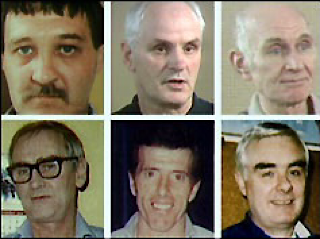
After 17 years in prison, the Birmingham Six could be freed within weeks. An announcement on February 25, 1991, by the Director of Public Prosecutions, Alan Green, says the convictions of the Birmingham Six can no longer be considered safe and satisfactory. Hugh Callaghan, Paddy Joe Hill, Gerry Hunter, Richard McIlkenny, Billy Power, and Johnny Walker, all from Northern Ireland, were all jailed in 1975 for an Irish Republican Army (IRA) attack on two pubs in Birmingham, England, in November 1974 in which 21 people died. The Birmingham Six have consistently maintained their innocence.
Speaking during a live radio broadcast by Irish broadcaster RTÉ, one of the six, Hugh Callaghan, speaks about his ordeal. “It should have happened a long time ago. It has been known for years and years that we were innocent,” he says.
The February 25 preliminary hearing is told both scientific and police evidence presented at the original trial can no longer be relied upon and that therefore the Crown‘s case against the men has collapsed.
Their third appeal is to be heard at the Court of Appeal on Monday, March 4, 1991. New evidence collected in the prior year is to be presented to the court, which will make the final decision on whether or not to release the men.
Friends, family and supporters are overjoyed by the news. The Irish government issues a statement saying it shares their relief and joy.
Gareth Peirce, the solicitor for five of the men, says the case is “a national disgrace” and calls for the evidence to be made public.
Patsy Power, William Power’s wife, says, “It’s over and done but the system has to be altered so nothing like this happens again.”
Former Master of the Rolls Tom Denning, Baron Denning, who rejected the men’s appeal in 1980, says he is saddened by the case. “As I look back I am very sorry, because I always thought that our police were splendid and am very sorry that in this case it appears the contrary,” he says.
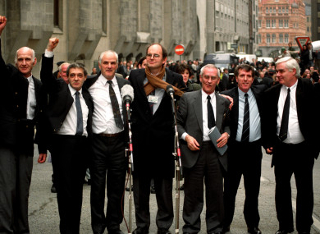
The Birmingham Six are released amid scenes of wild jubilation on March 14, 1991, after their convictions are quashed by the Court of Appeal. Their case – and that of the Guildford Four freed in 1989 – lead to the creation of a Royal Commission on Criminal Justice which makes various recommendations in 1993.
The six men struggle to cope with freedom following their release. Several turn to drink and most of their marriages suffer as a result.
Their fight for what they consider adequate compensation for one of Britain’s most notorious miscarriages of justice continues. Patrick Hill sets up his own pressure group – Miscarriages of Justice Organisation – and in 2002 says there are up to 4,000 people wrongfully imprisoned in the United Kingdom.
In February 1999, Gareth Peirce, the lawyer for five of the six, hands back an Order of the British Empire (CBE) awarded to her at the New Year Honours list.
The real Birmingham pub bombers have not been prosecuted.
(From: “1991: Birmingham Six on verge of freedom,” BBC ON THIS DAY, http://www.news.bbc.co.uk)
 seamus dubhghaill