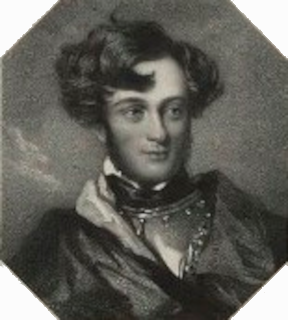
In 1838, Hill purchases land in Gweedore (Irish: Gaoth Dobhair), a “district” in northwest County Donegal in the west of Ulster, and, over the next few years, he expands his holdings to 23,000 acres. He himself describes the condition of the local population as “more deplorable than can well be conceived.” According to the schoolmaster, Patrick McKye, they are in the “most needy, hungry and naked condition of any people.” Among other improvements, he builds a port, Bunbeg Harbour, to encourage fishing, improves the roads and other infrastructure, and constructs The Gweedore Hotel to attract wealthy tourists.
However, Hill’s attempts to reform local farming practices, in particular, his suppression of the rundale system of shared landholding, proves unpopular and controversial. While his reforms may have protected Gweedore from the worst effects of the Great Famine of the 1840s, as the local population did not decrease, as it did elsewhere in Ireland, his attitude to the famine is uncompromising and unsympathetic:
“The Irish people have profited much by the Famine, the lesson was severe; but so were they rooted in old prejudices and old ways, that no teacher could have induced them to make the changes which this Visitation of Divine Providence has brought about, both in their habits of life and in their mode of agriculture.”
Hill’s book Facts from Gweedore (1845) provides an account of conditions in Gweedore and seeks to explain and justify Hill’s agricultural reforms. It runs to five editions and plays a large part in the bitter public debates about the effects of Irish landlordism. In June 1858, he gives evidence to a House of Commonsselect committee on Irish poverty. The committee is critical of his actions.
Hill is twice married, to two sisters, daughters of Edward Austen Knight, brother of Jane Austen. On October 21, 1834, he marries Cassandra Jane Knight (1806–42). They have four children:
Norah Mary Elizabeth Hill (December 12, 1835 – April 24, 1920)
Captain Arthur Blundell George Sandys Hill (May 13, 1837 – June 16, 1923)
Augustus Charles Edward Hill (March 9, 1839 – December 9, 1908)
Cassandra Jane Louisa Hill (March 12, 1842 – August 16, 1901)
On May 11, 1847, Hill marries Louisa Knight (1804–89), niece and goddaughter of Jane Austen. She had moved to Ulster after Cassandra’s death to look after the children. The marriage prompts a parliamentary investigation into the legality of a marriage between a widower and his deceased wife’s sister. They have one son:
George Marcus Wandsbeck Hill (April 9, 1849 – March 22, 1911)
Hill dies at his residence, Ballyare House, in Ramelton, County Donegal, on April 6, 1879. He is buried at Conwal Parish Church in Letterkenny, alongside his first wife.
The Battle of Aughrim (Irish: Cath Eachroma), the decisive battle of the Williamite War in Ireland, is fought on July 22, 1691, near the village of Aughrim, County Galway. It is fought between the largely Irish Jacobite army loyal to James II and the forces of William III. The battle is possibly the bloodiest ever fought in the British Isles with 5,000–7,000 people being killed. The Jacobite defeat at Aughrim means the effective end of James’s cause in Ireland, although the city of Limerick holds out until the autumn of 1691.
After heavy mist all morning, Dutch officer Godert de Ginkel, who is leading William’s forces, moves his forces into position by about two o’clock in the afternoon, and both sides cannonade each other for the next few hours. Ginkel planns to avoid fully joining battle until the next day. He orders a probing attack on the Jacobites’ weaker right flank led by a captain and sixteen Danish troopers, followed by 200 of Sir Albert Cunningham‘s 6th (Inniskilling) Dragoons. The Jacobite response demonstrates the strength of their defence, but also means that the attackers are no longer able to break off the engagement as Ginkel had planned. A conference is held at about 4:00 p.m. Ginkel still favours withdrawing, but the Williamite infantry general Hugh Mackay argues for an immediate full-scale attack.
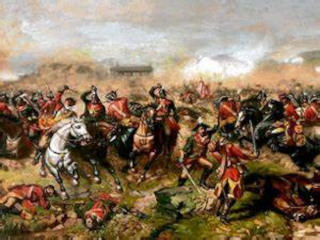
The battle is joined in earnest between five and six o’clock. In the centre, the largely English and Scots regiments under Mackay attempt a frontal assault on Major-GeneralWilliam Dorrington‘s infantry on Kilcommadan Hill. The attackers have to contend with waist-deep water and a tenacious Irish defence of the reinforced hedgelines. They withdraw with heavy losses as the Jacobites pursue them downhill, capturing colonels Thomas Erle and Henry Herbert.
On their left centre, the Williamites advance across low ground exposed to Jacobite fire and take a great number of casualties. The Williamite assault in this area, led by St. John’s and Tiffin’s regiments and the Huguenot foot, is driven back into the bog by the Irish foot fighting with clubbed (reversed) muskets. Many of the attackers are killed or drowned. In the rout, the pursuing Jacobites manage to spike a battery of Williamite guns. The Jacobite regiments of the Royal Irish Regiment of Foot Guards and Gordon O’Neill are said to have fought particularly strongly. The musketry is so intense that “the ridges seemed to be ablaze” according to Andreas Claudianus, a Norwegian fighting with the Danish infantry.
The Jacobite right and centre holding firm, Ginkel tries to force a way across the causeway on the Jacobite left, where any attack would have to pass along a narrow lane covered by Walter Burke’s regiment from their positions in Aughrim castle. Four battalions led by Lieutenant GeneralPercy Kirke secure positions near the castle, following which Sir Francis Compton‘s Royal Horse Guards get across the causeway at the third attempt. Dorrington, having earlier withdrawn two battalions of infantry from this area to reinforce the Jacobite centre, are faced only with weak opposition, reaching Aughrim village. While a force of Jacobite cavalry and dragoons under Henry Luttrell have been tasked with covering this flank, their commander orders them to fall back, following a route now known locally as “Luttrell’s Pass.” He is later alleged to have been in the pay of William, though it seems most probable that Luttrell withdrew as he had little or no infantry support. The cavalry regiments of Henri de Massue, Lanier, Langston and Robert Byerley also cross the causeway, attacking Dorrington’s flank.
Most commentators, even those sympathetic to William, judge that the Irish foot fought exceptionally well. Appearing to believe that the battle could be won, General Charles Chalmot de Saint-Ruhe is heard to shout, “they are running, we will chase them back to the gates of Dublin,” before riding across the battlefield to direct the defence against the Williamite cavalry on his left wing. However, as he rides over to rally his cavalry, he pauses briefly to direct the fire of a battery and is decapitated by a cannonball. His death is said to have occurred around sunset, shortly after eight o’clock.
After Saint-Ruhe’s death the Jacobite leave, devoid of a senior commander, collapse very quickly. The regiment of Horse Guards leave the field almost immediately, followed shortly by the cavalry and dragoon regiments of Luttrell, Dominic Sheldon and Piers Butler. Chevalier de Tessé attempts to head a cavalry counterattack but is seriously wounded shortly afterwards. The Jacobite left flank is now exposed. Mackay and Thomas Tollemache also attack again in the centre, pushing the Jacobites towards the hilltop. Burke and his regiment, still holding the castle, are forced to surrender. Most of the infantry remain unaware of Saint-Ruhe’s death, however, and John Hamilton‘s infantry on the Jacobite right continues to counter-attack, fighting the Huguenot foot to a standstill in an area still known locally as the “Bloody Hollow.” At around nine o’clock towards nightfall the Jacobite infantry is finally pushed to the top of Killcommadan hill and broke, fleeing towards a bog in the left rear of their position, while their cavalry retreat towards Loughrea.
Patrick Sarsfield and Butler briefly try to organise a rearguard action but as in many battles of the period most of the Jacobite casualties occur in the pursuit, which is ended only by darkness and the onset of mist and rain. The defeated infantry is cut down by the Williamite cavalry as they try to get away, many of them having thrown away their weapons in order to run faster.
In addition to the rank and file the Jacobite casualties and prisoners include many of its most experienced infantry officers. The dead include brigadiers Barker, O’Neill and O’Connell, and colonels Moore, Talbot, O’Mahony, Nugent, Felix O’Neil and Ulick Burke, Lord Galway. The two major generals commanding the Jacobite centre, Hamilton and Dorrington, are both taken prisoner, Hamilton dying of wounds shortly afterwards. Though the killing of prisoners to prevent rescue is a common practice at the time, Jacobite soldiers are accused of having “cut to pieces” colonel Herbert after his capture. One contemporary Jacobite source, Charles Leslie, alleges that about 2,000 Jacobites are killed “in cold blood” with many, including Lord Galway and colonel Charles Moore, killed after being promised quarter.
An eyewitness with the Williamite army, George Story, writes that “from the top of the Hill where [the Jacobite] Camp had been,” the bodies “looked like a great Flock of Sheep, scattered up and down the Countrey for almost four Miles round.”
Estimates of the two armies’ losses vary, but they are extremely heavy overall. It is generally agreed that 5,000–7,000 men were killed at Aughrim. Aughrim has been described as “quite possibly the bloodiest battle ever fought in the British Isles,” but earlier medieval battles, although poorly recorded, may rival this battle in casualty numbers. At the time, the Williamites claimed to have lost only 600 and to have killed fully 7,000 Jacobites. Some recent studies put the Williamite losses as high as 3,000, but they are more generally given as between 1,000–2,000, with 4,000 Jacobites killed. Another 4,000 Jacobites deserted, while Ginkel recorded 526 prisoners taken of all ranks. While Ginkel had given word to Dorrington that the captives would be treated as prisoners of war, general officers were instead taken to the Tower of London as prisoners of state, while the majority of the rank and file were incarcerated on Lambay Island where many died of disease and starvation.
Aughrim is the decisive battle of the conflict. The Jacobites lost many experienced officers, along with much of the army’s equipment and supplies. The remnants of the Jacobite army retreat to the mountains before regrouping under Sarsfield’s command at Limerick. Many of their infantry regiments are seriously depleted. The city of Galway surrenders without a fight after the battle, on advantageous terms, while Sarsfield and the Jacobites’ main army surrender shortly afterwards at Limerick after a short siege.

 seamus dubhghaill