seamus dubhghaill

Promoting Irish Culture and History from Little Rock, Arkansas, USA


Leave a comment

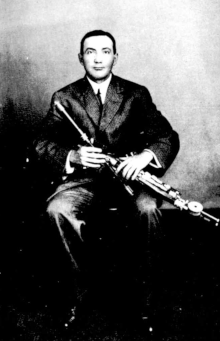
Birth of Patrick “Patsy” Touhey

Patrick “Patsy” J. Touhey, a celebrated player of the uilleann pipes, is born on February 26, 1865, in Cahertinny, Bullaun, Loughrea, County Galway. His innovative technique and phrasing, his travels back and forth across the United States to play on the variety and vaudeville stage, and his recordings make his style influential among Irish American pipers. He can be seen as the greatest contributor to a distinctive American piping style.

According to Chief Francis O’Neill of the Chicago Police Department, in his seminal work O’Neill’s Irish Minstrels and Musicians, Touhey is the third generation of accomplished pipers stemming from his grandfather, Michael Twohill (the original spelling, b. ca. 1800), his father James and his uncle Martin, who are considered accomplished players. The family arrives in Boston around 1868, and his father arranges for his instruction from Bartley Murphy of County Mayo. However, at the age of ten Patsy loses his father and later lays the pipes aside.

In his late teens Touhey strays into a Bowery music hall where John Eagan, the “White Piper” of Galway, is engaged. Enthralled by Eagan’s virtuosity, he takes up the pipes again, and under the instruction of Eagan and Billy Taylor of Philadelphia soon becomes a master.

Touhey and Eagan tour the northeastern United States with “Harrigan’s Double Hibernian Co., Irish and American Tourists” in 1885 and 1886. This is his apparent introduction to theatrical life. Harrigan’s company stars Jeremiah “Jere” Cohan, the father of George M. Cohan, later a famous songwriter and showman. Despite a persistent legend, there is no evidence that Touhey plays publicly for the step-dancing of George M. Cohan, who is seven or eight years old at the time. Between 1886 and 1895 he appears in several theatre productions including “Inshavogue” and “The Ivy Leaf.” At the 1893 World’s Columbian Exposition in Chicago, he plays at the Irish Village, one of two rival Irish pavilions, and is later engaged for the 1904 World’s Fair in St. Louis (Louisiana Purchase Exposition). From about 1896 until 1921 he plays in vaudeville skits, trading jokes with his wife, Mary, and their on and off partner Charles Henry Burke. The shows include slapstick, low-brow gags, Irish nostalgia, and a piping finale to which Mary Touhey dances.

Chicago Police Chief Francis O’Neill, a prominent compiler of Irish dance tunes, calls Touhey “the genial wizard of the Irish pipers . . . A stranger to jealousy, his comments are never sarcastic or unkind, neither does he display any tendency to monopolize attention in company when other musicians are present.”

Touhey lives on Bristow Street in the Bronx, New York City, from at least 1900 until 1908. He and Mary live in rural East Haddam, Connecticut from 1908 to 1919, then in Freeport, New York from 1919 to 1922. In 1922 he moves back to the Bronx. He dies suddenly in his home at 1175 Concourse, New York, on January 10, 1923. He is buried in Saint Raymond’s Cemetery in the Bronx.

A statue of Patsy Touhey is unveiled in 2008 in Loughrea, near the place where he was born. It is a bronze sculpture by James MacCarthy that shows Touhey sitting on a limestone block and playing his pipes. Behind him, on the wall, there are three plaques with portraits of Peter and Vincent Broderick, two other local musicians, and Touhey himself. The statue is a tribute to the musical heritage of Loughrea and Galway, and a reminder of the connection between Ireland and its diaspora.

Recordings made of Tuohy in the 1900s have been digitised and made available on the website of the Irish Traditional Music Archive (ITMA), Dublin.

1 Comment

“Typhoid Mary” Placed in Quarantine

typhoid-mary

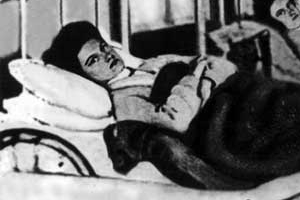
Mary Mallon, better known as Typhoid Mary, the first person in the United States identified as an asymptomatic carrier of the pathogen associated with typhoid fever, is placed in quarantine on March 27, 1869, where she remains for the rest of her life.

Mallon is presumed to have infected 51 people, three of whom die, over the course of her career as a cook. She is twice forcibly isolated by public health authorities and dies after a total of nearly three decades in isolation.

Mallon is born on September 23, 1869, in Cookstown, County Tyrone in what is now Northern Ireland. She immigrates to the United States in 1883 at the age of fifteen and lives with her aunt and uncle.

From 1900 to 1907, Mallon works as a cook in the New York City area for seven families. In 1900, she works in Mamaroneck, New York, where, within two weeks of her employment, residents develop typhoid fever. In 1901, she moves to Manhattan, where members of the family for whom she works develop fevers and diarrhea, and the laundress dies. Mallon then goes to work for a lawyer but leaves after seven of the eight people in that household become ill.

In 1906, Mallon takes a position in Oyster Bay, Long Island, and within two weeks ten of the eleven family members are hospitalized with typhoid. She changes jobs again and similar occurrences happen in three more households. She works as a cook for the family of a wealthy New York banker, Charles Henry Warren. When the Warrens rent a house in Oyster Bay for the summer of 1906, Mallon goes along as well. From August 27 to September 3, six of the eleven people in the family come down with typhoid fever. The disease at that time is “unusual” in Oyster Bay, according to three medical doctors who practice there. Mallon is subsequently hired by other families and outbreaks follow her.

In late 1906, one family hires a typhoid researcher named George Soper to investigate. Soper publishes the results on June 15, 1907, in the Journal of the American Medical Association. He believes Mallon might be the source of the outbreak, but she repeatedly turns him away.

The New York City Health Department sends physician Sara Josephine Baker to talk to Mallon. A few days later, Baker arrives at Mallon’s workplace with several police officers, who take her into custody.

Mallon attracts so much media attention that she is called “Typhoid Mary” in a 1908 issue of the Journal of the American Medical Association. Later, in a textbook that defines typhoid fever, she is again called “Typhoid Mary.”

The New York City Health Inspector determines her to be a carrier. Under sections 1169 and 1170 of the Greater New York Charter, Mallon is held in isolation for three years at a clinic located on North Brother Island.

Upon her release, Mallon is given a job as a laundress. In 1915, Mallon starts another major outbreak, this time at Sloane Hospital for Women in New York City. Twenty-five people are infected and two die. She again leaves, but the police are able to locate and arrest her when she brings food to a friend on Long Island. After arresting her, public health authorities return her to quarantine on North Brother Island on March 27, 1915.

Mallon spends the rest of her life in quarantine at the Riverside Hospital. Six years before her death, she is paralyzed by a stroke. She dies in North Brother Island, East River, New York, on November 11, 1938, of pneumonia. An autopsy finds evidence of live typhoid bacteria in her gallbladder. Mallon’s body is cremated, and her ashes are buried at Saint Raymond’s Cemetery in the Bronx.


Leave a comment

Death of Vincent “Mad Dog” Coll, Mob Hitman

vincent-mad-dog-coll

Vincent “Mad Dog” Coll, born Uinseann Ó Colla, Irish American mob hitman in the 1920s and early 1930s in New York City, dies on February 8, 1932.

Coll is born in Gweedore, County Donegal, on July 20, 1908. When he is not quite one year old, the Coll family emigrates to New York in search of a better life. At age 12, he is sent to a reform school. After being expelled from multiple Catholic reform schools, he joins The Gophers street gang. He joins up with Dutch Schultz‘s gang and quickly rises through the ranks. By the late 1920s he is working as an armed guard for the illegal beer delivery trucks of Schultz’s mob.

Coll is a loose cannon, and Schultz soon grows tired of his reckless behavior. In 1929, Coll robs a dairy in the Bronx of $17,000 without Schultz’s permission. When Schultz confronts him about the robbery, rather than being apologetic, Coll demands he be made an equal partner.

By January 1930 Coll has formed his own gang and is engaged in a shooting war with Schultz. One of the earliest victims is Peter Coll, shot dead on May 30, 1931, while driving down a Harlem street. Coll goes into a rage of grief and vengeance. Over the next three weeks he guns down four of Schultz’s men. In all, around 20 men are killed in the bloodletting. The exact figure is hard to pin down as New York is also in the midst of the vicious Castellammarese War at the same time. It is mayhem on the streets of Manhattan and the police often have difficulty in deciding which corpse belongs to which war.

On July 28, 1931, Coll allegedly participates in a kidnapping attempt that results in the shooting death of a child. His target is bootlegger Joseph Rao, a Schultz underling who is lounging in front of a social club. Several children are playing outside a nearby apartment house. A large touring car pulls up to the curb, and several men point shotguns and submachine guns towards Rao and start shooting. Rao throws himself to the sidewalk, however, and four young children are wounded in the attack. One of them, five-year-old Michael Vengalli, later dies at Beth David Hospital. After the Vengalli killing, New York City Mayor Jimmy Walker dubs Coll a “Mad Dog”.

On October 4, 1931, after an extensive manhunt, New York police arrest Coll at a hotel in the Bronx. He surrenders peacefully. On October 5, a grand jury in New York city indicts Coll in the Vengalli murder. The trial begins in December 1931. He retains famed defense lawyer Samuel Leibowitz. The prosecution case soon falls apart. At the end of December, the judge issues a directed verdict of not guilty.

It was said that both Dutch Schultz and Owney Madden put a $50,000 bounty on Coll’s head. On February 1, 1932, four or five gunmen invade a Bronx apartment which Coll is rumored to frequent and open fire with pistols and submachine guns. Three people, Coll gangsters Patsy Del Greco and Fiorio Basile and bystander Emily Tanzillo, are killed. Three others are wounded. Coll himself does not show up until 30 minutes after the shooting.

At 12:30 AM on February 8, one week after the Bronx shootings, Coll is using a phone booth at a drug store at Eighth Avenue and 23rd Street in Manhattan. He is reportedly talking to Madden, demanding $50,000 from the gangster under the threat of kidnapping his brother-in-law. Madden keeps Coll on the line while it is traced. Three men in a dark limousine soon arrive at the drug store. While one waits in the car, two others step out. One man waits outside while the other walks inside the store. The gunman tells the cashier to stay calm, draws a Thompson submachine gun from under his overcoat and opens fire on Coll in the glass phone booth. He dies instantly. The killers take off in their car and are chased unsuccessfully up Eighth Avenue.

A total of 15 bullets are removed from Coll’s body at the morgue and even more may have passed through him. He is buried next to his brother Peter at Saint Raymond’s Cemetery in the Bronx. Dutch Schultz sends a floral wreath bearing a banner with the message, “From the boys.”


Leave a comment

Death of Mary Mallon, Better Known as “Typhoid Mary”

typhoid-mary

Mary Mallon, better known as Typhoid Mary, dies in North Brother Island, East River, New York, on November 11, 1938. She is the first person in the United States identified as an asymptomatic carrier of the pathogen associated with typhoid fever. She is presumed to have infected 51 people, three of whom die, over the course of her career as a cook. She is twice forcibly isolated by public health authorities and dies after a total of nearly three decades in isolation.

Mallon is born on September 23, 1869, in Cookstown, County Tyrone, Northern Ireland. She immigrates to the United States in 1883 at the age of fifteen and lives with her aunt and uncle.

From 1900 to 1907, Mallon works as a cook in the New York City area for seven families. In 1900, she works in Mamaroneck, New York, where, within two weeks of her employment, residents develop typhoid fever. In 1901, she moves to Manhattan, where members of the family for whom she works develop fevers and diarrhea, and the laundress dies. Mallon then goes to work for a lawyer but leaves after seven of the eight people in that household become ill.

In 1906, she takes a position in Oyster Bay, Long Island, and within two weeks ten of the eleven family members are hospitalized with typhoid. She changed jobs again and similar occurrences happen in three more households. She works as a cook for the family of a wealthy New York banker, Charles Henry Warren. When the Warrens rent a house in Oyster Bay for the summer of 1906, Mallon goes along as well. From August 27 to September 3, six of the eleven people in the family come down with typhoid fever. The disease at that time is “unusual” in Oyster Bay, according to three medical doctors who practice there. Mallon is subsequently hired by other families and outbreaks follow her.

In late 1906, one family hires a typhoid researcher named George Soper to investigate. Soper publishes the results on June 15, 1907, in the Journal of the American Medical Association. He believes Mallon might be the source of the outbreak, but she repeatedly turns him away.

The New York City Health Department sends physician Sara Josephine Baker to talk to Mallon. A few days later, Baker arrives at Mallon’s workplace with several police officers, who take her into custody.

Mallon attracts so much media attention that she is called “Typhoid Mary” in a 1908 issue of the Journal of the American Medical Association. Later, in a textbook that defines typhoid fever, she is again called “Typhoid Mary.”

The New York City Health Inspector determines her to be a carrier. Under sections 1169 and 1170 of the Greater New York Charter, Mallon is held in isolation for three years at a clinic located on North Brother Island.

Upon her release, Mallon is given a job as a laundress. In 1915, Mallon starts another major outbreak, this time at Sloane Hospital for Women in New York City. Twenty-five people are infected and two die. She again leaves, but the police are able to locate and arrest her when she brings food to a friend on Long Island. After arresting her, public health authorities return her to quarantine on North Brother Island on March 27, 1915.

Mallon spends the rest of her life in quarantine at the Riverside Hospital. Six years before her death, she is paralyzed by a stroke. On November 11, 1938, at the age of 69, she dies of pneumonia. An autopsy finds evidence of live typhoid bacteria in her gallbladder. Mallon’s body is cremated, and her ashes are buried at Saint Raymond’s Cemetery in the Bronx.