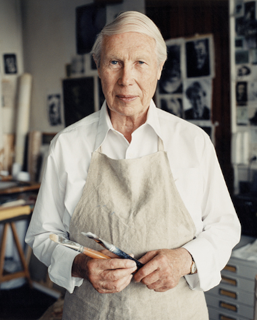
Le Brocquy’s work receives many accolades in a career that spans some seventy years of creative practice. In 1956, he represents Ireland at the Venice Biennale, winning the Premio Acquisito Internationale (a once-off award when the event was acquired by the Nestle Corporation) with A Family (National Gallery of Ireland), subsequently included in the historic exhibition Fifty Years of Modern Art at the 1958 Brussels World’s Fair. That same year he marries the Irish painter Anne Madden and leaves London to work in the French Midi.
Le Brocquy is widely acclaimed for his evocative “Portrait Heads” of literary figures and fellow artists, which include William Butler Yeats, James Joyce, and his friends Samuel Beckett, Francis Bacon and Seamus Heaney. In his later years le Brocquy’s early “Tinker” subjects and Grey period “Family” paintings, attract attention on the international marketplace placing le Brocquy within a very select group of British and Irish artists whose works have commanded prices in excess of £1 million during their lifetimes. Others in this group include Lucian Freud, David Hockney, Frank Auerbach, and Francis Bacon.
Today, Le Brocquy’s work is represented in numerous public collections from the San Diego Museum of Art and the Solomon R. Guggenheim Museum in New York City to the Tate Modern in London. In Ireland, he is honoured as the first and only painter to be included during his lifetime in the Permanent Irish Collection of the National Gallery of Ireland.
Le Brocquy dies in Dublin on April 25, 2012, and is survived by his daughter Seyre from his first marriage (1938–1948) to Jean Stoney, and his two grandsons John-Paul and David; his second wife Anne Madden, and their two sons, Pierre and Alexis.
The style of trompe-l’œil painting that Harnett develops is distinctive and inspired many imitators, but it is not without precedent. A number of Dutch Golden Age painters, Pieter Claesz for instance, had specialized in tabletop still life of astonishing verisimilitude. Raphaelle Peale, working in Philadelphia in the early 19th century, pioneers the form in America. What sets Harnett’s work apart, besides his enormous skill, is his interest in depicting objects not usually made the subject of a painting.
Harnett paints musical instruments, hanging game, and tankards, but also paints the unconventional Golden Horseshoe (1886), a single rusted horseshoe shown nailed to a board. He paints a casual jumble of second-hand books set on top of a crate, Job Lot, Cheap (1878), as well as firearms and even paper currency. His works sell well, but they are more likely to be found hanging in a tavern or a business office than in a museum, as they did not conform to contemporary notions of high art.
Harnett spent the years 1880–1886 in Europe, staying in Munich from 1881 until early 1885. His best-known paintings, the four versions of After the Hunt, are painted between 1883 and 1885. Each is an imposing composition of hunting equipment and dead game, hanging on a door with ornate hinges at the right and keyhole plate at the left. These paintings, like the horseshoe or currency depictions mentioned earlier, are especially effective as trompe-l’œil because the objects occupy a shallow space, meaning that the illusion is not spoiled by parallax shift if the viewer moves.
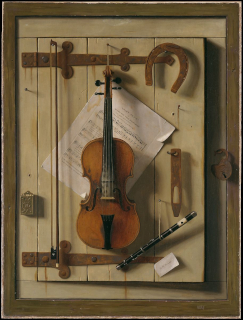
Overall, Harnett’s work is most comparable to that of the slightly younger John F. Peto. The two artists know each other, and a comparison can be made between two paintings featuring violins. Harnett’s Music and Good Luck from 1888 shows the violin hanging upright on a door with ornate hinges and with a slightly torn piece of sheet music behind it. The elements are arranged in a stable, deliberate manner. Peto’s 1890 painting shows the violin hanging askew, as well as chipped and worn, with one broken string. The sheet music is dog-eared and torn around the edges and placed haphazardly behind the instrument. The hinges are less ornate, and one is broken. Harnett’s objects show signs of use but are well preserved, while Peto’s more humble objects are nearly used up.
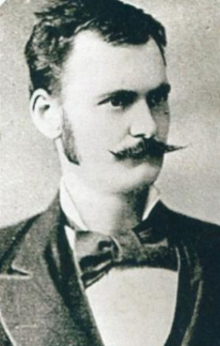
Crippling rheumatism plagues Harnett in his last years, reducing the number but not the quality of his paintings. He dies in New York City on October 29, 1892. Other artists who paint similar compositions in Harnett’s wake include his contemporary John Haberle and successors such as Otis Kaye and Jefferson David Chalfant.

 seamus dubhghaill