KLM Flight 633, a Lockheed Constellation Triton passenger flight from Amsterdam to New York City, ditches on a mudbank in the River Shannon immediately after takeoff from Shannon Airport on September 5, 1954. Twenty-eight people are killed in the accident which is caused by an unexpected re-extension of the landing gear, possibly compounded by pilot error.
The Lockheed Super Constellation Triton is piloted by Adriaan Viruly, one of the airline’s most senior pilots. After a refueling stop at Shannon, the plane takes off for the transatlantic leg of the flight at 2:40 AM. There are 46 passengers and ten crew on board. Shortly after takeoff the pilot reduces power from maximum to METO (Maximum Except Take Off). The pilot is unaware that the landing gear is not retracted, and as result the aircraft descends to land in the Shannon. It turns around on impact and breaks into two sections.
The aircraft is partially submerged and at least one of the fuel tanks ruptures during the crash. The fuel fumes render many passengers and crew unconscious, who then drown in the rising tide. In the end, three members of the cabin crew and 25 passengers perish.
Even though the crash occurs less than one minute after the plane takes off from Shannon Airport, airport authorities remain unaware of the disaster until the mud-caked navigator of the craft, Johan Tieman, stumbles into the airport two and a half hours after the crash and reports, “We’ve crashed!” Tieman had swum ashore and floundered painfully across the marshes to the airport, whose lights are clearly visible from the scene of the crash. It is not until 7:00 in the morning that the first launch reaches the survivors, who are huddled on a muddy flat in the river.
The official investigation concludes that the accident is caused by an unexpected re-extension of the landing gear and the captain’s incorrect behaviour in this situation. Viruly, who is only one year from retirement, rejects the responsibility for the crash and is bitter about his subsequent treatment by KLM. In an interview he later states that there simply had not been enough time to react.
The first aircraft, an Irish Air Corps Aero Anson A43, lands at the newly opened Rineanna Airfield, which is later to become known as Shannon International Airport, on May 18, 1939.
Transatlantic aviation in the Shannon Estuary first commences with a seaplane base at Foynes. In October 1935, the Irish Government makes a decision to initiate a survey to find suitable bases for the operation of seaplanes and land planes on a transatlantic service. The Department of Defence, which provides technical advice on aviation to the Civil Aviation Section of the Department of Industry, is given the task.
On November 21, 1935, a survey party sets out and surveys sites as far north as Athlone and south to Askeaton. Among the sites for a seaplane base to be considered are the Shannon just below Limerick, Lough Derg, Lough Corrib, Tralee Bay, Kenmare Bay, Lough Ree, and Valentia. Foynes, near the mouth of the Fergus River, is finally selected due to its sheltered anchorage and its proximity to long open stretches of water.
The first priority is drainage to remove surface water from the site and to construct embankments to prevent flooding of the airfield due to its proximity to the tidal River Shannon. Several hundred men are employed to dig narrow lateral drains for the approximately 135 miles of pipes which are laid in parallel lines 50 feet apart over almost the entire area of the airfield site. They also excavate catchment drains to collect water from the surface of the site.
At this time all indications are that regular aerial travel between Europe and the United States will be initially by flying boat and accordingly, the base at Rineanna is designed to cater to both land planes and flying boats. Construction work commences to build embankments and a breakwater to provide for a seaplane base and to protect the airfield site from flooding from the River Shannon.
Developments in aviation during World War I ensure land planes and not flying boats are to be the future of aviation, therefore the mooring basin and the east breakwater which are being constructed for flying boats at Rineanna are never quite finished. Construction of the embankments continue to protect the site from the River Shannon and to form a drainage lagoon for surface water from the western headland of the airport site.
When World War II ends, the airport is ready to be used by the many new post-war commercial airlines of Europe and North America. On September 16, 1945, the first transatlantic proving flight, a Pan AmDC-4, lands at Shannon from New York City. On October 24, the first scheduled commercial flight, an American Overseas Airlines DC-4, passes through Shannon Airport. An accident involving President Airlines on September 10, 1961 results in the loss of 83 lives. The Douglas DC-6 aircraft crashes into the River Shannon while leaving Shannon Airport for Chicago.
The number of international carriers rises sharply in succeeding years as Shannon becomes well known as the gateway between Europe and the Americas as limited aircraft range necessitates refueling stops on many journeys. Shannon becomes the most convenient stopping point before and after a trip across the Atlantic. Additionally, during the Cold War, many transatlantic flights from the Soviet Union stop here for refueling, because Shannon is the westernmost non-NATO airport.
Shannon Airport is one of Ireland’s three primary airports, along with Dublin Airport and Cork Airport, and includes the longest runway in Ireland at 10,495 feet. It is a designated emergency landing site for the Space Shuttle during the U.S. shuttle program. In 2015, 1.715 million passengers pass through the airport, making it the third busiest airport in the country after Dublin and Cork. Shannon Airport is in Shannon, County Clare, and mainly serves Limerick, Ennis, Galway, and the south-west of Ireland.

 KLM Flight 633, a Lockheed Constellation Triton passenger flight from Amsterdam to New York City, ditches on a mudbank in the River Shannon immediately after takeoff from Shannon Airport on September 5, 1954. Twenty-eight people are killed in the accident which is caused by an unexpected re-extension of the landing gear, possibly compounded by pilot error.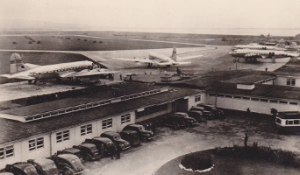
 seamus dubhghaill