seamus dubhghaill

Promoting Irish Culture and History from Little Rock, Arkansas, USA


Leave a comment

Birth of IRA Leader Seán Treacy

sean-allis-treacy

Seán Allis Treacy, one of the leaders of the Third Tipperary Brigade of the Irish Republican Army during the Irish War of Independence, is born on February 14, 1895, in Soloheadbeg, County Tipperary.

Treacy leaves school at the age of 14 and works as farmer while also developing deep patriotic convictions. He is a member of the Gaelic League, and of the Irish Republican Brotherhood (IRB) from 1911 and the Irish Volunteers from 1913.

He is picked up in the mass arrests following the Easter Rising in 1916. He spends much of the following two years in prison, where he goes on hunger strike on several occasions.

In 1918, Treacy is appointed Vice Officer-Commanding of the 3rd Tipperary Brigade of the Irish Volunteers, which becomes the Irish Republican Army in 1919.

On January 21, 1919, Treacy and Dan Breen, together with Seán Hogan, Séamus Robinson, and five other volunteers, help to ignite the conflict that is to become the Irish War of Independence. They ambush and shoot dead Constables Patrick MacDonnell and James O’Connell of the Royal Irish Constabulary (RIC), who are guarding a transport of gelignite explosives, during the Soloheadbeg Ambush near Treacy’s home. Treacy leads the planning of the ambush and briefs the brigade’s OC Robinson on his return from prison in late 1918. Robinson supports the plans and agrees they will not go to GHQ for permission to undertake the attack.

As a result of the Soloheadbeg Ambush, South Tipperary is placed under martial law and declared a Special Military Area under the Defence of the Realm Act. After Soloheadbeg ambush party member Seán Hogan is arrested on May 12, 1919, Treacy, Breen, and Séamus Robinson are joined by five men from the IRA’s East Limerick Brigade to organise Hogan’s rescue. Hogan is brought to the train which is intended to take him from Thurles to Cork city on May 13, 1919. As the train steams across the Tipperary border and into County Limerick, the IRA party boards the train in Knocklong. A close-range struggle ensues on the train. Treacy and Breen are seriously wounded in the gunfight and two RIC men die, but Hogan is rescued. His rescuers rush him into the village of Knocklong where a butcher cuts off his handcuffs using a cleaver.

A search for Treacy and the others is mounted across Ireland. Treacy leaves Tipperary for Dublin to avoid capture. In Dublin, Michael Collins employs Treacy on assassination operations with “the Squad“. In the summer of 1920, he returns to Tipperary and organises several attacks on RIC barracks before again moving his base of operations to Dublin.

By spring 1920 the political police of both the Crimes Special Branch of the Royal Irish Constabulary (RIC) and G-Division (Special Branch) of the Dublin Metropolitan Police (DMP) have been effectively neutalised by IRA counterintelligence operatives working for Michael Collins. The British thoroughly reorganise their administration at Dublin Castle and begin to import dozens of professional secret service agents from all parts of the British Empire into Ireland to track down IRA operatives and Sinn Féin leaders.

On October 11, 1920, Treacy and Breen are holed up in a safe house on the north side of Dublin when it is raided by a police unit. In the ensuing shootout, two senior British officers are wounded and die the next day while Treacy and Breen are wounded, Breen seriously. Treacy and Breen manage to escape through a window and shoot their way through the police cordon.

Treacy is discovered at the Republican Outfitters shop at 94 Talbot Street on October 14 a British Secret Service surveillance team led by Major Carew and Lt. Gilbert Price. They were stalking him in hopes that he would lead them to Collins or to other high-value IRA targets. Treacy realises that he is being followed and runs for his bicycle but grabs the wrong bike, taking one that is far too big for him, and falls. Price draws his pistol and closes in on Treacy. Treacy draws his parabellum automatic pistol and shoots Price and another British agent before he is hit in the head, dying instantly.

Treacy is buried at Kilfeacle graveyard where, despite a large presence of British military personnel, a volley of shots is fired over the grave.

1 Comment

The 1996 Docklands Bombing

docklands-bombing

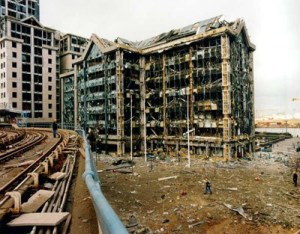
The Docklands bombing, also known as the Canary Wharf bombing or the South Quay bombing, occurs on February 9, 1996, marking the end of the Irish Republican Army‘s (IRA) seventeen-month ceasefire.

At about 7:01 PM on February 9, the Provisional Irish Republican Army detonates a large bomb in a small lorry about 80 yards from South Quay Station on the Docklands Light Railway in the Canary Wharf financial district of London. The bomb, containing 500 kg of ammonium nitrate fertilizer and sugar and a detonating cord made of semtex, PETN, and RDX high explosives, is placed directly under the point where the tracks cross Marsh Wall.

The IRA sends telephone warnings 90 minutes prior to the detonation and the area is evacuated. However, two men working in the newsagents shop directly opposite the explosion, Inam Bashir and John Jeffries, are not evacuated in time and are killed in the explosion. Thirty-nine people require hospital treatment as a result of the blast and falling glass. A portion of the South Quay Plaza is destroyed, and the explosion leaves a crater ten metres wide and three metres deep. The shockwave from the blast causes windows to rattle five miles away.

Approximately £100 million worth of damage is done by the blast. The Midland Bank building is damaged beyond economic repair and is demolished. South Quay Plaza I and II are severely damaged and require complete rebuilding. The station itself is extensively damaged, but both it and the bridge under which the bomb is exploded are reopened within weeks.

The bombing marks the end of a 17-month IRA ceasefire during which Irish, British, and American leaders work for a political solution to the troubles in Northern Ireland. IRA member James McArdle is convicted of conspiracy to cause explosions and sentenced to 25 years in prison, but murder charges are dropped. McArdle is released under the terms of the Good Friday Agreement in June 2000 with a royal prerogative of mercy from Queen Elizabeth II.

dockland-bombing-damage

The IRA describes the deaths and injuries as a result of the bomb as “regrettable,” but says that they could have been avoided if police had responded promptly to “clear and specific warnings.” Commissioner of the Metropolitan Police Sir Paul Condon says, “It would be unfair to describe this as a failure of security. It was a failure of humanity.”

Gerry Adams, the leader of Sinn Féin, the political wing of the IRA, speaks of the need to continue the peace process. British Prime Minister John Major says there is now “a dark shadow of doubt” where optimism has existed.

On February 28, Prime Minister Major and Taoiseach of the Republic of Ireland John Bruton, announce that all-party talks will be resumed in June. Major’s decision to drop the demand for IRA decommissioning of weapons before Sinn Fein is allowed into talks leads to criticism from the press, which accuse him of being “bombed to the table.”


Leave a comment

Birth of Constance Georgine Gore-Booth (Countess Markievicz)

countess-markievicz

Constance Georgine Gore-Booth is born on February 4, 1868, at Buckingham Gate, London, the eldest daughter of Arctic explorer and philanthropist Sir Henry Gore-Booth and Georgina May Hill.

The Gore-Booths are known as model landlords in County Sligo as they provide free food for the tenants on their estate. Perhaps being raised in this atmosphere of concern for the common man has something to do with the way Constance and her younger sister, Eva, conduct their later lives.

Gore-Booth decides to train as a painter and, in 1892, she enters the Slade School of Art in London because, at the time, only one art school in Dublin accepts female students. While in school in London Gore-Booth first becomes politically active and joins the National Union of Women’s Suffrage Societies.

She later moves to Paris and enrolls at the prestigious Académie Julian where she meets her future husband, Count Casimir Markievicz. They are married in London on September 29, 1900, making her Countess Markievicz. The Markieviczes relocate to Dublin in 1903 and move in artistic and literary circles, with Constance being instrumental in founding the United Artists Club.

In 1908, Markievicz becomes actively involved in nationalist politics in Ireland and joins Sinn Féin and Inghinidhe na hÉireann (Daughters of Ireland), a revolutionary women’s movement founded by Maud Gonne. In the same year, Markievicz plays a dramatic role in the women’s suffrage campaigners’ tactic of opposing Winston Churchill‘s election to Parliament during the Manchester North West by-election. Churchill ultimately loses the election to Conservative candidate William Joynson-Hicks.

In 1909, Markievicz founds Fianna Éireann, a para-military nationalist scouts organisation that instructs teenage boys and girls in the use of firearms. Patrick Pearse says that the creation of Fianna Éireann is as important as the creation of the Irish Volunteers in 1913. She is jailed for the first time in 1911 for speaking at an Irish Republican Brotherhood demonstration organised to protest against George V’s visit to Ireland.

Markievicz joins James Connolly‘s socialist Irish Citizen Army, a small volunteer force formed in response to the lock-out of 1913, to defend the demonstrating workers from the police. During the Howth gun-running on July 26, 1914, Irish Citizen Army members led by Markievicz, and including Thomas MacDonagh, Bulmer Hobson, Douglas Hyde and Darrell Figgis, unload arms from Erskine Childers‘ yacht Asgard in Howth harbour with hand carts and wheelbarrows.

As a member of the Irish Citizen Army, Markievicz takes part in the 1916 Easter Rising. Under Michael Mallin and Christopher Poole, she supervises the erection of barricades as the Rising begins and is in the middle of the fighting all around Stephen’s Green. Mallin and Poole and their men and women, including Markievicz, hold out for six days, ending the engagement when the British bring them a copy of Patrick Pearse’s surrender order.

They are taken to Dublin Castle and Markievicz is transported to Kilmainham Gaol, where she is the only one of 70 women prisoners who is put into solitary confinement. At her court martial on May 4, 1916, Markievicz is sentenced to death, but General Maxwell commutes this to life in prison on “account of the prisoner’s sex.” It is widely reported that she tells the court, “I do wish your lot had the decency to shoot me.” Markievicz is transferred to Mountjoy Prison and then to Aylesbury Prison in England in July 1916. She is released from prison in 1917, along with others involved in the Rising.

In the 1918 general election, Markievicz is elected for the constituency of Dublin St Patrick’s, making her the first woman elected to the British House of Commons. However, in line with Sinn Féin abstentionist policy, she does not take her seat in the House of Commons. She is re-elected to the Second Dáil in the elections of 1921. Markievicz serves as Minister for Labour from April 1919 to January 1922, holding cabinet rank from April to August 1919, becoming both the first Irish female Cabinet Minister and only the second female government minister in Europe.

Markievicz leaves government in January 1922 along with Éamon de Valera and others in opposition to the Anglo-Irish Treaty. She fights actively for the Republican cause in the Irish Civil War. She is returned in the 1923 general election for the Dublin South constituency but again, in common with other Republican candidates, she does not take her seat.

She joins Fianna Fáil on its foundation in 1926, chairing the inaugural meeting of the new party in La Scala Theatre. In the June 1927 general election, she is re-elected to the 5th Dáil as a candidate for the new Fianna Fáil party, which is pledged to return to Dáil Éireann.

Before she can take up her seat, Markievicz dies at the age of 59 on July 15, 1927, in a public ward “among the poor where she wanted to be” of complications related to appendicitis. One of the doctors attending her is her revolutionary colleague, Kathleen Lynn. Also at her bedside are Casimir and Stanislas Markievicz, Éamon de Valera, and Hanna Sheehy-Skeffington. Refused a state funeral by the Free State government, Markievicz is buried at Glasnevin Cemetery, Dublin, and de Valera gives the funeral oration.


Leave a comment

Éamon de Valera Escapes from Lincoln Gaol

boland-collins-devalera

Éamon de Valera, along with Seán McGarry and Seán Milroy, escape from Lincoln Gaol in Lincoln, Lincolnshire, England on February 3, 1919.  The escape plot is engineered by fellow Sinn Féin members Harry Boland and Michael Collins (pictured to the left of de Valera).

After his participation as a leader of the Easter Rising of 1916, de Valera is arrested and sentenced to death for his role in the uprising, but the sentence is later commuted due to his American citizenship. Following his release from prison in 1916, he quickly gains fame on the Irish political scene, ultimately becoming the leader of Sinn Féin. He also gains notoriety amongst the British political elites, which ensures his eventual re-arrest and imprisonment in Lincoln Gaol.

De Valera is sent to Lincoln Gaol presumably for his participation in a “German Plot” against the British. Once incarcerated at Lincoln, de Valera, wanting to embarrass the English, quickly begins to plan his escape with the assistance of Milroy and McGarry. Irish Republicans on the outside, including Boland and Collins, also assist in the planning.

Open fields surrounded by barbed wire are to the rear and east of the prison. The Republicans hope to use this to their advantage by sneaking de Valera through a rear door. The plans are sung in Gaelic to de Valera through a window in his cell by a fellow Irish inmate in order to confuse the guards. The first song tells him of the escape route and the second gives him instructions to obtain a copy of the master-key for the prison.

De Valera, being a deeply religious man, is active in the prison’s chapel from the beginning of his internment. Using his connections within the chapel, over time he manages to steal candles from the altar. While Mass is being read, he “borrows” the master-key of the chaplain and makes an impression of it in the candle wax. The mould is then wrapped in paper and tossed over the prison wall so a duplicate can be made.

The key is duplicated and smuggled back into the prison concealed in a cake and the escape begins on the evening of February 3, 1919. While Collins and other members of Sinn Féin cut through the barbed wire, a group of Irish girls are sent to flirt with the prison guards to ensure they are preoccupied. With the guards’ attention diverted, de Valera, wrapped in a fur coat, McGarry, and Milroy are able to walk to the back door of the prison and, after some difficulty with the key, walk away from the prison.

They stroll down Wragby Road to the Adam & Eve Pub where a taxi driver, unaware of who his passengers are, awaits them. De Valera is swiftly moved to the railway station where they split up. Collins and Boland catch a train to London from St. Mark’s while the rest drive to Worksop where another innocent taxi driver drives them to Sheffield. De Valera then returns to Ireland briefly before traveling on to the United States. The prison officials, realizing that the men will be virtually impossible to locate, concede defeat after a one-day search of the city.

The escape from Lincoln Gaol is major news and is covered in all the national papers. Prison officials blame the escape on the ability of special prisoners to interact with the general prison population. The escape proves to be an important moment in Irish history – when a cake, a wax key, and some pretty Irish girls help spring the future Irish president from Lincoln Gaol.


1 Comment

Tomás MacCurtain Elected Sinn Féin Lord Mayor of Cork

tomas-maccurtain

Tomás MacCurtain is elected Sinn Féin Lord Mayor of Cork on January 31, 1920.

MacCurtain is born at Ballyknockane in the Parish of Mourne Abbey on March 20, 1884. He attends Burnfort National School until the family moves to Blackpool on the north side of Cork city in 1897, where he attends The North Monastery School. He becomes active in numerous cultural and political movements and joins the Blackpool branch of the Gaelic League, becoming its secretary in 1902. He works in his early career as a clerk and in his free time teaches the Irish language. He joins the Fianna Éireann in 1911 and is a founding member of the Irish Volunteers.

At the outset of the Easter Rising in April 1916, MacCurtain commands a force of up to 1,000 men of the Irish Volunteers who assemble at various locations around County Cork. MacCurtain and his officers await orders from the volunteer leadership in Dublin, but conflicting instructions and confusion prevail, and the Cork volunteers never entered the fray. A tense week-long stand-off develops when British forces surround the volunteer hall. A negotiated agreement leads to the surrender of the volunteers’ arms to then Lord Mayor of Cork Thomas Butterfield on the understanding that they will be returned. The weapons are not returned and MacCurtain is jailed in the Frongoch Prisoner of War camp in Wales. Eighteen months later, after the general amnesty of participants in the Rising, MacCurtain returns to active duty as a Commandant of what is now the Irish Republican Army (IRA).

By 1918, MacCurtain is a brigade commander in the IRA. During the Conscription Crisis in the autumn 1918, he actively encourages the hiring of the women of Cumann na mBan to cater for Volunteers. MacCurtain is personally involved with Michael Collins‘ Squad that attempts to assassinate Lord John French, whose car is missed as the convoy passes through the ambush positions. Despite the setback he remains brigadier of No.1 Cork when he is elected the Sinn Féin councillor for NW Ward No. 3 of Cork in the January 1920 council elections and is chosen by his fellow councillors to be the Lord Mayor. He begins a process of political reform within the city.

On his 36th birthday, March 20, 1920, MacCurtain is shot dead in front of his wife and son by a group of men with blackened faces in retaliation for the shooting of a policeman. MacCurtain’s house in the city’s Blackpool area is also ransacked. The assassins are found to be members of the Royal Irish Constabulary (RIC) by the official inquest into the event.

The killing causes widespread public outrage. The coroner’s inquest passes a verdict of wilful murder against British Prime Minister Lloyd George and against certain members of the RIC. Michael Collins later orders his personal assassination squad to hunt down and kill the police officers involved in the attack. RIC District Inspector Oswald Swanzy, who had ordered the attack, is fatally shot with MacCurtain’s own revolver while leaving a Protestant church in Lisburn, County Antrim on August 22, 1920, sparking a “pogrom” against the Catholic residents of the town. MacCurtain is buried in St. Finbarr’s Cemetery, Cork.


Leave a comment

Bloody Sunday in Derry, Northern Ireland

bogside-mural

Bloody Sunday, sometimes referred to as the Bogside Massacre, occurs on January 30, 1972, in the Bogside area of Derry, Northern Ireland. Twenty-six unarmed civilians are shot by British soldiers of the 1st Battalion, Parachute Regiment, as they march in protest of internment (imprisonment without trial). Thirteen people are killed on the spot, and another dies over four months later as a result of his injuries.

The march, organised by the Northern Ireland Civil Rights Association and the Northern Resistance Movement, begins at about 2:45 PM at Bishop’s Field and is to conclude at the Guildhall, in the city centre, where a rally is to take place. There are as many as 15,000 people in the march, with many joining along the route.

As the march makes its way along William Street and nears the city centre, its path is blocked by British Army barricades. The organisers then redirect the march down Rossville Street with the intention of holding the rally at Free Derry Corner instead. Some of the marchers, however, break away from the march and begin throwing stones at soldiers manning the barricades. The soldiers fire rubber bullets, CS gas, and water cannon to try and disperse the rioters and observers report that this rioting is not intense.

Some of the marchers spot British paratroopers hiding in a derelict three-story building overlooking William Street and begin throwing stones at the windows. At about 3:55 PM, the first shots are fired as these paratroopers open fire with real bullets. Civilians Damien Donaghy and John Johnston are shot and wounded while standing on waste ground opposite the building. The soldiers claim Donaghy is holding a black cylindrical object.

At 4:07 PM, the paratroopers are ordered to go through the barricades and arrest rioters. On foot and in armoured vehicles, the paratroopers chase people down Rossville Street and into the Bogside. Two people are knocked down by the vehicles. Although Brigadier Pat MacLellan orders that only one company of paratroopers be sent on foot through the barricades and that they should not chase people down Rossville Street, Lieutenant Colonel Derek Wilford disobeys this order. This results in no separation between the rioters and the peaceful marchers.

There are many claims of paratroopers beating people, clubbing them with rifle butts, firing rubber bullets at them from close range, making threats to kill, and hurling abuse. One group of paratroopers take up position at a low wall about 80 yards in front of a rubble barricade that stretches across Rossville Street. Some of the people near the barricade throw stones at the soldiers but they are not close enough to hit the soldiers. The soldiers then open fire on the people at the barricade, killing six and wounding another.

A large group of people flee or are chased into the car park of Rossville Flats, which is like a courtyard, surrounded on three sides by high-rise flats. The soldiers open fire, killing one civilian, Jackie Duddy, who is shot in the back, and wounding six others.

Other people flee into the car park of Glenfada Park, which is also a courtyard-like area surrounded by flats. From a distance of approximately 50 yards, the soldiers shoot at people across the car park. Two civilians are killed and at least four others wounded. The soldiers pass through the car park and out the other side. Some soldiers exit the southwest corner, where they shoot and kill two civilians. The remainder exit the southeast corner and shoot four more civilians, killing two.

Only about ten minutes elapse between the time soldiers first drive into the Bogside and the time the last of the civilians is shot. Under the command of Major Ted Loden, more than 100 rounds are fired by the soldiers.

Some of those shot are given first aid by civilian volunteers, either on the scene or after being carried into nearby homes. The first ambulances arrive at 4:28 PM. The injured are then driven to the hospital, either in civilian cars or in ambulances. The three boys killed at the rubble barricade are driven to hospital by the paratroopers after, as witnesses claim, they lifted the bodies by the hands and feet and dumped them in the back of their vehicle as if they were “pieces of meat.”

In April 1972, the British government releases a report exonerating British troops from any illegal actions during the protest. The shootings act as a rallying call for the Irish Republican Army (IRA) as their numbers swell and Irish indignation over Britain’s Northern Ireland policies grow. As a result, Britain increases its military presence in the North while removing any vestige of Northern self-rule. On July 21, 1972, the IRA explode 20 bombs simultaneously in Belfast, killing British military personnel and a number of civilians. Britain responds by instituting a new court system composed of trial without jury for terrorism suspects and conviction rates exceed 90 percent. No criminal charges have ever been brought against the participating members of the British military.


Leave a comment

Sinn Féin Splits in 1970

sinn-fein

On January 11, 1970, at Sinn Féin‘s Ard Fheis at the Intercontinental Hotel in Ballsbridge, Dublin, the proposal to end abstentionism and take seats, if elected, in the Dáil, the Northern Ireland Parliament, and the Parliament of the United Kingdom is put before the members. A similar motion had been adopted at an Irish Republican Army (IRA) convention the previous month, leading to the formation of a Provisional Army Council by Seán Mac Stíofáin and other members opposed to the leadership.

There are allegations of malpractice and that some supporters cast votes to which they are not entitled. In addition, the leadership has also refused voting rights to a number of Sinn Féin cumainn (branches) known to be in opposition, particularly in the north and in County Kerry. The motion is debated all of the second day, and when it was put to a vote at 5:30 PM the result is 153:104 in favour of the motion, failing to achieve the necessary two-thirds majority.

The Executive attempts to circumvent this by introducing a motion in support of the IRA Army Council, led by Tomás Mac Giolla, which only requires a simple majority. In protest of the motion, Ruairí Ó Brádaigh and his minority group walks out of the meeting. These members reconvene at a hall in 44 Parnell Square, which they had already booked in anticipation of the move by the leadership. They appoint a Caretaker Executive, and pledged allegiance to the Provisional Army Council.

irish-republican-army

The Caretaker Executive declares itself in opposition to the ending of abstentionism, the drift towards Marxism, the failure of the leadership to defend the nationalist people of Belfast during the 1969 Northern Ireland riots, and the expulsion of traditional republicans by the leadership during the 1960s. At the October 1970 Ard Fheis, it is announced that an IRA convention has been held and has regularised its structure, bringing the “provisional” period to an end.

At the end of 1970 the terms “Official IRA” and “Regular IRA” are introduced by the press to differentiate the two factions. During 1971, the rival factions play out their conflict in the press with the Officials referring to their rivals as the Provisional Alliance, while the Provisionals refer to the Officials (IRA and Sinn Féin) as the National Liberation Front (NLF).

The Falls Road Curfew, coupled with internment in August 1971, and Bloody Sunday in Derry in January 1972, boosts the Provisionals in Belfast. These events produce an influx into the Provisionals on the military side, making them the dominant force and finally eclipsing the Officials everywhere. Despite becoming the dominant group and the dropping of the word “provisional” at the convention of the IRA Army Council in September 1970, they are still known to the mild irritation of senior members as Provisionals, Provos, or Provies.


Leave a comment

Éamon de Valera Resigns as President of the Republic

eamon-de-valeraThe Anglo-Irish Treaty is introduced to replace the Republic with a dominion of the British Commonwealth with the King represented by a Governor-General of the Irish Free State. The Treaty is finally signed on December 6, 1921.
Éamon de Valera does not join in on the negotiations. His opponents say that he does so because he knows that the British will only allow an Irish dominion, not a republic, and does not want to be blamed for giving up the idea of a republic. De Valera says he is angry because the delegates working out the treaty had not asked him before signing the treaty. But at a secret session of the Dáil during the Treaty debates and publicised in January 1922, de Valera’s ideas for a treaty include dominion status, the “Treaty Ports,” a veto by the parliament in Belfast, and the king as head of the Commonwealth. Ireland would pay a share of the imperial debt.

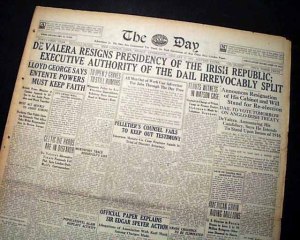
On January 9, 1922, when the Treaty is accepted by a vote of 64 to 57, de Valera resigns as President of the Republic and a large minority of Sinn Féin Teachta Dálas (TDs) leave Dáil Éireann. De Valera  states, “In view of the vote that was taken here on Saturday and which I had definitely to oppose as one that was tending to subvert the Republic which I was elected to my present position to defend and maintain; and as it appeared to me also to be a vote which would tend to subvert the independence of the country, I could no longer continue— as I was beaten in that — I could no longer continue in my present office feeling I did not have the confidence of the House. I therefore wish to place my resignation in the hands of the Assembly.”the-day-01-09-1922

A motion to re-elect De Valera as President is defeated along pro and anti-treaty lines by 60 votes to 58. Arthur Griffith, de Valera opponent and former colleague, is elected President of Dáil Éireann in his place.

Following the vote, Griffith says, “Before another word is spoken I want to say: I want the Deputies here to know, and all Ireland to know, that this vote is not to be taken as against President de Valera. It is a vote to help the Treaty, and I want to say now that there is scarcely a man I have ever met in my life that I have more love and respect for than President de Valera. I am thoroughly sorry to see him placed in such a position. We want him with us.”


Leave a comment

Birth of Daniel “Dan” Keating

dan-keatingDaniel “Dan” Keating is born in Castlemaine, County Kerry, on January 2, 1902. Keating is a life-long Irish republican and patron of Republican Sinn Féin.

Keating is educated in local schools, including the Christian Brothers School in Tralee, where he does his apprenticeship. During this time he also becomes a skillful Gaelic football player.

In 1918, Keating joins Fianna Éireann and two years later, during the Irish War of Independence, he joins the Boherbee B Company, 3rd Battalion, 1st Kerry Brigade, Irish Republican Army (IRA). On June 1, 1921, Keating is involved in an ambush between Castlemaine and Milltown which claims the lives of five Royal Irish Constabulary (RIC) men. On July 10, 1921, on the eve of the truce between the IRA and British forces, Keating’s unit is involved in a gun battle with the British Army near Castleisland.

Keating opposes the 1921 Anglo-Irish Treaty and fights on the Republican side in the Irish Civil War. During the Civil War, he is involved in operations in Kerry, Limerick, and Tipperary, before his column is arrested by Free State Forces. Keating spends seven months in Portlaoise Prison and the Curragh Prison before his release in March 1923.

Keating remains an IRA member for a long time after the Civil War and is arrested several times during the 1930s on various charges. Keating is also active in London during the 1939/1940 IRA bombing campaign.

In 1933, he is involved in an assassination attempt on the leader of the Irish Blueshirts, Eoin O’Duffy, during a visit to County Kerry. The attack is to happen at Ballyseedy, where Free State forces had carried out the Ballyseedy Massacre during the Irish Civil War. However, the plot fails when the person travelling with O’Duffy refuses to divulge what car O’Duffy would be riding.

Keating retires and returns to his native Kerry in 1978, living out the rest of his life with relatives in Knockbrack. After the death of former IRA volunteer George Harrison in November 2004, Keating becomes patron of Republican Sinn Féin until his own death on October 2, 2007 at the age of 105 years. At the time of death he is Ireland’s oldest man and the last surviving veteran of the Irish War of Independence. He is buried in Kiltallagh Cemetery, Castlemaine.