The Free State is established as a Dominion of the British Commonwealth of Nations. For one day, it encompasses all thirty-two counties of Ireland. Northern Ireland, which is comprised of the six northernmost counties, exercises its right under the Treaty to opt out of the new state on December 7.
The Free State government consists of the Governor-General, the representative of the king, and the Executive Council, which replaces both the revolutionary Dáil Government and the Provisional Government set up under the Treaty. W. T. Cosgrave, who had led both of these governments since August 1922, becomes the first President of the Executive Council. The legislature consists of Dáil Éireann, the lower house, and Seanad Éireann, also known as the Senate. Members of the Dáil are required to take an Oath of Allegiance, swearing fidelity to the king. The oath is a key issue for opponents of the Treaty, who refuse to take the oath and therefore do not take their seats. Pro-Treaty members, who form Cumann na nGaedheal in 1923, hold an effective majority in the Dáil from 1922 to 1927, and thereafter rule as a minority government until 1932.
In the first months of the Free State, the Irish Civil War is waged between the newly established National Army and the anti-Treaty IRA, who refuse to recognise the state. The Civil War ends in victory for the government forces, with the anti-Treaty forces dumping its arms in May 1923. The anti-Treaty political party, Sinn Féin, refuses to take its seats in the Dáil, leaving the relatively small Labour Party as the only opposition party. In 1926, when Sinn Féin president Éamon de Valera fails to have this policy reversed, he resigns from Sinn Féin and founds Fianna Fáil. Fianna Fáil enters the Dáil following the 1927 general election, and enters government after the Irish general election of 1932, when it becomes the largest party.
De Valera abolishes the Oath of Allegiance and embarks on an economic war with Britain. In 1937 he drafts a new constitution, which is passed by a referendum in July of that year. The Free State comes to an end with the coming into force of the new constitution on December 29, 1937. Under the new constitution the Irish state is named Ireland.
(Pictured: The Executive Council of the Irish Free State, October 1928)
Patrick Henry Pearse, teacher, barrister, poet, writer, nationalist, and political activist who is one of the leaders of the 1916 Easter Rising, is born in Dublin on November 10, 1879. Pearse’s father, James, is a stone worker who works on church buildings in Dublin and his mother, Margaret, comes from a family that has endured the Great Famine in 1846 and has left County Meath for Dublin. Here she brings up four children, Patrick being the second. Pearse has a comfortable childhood as his father is in constant work.
It is at school that Pearse first develops a love of Irish history. He is also taught the Irish language for the first time and while still a teenager, Patrick joins the Gaelic League, an organisation that wants to promote the Irish language and Irish literature. Pearse graduates with a law degree from the King’s Inns and, in 1901, he starts a BA course in modern languages but is called to the Bar in Dublin.
Regardless of his law training, Pearse is more interested in what he is learning about Ireland as a nation. All his knowledge about law has been based around the English language and he wants to know more about what he considers to be the rightful language of Ireland. This is not the Gaelic used in Dublin. Pearse has convinced himself that the real Irish language is based in Connaught, and he teaches himself the dialect of the area. Connaught is also a region that has been severely affected by the Great Famine. Therefore, the number of people who speak what Pearse considers to be proper Gaelic have been greatly reduced. From 1903 to 1909, Pearse develops his involvement in the Gaelic League’s An Claidheamh Soluis (The Sword of Light) which seeks to expand the use of Gaelic in Irish life, and, in particular, literature.
By 1909, Pearse has developed some political leanings. He cannot accept the impact England, and all things English have on Ireland and the Irish people, but his concern is more for Irish culture rather than Irish politics. Pearse wants Irish history and culture taught as compulsory subjects in both Irish schools and colleges. He breaks with the Roman Catholic Church when its national college, St. Patrick’s College, Maynooth, demotes courses in Irish history/culture to topics for trainee priests. He is keen for Maynooth to have compulsory Irish courses simply because priests then have a major influence in the areas where they work. However, all of Pearse’s protests fall on deaf ears. As a result, he founds his own school in Dublin, an “Irish-Ireland” school called St. Enda’s School.
Between 1909 and 1912, Pearse becomes more interested and involved in politics. Despite a limited income and the problems of keeping St. Edna’s on an even financial keel, Pearse launches his own newspaper called An Barr Buadh (The Trumpet of Victory). At this time the Home Rule issue has reared its head again. Sinn Féin and other republican movements have far more impact than Pearse, who seems to many to be no more than a political maverick. Many feel that Pearse is out of his depths in politics and that his input into Irish politics is no more than romanticism with an Irish slant.
By 1913, Pearse has become more depressed about the way Ireland is going under the rule of London. Those who know him, describe him as becoming more and more melancholy as the year progresses. Others believe that he is becoming more fanatical. He helps to organise the Irish Volunteers, the public face of the outlawed Irish Republican Brotherhood, before the outbreak of World War I. In 1914, he is sent on a fund-raising tour of America by Clan na Gael, an organisation that aids the Irish Republican Brotherhood. While the tour is a reasonable success financially, not many Americans are swayed by Pearse’s speeches.
By the time World War I starts, Pearse has taken an extreme political stance. He wants full Irish independence – not what the suspended Home Rule Bill of 1912 offers. He does not support the part Ireland plays in the war effort. He also splits the Irish Volunteers. He takes a small number of these men with him when John Redmond gives his agreement to suspend the Home Rule Bill until the war is over. By now, Pearse has become extreme. He publishes a pamphlet called The Murder Machine which is a severe condemnation of the Irish educational system. He also realises that with London totally focused on the war in Europe, the time is ripe to overthrow British rule in Ireland.
However, in this respect, Pearse is totally wrong. The young men who have volunteered to fight in the war have done so because they want to. Pearse has no mass support in Ireland whereas John Redmond has far more public support in the south. He also assumes incorrectly that all those in southern Ireland are completely against British rule. What Pearse fails to recognise, is that many people in Dublin itself rely on the British for work. They may not like this, but work brings in money regardless of where or who it comes from.
Those who participate in the Easter Uprising of 1916 are in the minority. Pearse decides to take command of the rebellion, and he reads aloud the declaration of independence at the General Post Office. Pearse also is one of the signatories of “Poblacht na hÉireann” (To the People of Ireland).
If Pearse expects the actions of the rebels in Dublin to spark off other uprisings in other Irish cities and towns, he is mistaken. In Dublin, the people of the city fail to offer the rebels any support. In fact, some Dubliners take the opportunity of the rebellion to loot the shops in Sackville Street. The Uprising is doomed from the start.
During the rebellion, Pearse says, “When we are all wiped out, people will blame us for everything, condemn us…. (but) in a few years they will see the meaning of what we tried to do.” Ironically, he is correct in this assessment.
On Friday, April 28, 1916, Pearse surrenders to the British army. By the following day all the rebels have surrendered. As they are paraded through the streets of Dublin before going to Kilmainham Gaol, they are jeered and verbally abused by Dubliners who have seen parts of their city destroyed. They blame Pearse and his followers rather than the British.
At Kilmainham Gaol, Pearse is charged with treason by a military court and sentenced to death. On May 16, Pearse is shot by firing squad. Eventually fourteen other rebel leaders are also executed by firing squad. Pearse’s body, and those of the other leaders, are thrown into a pit without a coffin or a burial service. Ironically, it is in death that Pearse finds real fame.
No one knows the fate of the rebel leaders until after the executions. Many in Ireland are horrified at the way they have been treated. If Pearse had not received national support during his life, his movement certainly received it after his death. Pearse had written that he wanted his fame and deeds to “live after me.” In death, Patrick Pearse is known as the “First President of Ireland” and Irish history and culture become part of the educational system after 1922.
Republican Sinn Féin (Irish: Sinn Féin Poblachtach), an unregistered Irish Republican political organisation, is founded at the West County Hotel in Dublin on November 2, 1986.
Republican Sinn Féin (RSF) claim to be heirs of the Sinn Féin party founded in 1905 and take its present form in 1986 following a split with Provisional Sinn Féin. RSF members take seats when elected in local Irish councils but do not recognise the partition of Ireland and subsequently the legitimacy of the Northern Ireland or Republic of Ireland governments, so does not register itself under them.
The decision to form, or to reorganise or reconstitute as its supporters see it, the organisation was taken in response to Gerry Adams-led Sinn Féin’s decision at its 1986 ardfheis to end its policy of abstentionism and to allow elected Sinn Féin Teachtaí Dála take their seats in Leinster House‘s Dáil Éireann. The supporters of Ruairí Ó Brádaigh and Dáithí Ó Conaill who go on to form RSF oppose this move as it signals a departure from the traditional republican analysis which views the parliament of the Republic of Ireland as an illegal assembly, set up by an act of the British parliament. They argue that republicans owe their allegiance to the All-Ireland (32 County) Irish Republic, maintaining that this state exists de jure and that its authority rests with the IRA Army Council. Hence, if elected, its members refuse to take their seats in the Oireachtas.
The organisation views itself as representing “true” or “traditional” Irish republicanism, while in the mainstream media the organisation is portrayed as a political expression of “dissident republicanism.” Republican Sinn Féin rejects the Good Friday Agreement and indeed the Anglo-Irish Treaty. As part of this they refuse to discount Irish republicans using militant means to “defend the Irish Republic” and considers the Continuity Irish Republican Army (IRA) to be the legitimate army of the Irish Republic. The CIRA is designated as a terrorist organisation by the governments of the United Kingdom and Republic of Ireland.
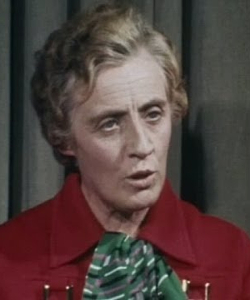
Drumm is born in Newry, County Down to a staunchly Irish republican family. Drumm’s mother has been active in the Irish War of Independence and the Irish Civil War. Drumm grows up in the village of Killean, County Armagh, where she plays camogie. She is active in the republican movement after meeting her husband, a republican prisoner. She begins to speak at many rallies and protest meetings and is soon elected as Vice President of Sinn Fein. She becomes involved in the Northern Ireland Civil Rights Association in the 1960s and works to rehouse Catholics forced from their homes by loyalist intimidation.
Drumm is jailed twice for seditious speeches. After she is released from HM Prison Armagh, raids on her house by the security forces escalate. She is widely demonised in the British media and is already a target for assassination when she is admitted to Belfast’s Mater Hospital for eye treatment in October 1976.
While recovering from the operation, Drumm is shot at point blank range in a joint operation by the Ulster Volunteer Force and the Ulster Defence Association who are able to enter and leave the hospital undisturbed. No one has ever been convicted of her murder.
Drumm’s speeches and quotations can be found on murals across Northern Ireland, including:
“The only people worthy of freedom are those who are prepared to go out and fight for it every day, and die if necessary.”
“We must take no steps backward, our steps must be onward, for if we don’t, the martyrs that died for you, for me, for this country will haunt us forever.”
Captain Geoffrey Thomas Baggallay, a “one-legged” courts-martial officer, phones Dublin Castle at 1:15 AM telling of John Lynch’s presence at the Exchange Hotel. A group of 12 soldiers, believed to be members of the Cairo Gang, enter the hotel wearing military caps and long black Burberry coats. They hold the hotel porter, William Barrett, at gunpoint. After consulting the register, they proceed to Lynch’s room on the third floor, where Lynch has been staying since September 12.
They shoot Lynch and then leave, claiming that Lynch had fired a shot at them when they attempted to arrest him. The military reports a death at the hotel at 2:15 AM. The Royal Irish Constabulary (RIC) arrives after the military reports the death to them. The coroner’s verdict is that Lynch is shot by a soldier in self-defence. No evidence is given by any soldiers at the inquiry. The Irish Republican Army (IRA) believe that the actual murder is carried out by Henry James Angliss and Charles Ratsch Peel working undercover. The group of khaki-clad men who shoot Lynch number about twelve, and the IRA certainly believes that Angliss and Peel are among them based on inside information received from “Lt G” at Dublin Castle. Lt G is believed to be Lily Mernin who works as a typist at army headquarters.
Michael Collins believes that many of the British officers that are later killed on “Bloody Sunday” shot John Lynch in the Exchange Hotel. Lynch is the local Sinn Féin organiser of a loan and is in Dublin to hand over £23,000 in subscriptions to Collins. Altogether £370,163 is raised in the loan effort in Ireland by September 1920 when it closes down.
It is impossible to know who the twelve men of the raiding party are, however, apparently Lt. Angliss, under the influence of drink, divulges his participation in the shooting to a girl who passes this information on to an Irish Intelligence Service informant. Peel escapes death on “Bloody Sunday” by barricading himself in his room. George Osbert Smyth is understood to have been part of the raiding party, from information given to his family on a visit home. Osbert Smyth is shot dead in October 1920 while trying to arrest IRA suspects Dan Breen and Sean Treacy at a house in Drumcondra.
On April 10, 1919, the First Dáil announces a policy of ostracism of Royal Irish Constabulary men. At the time Sinn Féin official policy is against acts of violence. Boycotting, persuasion, and mild intimidation succeed against many officers. However, others escalate their activities against republicans and in March 1920 Collins asks Dick McKee to select a small group to form an assassination unit.
When the squad is formed, it comes directly under the control of the Director of Intelligence or his deputy and under no other authority. The Squad is commanded by Mick McDonnell.
The original ‘Twelve Apostles’ are Mick McDonnell, Tom Keogh, Jimmy Slattery, Paddy Daly, Joe Leonard, Ben Barrett, Vincent Byrne, Sean Doyle, Paddy Griffin, Eddie Byrne, Mick Reilly, and Jimmy Conroy. After some time, the Squad is strengthened with the addition of Ben Byrne, Frank Bolster, Mick Keogh, Mick Kennedy, Bill Stapleton, and Sam Robinson. They are employed full-time and receive a weekly wage.
Sometimes the squad is strengthened as occasion demands by members of the Intelligence staff, the Active Service Unit, munition workers, and members of the Dublin Brigade.
On July 30, 1919, the first assassination authorised by Michael Collins is carried out when Detective Sergeant “the Dog” Smith is shot near Drumcondra, Dublin. The Squad continues targeting plainclothes police, members of the G Division of the Dublin Metropolitan Police, and occasionally, problematic civil servants. Organisationally it operates as a subsection of Collins’ Intelligence Headquarters. Two of the executions by The Squad are the killing on January 21, 1920, of RIC Inspector William Redmond of the DMP “G” Division and on March 2, 1920, of British double agent John Charles Byrnes.
One of the Apostles’ particular targets is the Cairo Gang, a deep-cover British intelligence group, so called since it has either been largely assembled from intelligence officers serving in Cairo or from the Dublin restaurant called The Cairo, which the gang frequents. Sir Henry Wilson brings in the Cairo Gang in mid-1920, explicitly to deal with Michael Collins and his organization. Given carte blanche in its operations by Wilson, the Cairo Gang adopts the strategy of assassinating members of Sinn Féin unconnected with the military struggle, assuming that this would cause the IRA to respond and bring its leaders into the open.
The most well-known operation executed by the Apostles occurs on Bloody Sunday, November 21, 1920, when British MI5 officers, linked to the Cairo Gang and significantly involved in spying, are shot at various locations in Dublin. Fourteen are killed and six are wounded. In addition to the Twelve Apostles, a larger number of IRA personnel are involved in this operation. The only IRA man captured during the operation is Frank Teeling. In response to the killings, the Black and Tans retaliate by shooting up a Gaelic football match between Dublin and Tipperary at Croke Park, killing fourteen civilians including one of the players, Michael Hogan, and wounding sixty-eight. The Hogan stand at Croke Park is named after him.
In May 1921, after the IRA’s Dublin Brigade takes heavy casualties during the burning of the Custom House, the Squad and the Brigade’s Active Service Unit are combined into the Dublin Guard, under the direction of Paddy Daly. Under the influence of Daly and Michael Collins, most of the Guard takes the Free State side and joins the Irish Army in the Irish Civil War of 1922-23. During this conflict some of them are attached to the Criminal Investigation Department and are accused of multiple assassinations of Anti-Treaty fighters.
(Pictured: Squad Members Mick McDonnell, Liam Tobin, Vinny Byrne, Paddy Daly, and Jim Slattery)
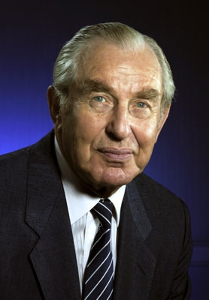
Chaim Herzog, Israeli politician, general, lawyer, and author who serves as the sixth President of Israel between 1983 and 1993, is born in Cliftonpark Avenue in Belfast on September 17, 1918.
Herzog joins the British Army during World War II, operating primarily in Germany as a tank commander in the Armoured Corps. There, he is given his lifelong nickname of “Vivian” because the British could not pronounce the name, “Chaim.” A Jewish soldier had volunteered that “Vivian” is the English equivalent of “Chaim.”
After leaving the army, Herzog opens a private law practice. He returns to public life when the Six-Day War breaks out in 1967, serving as a military commentator for Kol Israel radio news. Following the capture of the West Bank, he is appointed Military Governor of East Jerusalem, and Judea and Samaria.
Herzog enters politics in the 1981 elections, winning a Knesset seat as a member of the Alignment. Two years later, in March 1983, he is elected to the largely ceremonial role of President. He serves two five-year terms before retiring in 1993. He dies on April 17, 1997, and is buried on Mount Herzl, Jerusalem. His son, Isaac Herzog, has led the Israeli Labour Party and the parliamentary Opposition in the Knesset since 2013.
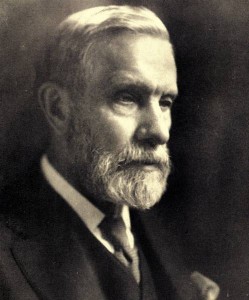
John Devoy, one of the most devoted revolutionaries the world has ever seen, is born in Kill, County Kildare, on September 3, 1842. Dedicating over 60 years of his life to the cause of Irish freedom, he is one of the few people to have played a leading role in the Fenian Rising of 1867, the 1916 Easter Rising, and the Irish War of Independence (1919 – 1921).
After the Great Famine, the family moves to Dublin where Devoy’s father obtains at job at Watkins’ brewery. Devoy attends night school at the Catholic University before joining the Fenians. In 1861 he travels to France with an introduction from Timothy Daniel Sullivan to John Mitchel. Devoy joins the French Foreign Legion and serves in Algeria for a year before returning to Ireland to become a Fenian organiser in Naas, County Kildare.
In 1865, when many Fenians are arrested, James Stephens, founder of the Irish Republican Brotherhood (IRB), appoints Devoy Chief Organiser of Fenians in the British Army in Ireland. His duty is to enlist Irish soldiers in the British Army into the IRB. In November 1865 Devoy orchestrates Stephens’ escape from Richmond Prison in Dublin.
In February 1866 an IRB Council of War calls for an immediate uprising but Stephens refuses, much to Devoy’s annoyance, as he calculated the Fenian force in the British Army to number 80,000. The British get wind of the plan through informers and move the regiments abroad, replacing them with regiments from Britain. Devoy is arrested in February 1866 and interned in Mountjoy Gaol, then tried for treason and sentenced to fifteen years penal servitude. In Portland Prison Devoy organises prison strikes and, as a result, is moved to Millbank Prison in Pimlico, London.
In January 1871, he is released and exiled to the United States as one of the “Cuba Five.” He receives an address of welcome from the House of Representatives. Devoy becomes a journalist for the New York Herald and is active in Clan na Gael. Under Devoy’s leadership, Clan na Gael becomes the central Irish republican organisation in the United States. In 1877 he aligns the organisation with the Irish Republican Brotherhood in Ireland.
Devoy’s fundraising efforts and work to sway Irish Americans to physical force nationalism makes possible the Easter Rising in 1916. In 1914, Patrick Pearse visits the elderly Devoy in America, and later the same year Roger Casement works with Devoy in raising money for guns to arm the Irish Volunteers. Though he is skeptical of the endeavor, he finances and supports Casement’s expedition to Germany to enlist German aid in the struggle to free Ireland from English rule. Also, before and during World War I, Devoy is also identified closely with the Ghadar Party, and is accepted to have played a major role in supporting Indian Nationalists, as well as playing a key role in the Hindu-German Conspiracy which leads to the trial that is the longest and most expensive trial in the United States at the time.
In 1916 Devoy plays an important role in the formation of the Clan-dominated Friends of Irish Freedom, a propaganda organization whose membership totals 275,000 at one point. The Friends fail in their efforts to defeat Woodrow Wilson for the presidency in 1916. Fearful of accusations of disloyalty for their cooperation with Germans and opposition to the United States’ entering the war on the side of Great Britain, the Friends significantly lower their profile after April 1917. Sinn Féin‘s election victories and the British government’s intentions to conscript in Ireland in April 1917 help to revitalize the Friends.
With the end of the war, Devoy plays a key role in the Friends’ advocacy for not the United States’ recognition of the Irish Republic but, in keeping with President Wilson’s war aims, self-determination for Ireland. The latter does not guarantee recognition of the Republic as declared in 1916 and reaffirmed in popular election in 1918. American Irish republicans challenge the Friends’ refusal to campaign for American recognition of the Irish Republic. Not surprisingly, Devoy and the Friends’ Daniel F. Cohalan become the key players in a trans-Atlantic dispute with de facto Irish president Éamon de Valera, touring the United States in 1919 and 1920 in hopes of gaining U.S. recognition of the Republic and American funds. Believing that the Americans should follow Irish policy, de Valera forms the American Association for the Recognition of the Irish Republic in 1920 with help from the Philadelphia Clan na Gael.
Devoy returns to Ireland and in 1919 addresses Dáil Éireann. He later supports the Anglo-Irish Treaty of 1921. Devoy is editor of The Gaelic American from 1903 until his death in Atlantic City on September 29, 1928. His body is returned to Ireland and buried in Glasnevin Cemetery. A large memorial to him stands on the road between his native Kill and Johnstown.
Éamon de Valera, prominent politician in twentieth-century Ireland, dies at the age of 92 in Linden Convalescent Home, Blackrock, County Dublin on August 29, 1975. His wife, Sinéad de Valera, four years his senior, had died the previous January, on the eve of their 65th wedding anniversary.
De Valera’s political career spans over half a century, from 1917 to 1973. He serves several terms as head of government and head of state. He also leads the introduction of the Constitution of Ireland.
Assessments of de Valera’s career are varied. He has often been characterised as a stern, unbending, devious, and divisive Irish politician. Biographer Tim Pat Coogan sees his time in power as being characterised by economic and cultural stagnation, while Diarmaid Ferriter argues that the stereotype of de Valera as an austere, cold and even backward figure is largely manufactured in the 1960s and is misguided.
On September 2, 1975, Éamon de Valera makes his final journey through the streets of Dublin to his final resting place at Glasnevin Cemetery. De Valera’s body is taken from St. Patrick’s Hall in Dublin Castle, where it has lain in state, to the the St. Mary’s Pro-Cathedral, where a requiem Mass is celebrated by his grandson, Father Seán Ó Cuív, and then on to Glasnevin Cemetery.
On a day of national mourning, over 200,000 people pay tribute to the statesman along the three-mile funeral route from Dublin city centre to Glasnevin. The Army No. 1 Band plays Wrap the Green Flag Round Me as de Valera is carried into Glasnevin Cemetery.
In attendance at the funeral are family, friends, colleagues, politicians, dignitaries, diplomats, veterans of the 1916 Easter Rising, and citizens who want to pay their respect. The final prayers are recited at the graveside by Father Ó Cuív. The firing party of young cadets from the Curragh fire a final volley in tribute over the grave.
Martin Cahill, prominent Irish criminal from Dublin, is assassinated on August 18, 1994. Cahill generates a certain notoriety in the media, which refers to him by the sobriquet “The General.” During his lifetime, Cahill takes particular care to hide his face from the media and is rarely photographed.
At age 16, Cahill is convicted of two burglaries and sentenced to an industrial school run by the Oblates of Mary Immaculate at Daingean, County Offaly. With his brothers, he continues to commit multiple burglaries in the affluent neighbourhoods nearby, at one point even robbing the Garda Síochána depot for confiscated firearms.
In 1983, Cahill and his gang famously steal gold and diamonds with a value of over €2.55 million from O’Connor’s jewelers in Harold’s Cross. The jewelers subsequently are forced to close, with the loss of more than one hundred jobs. He is also involved in stealing some of the world’s most valuable paintings from Russborough House in 1986 and extorting restaurants and hot dog vendors in Dublin’s nightclub district.
On November 1, 1993, Cahill’s gang abducts National Irish Bank CEO Jim Lacey, his wife, and four children and holds them hostage in an attempt to force the bank to hand over the estimated €10 million in cash in the bank’s vault. Ultimately, the plan fails, and the gang is arrested.
With all gang members from the Lacey kidnapping released on bail, on August 18, 1994, Cahill leaves the house at which he has been staying at Swan Grove and begins driving to a local video store to return a borrowed copy of Delta Force 3: The Killing Game. Upon reaching the intersection of Oxford Road and Charleston Road he is repeatedly shot in the face and upper torso and dies almost instantly. The gunman, who is armed with a .357 Magnum revolver, jumps on a motorbike and disappears from the scene.
There are a number of theories about who murdered Martin Cahill and why. Within hours of Cahill’s murder, the Provisional Irish Republican Army claims responsibility in a press release. The reasons cited are Cahill’s alleged involvement with a Portadown unit of the Ulster Volunteer Force, which had attempted a bomb attack on a south Dublin pub which was hosting a Sinn Féin fund-raiser.
Another theory surfaces that reputedly claims that two of Cahill’s underlings, John Gilligan and John Traynor, had put together a massive drug trafficking ring. When Cahill demanded a cut of the profits, the Gardaí believe that Traynor and Gilligan approached the IRA and suggested that Cahill was importing heroin, a drug that the IRA despised and were trying to prevent from being sold in Dublin. Gilligan reputedly paid the Provisional IRA a considerable sum in exchange for Cahill’s assassination. Frances Cahill’s memoir, Martin Cahill, My Father, alleges the General detested and steered clear of the drug trade.