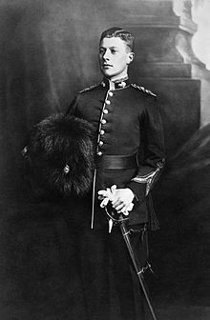
Nimy Bridge is being defended by a single company of the 4th Royal Fusiliers and a machine gun section with Dease in command. The gunfire is intense and the casualties very heavy, but the lieutenant continues to fire in spite of his wounds, until he is hit for the fifth time and is carried away.
Dease wins the first Victoria Cross to be awarded in the Great War and he receives it on the first day of the first significant British encounter in that war.
When Lieutenant Dease has been mortally wounded, Private Sidney Godley offers to defend the Railway Bridge while the rest of the section retreats and is also awarded the Victoria Cross. He is taken prisoner of war.
Rafferty is the third son of Irish miner and lorry driver Joseph Rafferty and his Scottish wife Mary Skeffington. His abusive alcoholic father dies when Gerry is only sixteen years old. He grows up in a council house on the town’s Glenburn estate and attends St. Mirin’s Academy. Inspired by his Scottish mother, who teaches him both Irish and Scottish folk songs, and the music of Bob Dylan and the Beatles, he starts writing his own material. In 1963 he leaves St. Mirin’s Academy and works in a butcher’s shop and as a civil service clerk while also playing with the local group Maverix on weekends.
In the mid-1960s Rafferty earns money busking on the London Underground. In 1966 he meets fellow musician Joe Egan and they are both members of the pop band the Fifth Column. In 1969 he becomes the third member of the folk-pop outfit the Humblebums, which also features comedian Billy Connolly and Tam Harvey. He and Connelly record two well-received albums on the Transatlantic Records label as a duo.
Rafferty releases his first solo album, Can I Have My Money Back?, in 1972. That same year he and Egan form the group Stealers Wheel. Stealers Wheel has a huge hit with the jaunty and witty song “Stuck in the Middle with You,” which peaks at #6 on the Billboard pop charts. Stealers Wheel has a lesser Top 40 hit with “Star” ten months later and eventually breaks up in 1975.
In 1978 Rafferty hits pay dirt with his second solo album, City to City, which soars to #1 on the Billboard album charts and sells over five million copies worldwide. The album also begets the hit song “Baker Street.” This haunting and poetic ballad is an international smash that goes to #2 in the United States, #3 in the United Kingdom, #1 in Australia, and #9 in the Netherlands.
Rafferty’s third album, Night Owl, likewise does well. Moreover, he has additional impressive chart successes with the songs “Right Down the Line,” “Home and Dry,” “Days Gone Down,” and “Get It Right Next Time.” Alas, a handful of albums he records throughout the 1980s and 1990s all prove to be commercial flops. He sings the vocal on the song “The Way It Always Starts” for the soundtrack of the movie Local Hero.
Rafferty is married to Carla Ventilla from 1970 to 1990. He records his last album, Another World, in 2000 and releases the compilation CD, Life Goes On, in 2009.
Rafferty has problems with alcoholism that directly contributes to his untimely death. In November 2010, he is admitted to the Royal Bournemouth Hospital where he is put on a life support machine and treated for multiple organ failure. After being taken off life support, he rallies for a short time, and doctors believe he might recover. He dies, however, of liver failure at the home of his daughter Martha in Stroud, Gloucestershire, on January 4, 2011.
Nimy Bridge is being defended by a single company of the 4th Royal Fusiliers and a machine-gun section with Dease in command. The gunfire is intense and the casualties very heavy, but the lieutenant continues to fire in spite of his wounds, until he is hit for the fifth time and is carried away.
Dease wins the first Victoria Cross to be awarded in the Great War and he receives it on the first day of the first significant British encounter in that war.
When Lieutenant Dease has been mortally wounded, Private Sidney Godley offers to defend the Railway Bridge while the rest of the section retreats and is also awarded the Victoria Cross. He is taken prisoner of war.


 seamus dubhghaill