Donal Donnelly, Irish theatre and film actor, is born to Irish parents in Bradford, West Yorkshire, England, on July 6, 1931. Perhaps best known for his work in the plays of Brian Friel, he has a long and varied career in film, on television and in the theatre. He lives in Ireland, the United Kingdom and the United States at various times, and his travels lead him to describe himself as “an itinerant Irish actor.”
Donnelly’s father, James, is a doctor from County Tyrone, and his mother, Nora O’Connor, is a teacher from County Kerry.
Donnelly gets his start in an amateur group calling itself the Globe Theatre Players. It is organised and run by Jim Fitzgerald and Monica Brophy. He then later tours with Anew McMaster‘s Irish repertory company before moving to England where he stars with Rita Tushingham in the film The Knack …and How to Get It.
For many years, Donnelly tours a one-man performance of the writings of George Bernard Shaw, adapted and directed by Michael Voysey and entitled My Astonishing Self.
On television, Donnelly plays the lead role of Matthew Browne in the 1970s ITV sitcom Yes, Honestly, opposite Liza Goddard. But from the late 1950s onwards, he often appears in such British TV programs as The Avengers, Z-Cars and The Wednesday Play.
In 1968, Donnelly records an album of Irish songs, Take the Name of Donnelly, which is arranged, produced and conducted by Tony Meehan formerly of the Shadows.
Donnelly, who is a heavy smoker all his life, dies from cancer at the age of 78 in Chicago, Illinois, on January 4, 2010. He is survived by his wife, Patricia ‘Patsy’ Porter, a former dancer he met working on Finian’s Rainbow, and two sons, Jonathan and Damian. Their only daughter, Maryanne, predeceases him after being killed in a riding accident. A brother, Michael Donnelly, is a Fianna Fáil senator and councillor, and Lord Mayor of Dublin(1990–91).
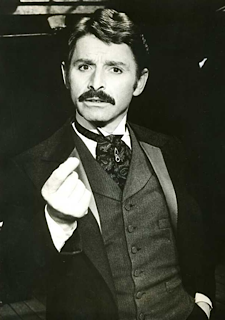
(Pictured: Publicity still of Donal Donnelly as Frederick Treves in the Broadway’s play TheElephant Man)
Paul Joseph Brady, Irish singer-songwriter and musician, is born in Belfast, Northern Ireland, on May 19, 1947. Interested in a wide variety of music from an early age, his work straddles folk and pop.
Brady begins learning piano around age six and by the age of eleven he has begun to play guitar, spending hours of his school holidays learning every song that the Shadows had recorded. He is also influenced by Chuck Berry.
In 1963, Brady begins performing as a piano player in a hotel in Bundoran, County Donegal. In October 1964, he attends University College Dublin and performs with a number of R&B groups, covering songs by the likes of Ray Charles and James Brown. The first of these is the Inmates (late 1964–about April 1965), which evolves into the Kult (about April–December 1965), featuring Brady, Jackie McAuley (ex-Them, and future Belfast Gypsies and Trader Horne), Brendan Bonass, and Dave Pennefather. He can be seen in the documentary film Charlie Is My Darling waiting outside Dublin‘s Adelphi Cinema for the Rolling Stones‘ concert of September 3, 1965. He next joins Rootzgroup (late 1965–May 1966) and Rockhouse (about May–December 1966).
During Brady’s time at college in Dublin, the country sees a huge rise in interest in traditional Irish music. He joins the popular Irish band The Johnstons when Michael Johnston leaves in May 1967. They move to London in 1969 and subsequently to New York City in 1972 to expand their audience. Despite some success, he returns to Ireland in 1974 to join the Irish group Planxty, the band that subsequently launches the solo careers of Andy Irvine, Liam O’Flynn, Dónal Lunny, and Christy Moore.
When Planxty disbands in late 1975, Brady forms a duo with Irvine from 1976 to 1978, a partnership that produces the successful album, Andy Irvine/Paul Brady. The next few years see him establish his popularity and reputation as one of Ireland’s best interpreters of traditional songs. His versions of ballads like “Arthur McBride” and “The Lakes of Pontchartrain” are considered definitive and are still popular at concerts today. In 1975 in New York, he records three albums for Shanachie Records as guitar accompanist to resident Irish fiddlers Andy McGann, Paddy Reynolds and John Vesey. He also records a 1976 album, The High Part of the Road, for the same label with Irish fiddler Tommy Peoples.
In 1978, Brady releases his first solo album, Welcome Here Kind Stranger, which wins him critical acclaim and is voted the “Folk Album of the Year” by Melody Maker magazine. However, it proves to be his last album covering traditional material. He decides to delve into pop and rock music and releases his first album of this genre in 1981, Hard Station.
Brady releases a number of successful solo albums throughout the 1980s: True for You (1983), Back to the Centre (1985), and Primitive Dance (1987). By the end of the decade, he is recognised and accepted as a respected performer and songwriter. His songs are being covered by a number of other artists, including Santana and Dave Edmunds.
Dylan is sufficiently impressed by Brady’s work to name-check him in the booklet of his 1985 box set, Biograph. The actual quote is “(…) people get too famous too fast these days and it destroys them. Some guys got it down – Leonard Cohen, Paul Brady, Lou Reed, secret heroes, John Prine, David Allen Coe, Tom Waits. I listen more to that kind of stuff than whatever is popular at the moment. They’re not just witchdoctoring up the planet, they don’t set up barriers (…)”.
In 1991, Brady reaches number 5 in the Irish Singles Chart with Nobody Knows.
Since his Hard Station album (1981), Brady is on various major labels until he creates his own label, PeeBee Music, in the late 1990s. He releases three albums in the 1990s: Trick or Treat, Songs & Crazy Dreams (a remixed compilation of earlier songs) and Spirits Colliding, which are met with critical acclaim. Trick or Treat is on Fontana/Mercury Records and receives a lot of promotion. As a result, some critics consider it his debut album and note that the record benefits from the expertise of experienced studio musicians, as well as producer Gary Katz, who works with the rock group Steely Dan. Rolling Stone, after praising his earlier but less-known solo records, calls Trick or Treat Brady’s “most compelling collection.”
Brady goes on to record several other albums, fifteen in total since going solo in 1978, and collaborates with a number of other established musicians including Bonnie Raitt and Richard Thompson. In 2006, he collaborates with Cara Dillon on the track “The Streets of Derry” from her album After the Morning. He also works with Fiachra Trench.
Brady’s fifteenth studio album, Hooba Dooba, is released in March 2010.
In 2017, a friendship is struck with Theo Katzman (Vulfpeck) and Brady tours Ireland in 2019 as half of this duo with Joe Dart, also of vulfpeck, Louis Cato and Lee Pardini. He continues to tour, record and collaborate with other artists. In 2019, Jimmy Buffett begins performing a cover of Brady’s hit, “The World is What you Make It.” In September 2019, Brady joins Buffett on his tour stops in both Dublin and London.
Brady releases the album Unfinished Business on his own label, PeeBee Music, licensed to Proper Music UK, in 2017.
While Brady and Andy Irvine’s planned tour of their 1976 album Andy Irvine/Paul Brady is impacted by the COVID-19 pandemic, they finish the tour in 2022. Musicians to join them on the tour include fiddle player Kevin Burke and multi-instrumentalist Dónal Lunny, both of whom had played on the original album.
In 2009, Brady receives an honorary degree of Doctor of Letters from the University of Ulster, in recognition of his services to traditional Irish music and songwriting.
Donal Donnelly, Irish theatre and film actor, dies in Chicago, Illinois, on January 4, 2010. Perhaps best known for his work in the plays of Brian Friel, he has a long and varied career in film, on television and in the theatre. He lives in Ireland, the United Kingdom and the United States at various times, and his travels lead him to describe himself as “an itinerant Irish actor.”
Donnelly gets his start in an amateur group calling itself the Globe Theatre Players. It is organised and run by Jim Fitzgerald and Monica Brophy. He then later tours with Anew McMaster‘s Irish repertory company before moving to England where he stars with Rita Tushingham in the film The Knack …and How to Get It.
For many years, Donnelly tours a one-man performance of the writings of George Bernard Shaw, adapted and directed by Michael Voysey and entitled My Astonishing Self.
On television, Donnelly plays the lead role of Matthew Browne in the 1970s ITV sitcom Yes, Honestly, opposite Liza Goddard. But from the late 1950s onwards, he often appears in such British TV programs as The Avengers, Z-Cars and The Wednesday Play.
In 1968, Donnelly records an album of Irish songs, Take the Name of Donnelly, which is arranged, produced and conducted by Tony Meehan formerly of the Shadows.
Donnelly, who is a heavy smoker all his life, dies from cancer at the age of 78 in Chicago, Illinois, on January 4, 2010. He is survived by his wife, Patricia ‘Patsy’ Porter, a former dancer he met working on Finian’s Rainbow, and two sons, Jonathan and Damian. Their only daughter, Maryanne, predeceases him after being killed in a riding accident. A brother, Michael Donnelly, is a Fianna Fáil senator and councillor, and Lord Mayor of Dublin (1990–91).
Robert William Gary Moore, Northern Irish musician, most widely recognised as a singer, songwriter, and virtuoso rock and blues guitarist, dies of a heart attack on February 6, 2011, in Estepona, Spain.
In a career dating back to the 1960s, Moore plays with musicians including Phil Lynott and Brian Downey during his teenage years, leading him to memberships of the Irish bands Skid Row and Thin Lizzy, and British band Colosseum II. Moore shares the stage with such blues and rock musicians as B. B. King, Albert King, Jack Bruce, Albert Collins, George Harrison, and Greg Lake, as well as having a successful solo career. He guests on a number of albums recorded by high-profile musicians.
Moore is born in Belfast, Northern Ireland on April 4, 1952. He starts performing at a young age, having picked up a battered acoustic guitar at the age of eight. He gets his first quality guitar at the age of 14, learning to play the right-handed instrument in the standard way despite being left-handed.
At the age of 16, aiming to become a musician, he moves to Dublin. Moore’s greatest influence in the early days is guitarist Peter Green of Fleetwood Mac who is a mentor to Moore when performing in Dublin. Other early musical influences are artists such as Albert King, Elvis Presley, Eric Clapton, The Shadows, and The Beatles. Later, having seen Jimi Hendrix and John Mayall’s Bluesbreakers in his hometown of Belfast, his own style develops into a blues-rock sound that becomes the dominant form of his career in music.
In Dublin, Moore joins the group Skid Row with Noel Bridgeman and Brendan “Brush” Shiels. It is with this group that he earns a reputation in the music industry, and his association with Phil Lynott begins.
Moore moves to England in 1970 and in 1973, under the name “The Gary Moore Band,” he releases his first solo album, Grinding Stone. Grinding Stone receives “Album of the Year” accolades on KTAC-FM/Seattle–Tacoma, Washington, in 1974.
In 1974 he joins Thin Lizzy after the departure of founding member Eric Bell. From 1975 to August 1978, he is a member of Colosseum II. In 1977, Moore rejoins Thin Lizzy, first as a temporary replacement for Brian Robertson, and on a permanent basis a year later.
Gary Moore dies of a heart attack in his sleep at the age of 58 during the early hours of February 6, 2011. At the time, he is on holiday with a girlfriend at the Kempinski Hotel in Estepona, Spain. Moore is laid to rest in St. Margaret’s Churchyard, Rottingdean, East Sussex, England, in a private ceremony with only family and close friends in attendance.
Robert William Gary Moore, Northern Irish musician, most widely recognised as a singer, songwriter, and virtuoso rock and blues guitarist, is born in Belfast on April 4, 1952.
In a career dating back to the 1960s, Moore plays with musicians including Phil Lynott and Brian Downey during his teenage years, leading him to memberships of the Irish bands Skid Row and Thin Lizzy, and British band Colosseum II. Moore shares the stage with such blues and rock musicians as B.B. King, Albert King, Jack Bruce, Albert Collins, George Harrison, and Greg Lake, as well as having a successful solo career. He guests on a number of albums recorded by high-profile musicians.
Moore starts performing at a young age, having picked up a battered acoustic guitar at the age of eight. He gets his first quality guitar at the age of 14, learning to play the right-handed instrument in the standard way despite being left-handed.
At the age of 16, aiming to become a musician, he moves to Dublin. Moore’s greatest influence in the early days is guitarist Peter Green of Fleetwood Mac who is a mentor to Moore when performing in Dublin. Other early musical influences are artists such as Albert King, Elvis Presley, The Shadows, and The Beatles. Later, having seen Jimi Hendrix and John Mayall’s Bluesbreakers in his hometown of Belfast, his own style is developing into a blues-rock sound that becomes the dominant form of his career in music.
In Dublin, Moore joins the group Skid Row with Noel Bridgeman and Brendan “Brush” Shiels. It is with this group that he earns a reputation in the music industry, and his association with Phil Lynott begins.
Moore moves to England in 1970 and in 1973, under the name “The Gary Moore Band,” he releases his first solo album, Grinding Stone. Grinding Stone receives “Album of the Year” accolades on KTAC-FM/Seattle-Tacoma, Washington, in 1974.
In 1974 he joins Thin Lizzy after the departure of founding member Eric Bell. From 1975 to August 1978, he is a member of Colosseum II. In 1977, Moore rejoins Thin Lizzy, first as a temporary replacement for Brian Robertson, and on a permanent basis a year later.
Gary Moore dies of a heart attack in his sleep at the age of 58 during the early hours of February 6, 2011. At the time, he is on holiday with a girlfriend at the Kempinski Hotel in Estepona, Spain. Moore is laid to rest in St. Margaret’s Churchyard, Rottingdean, East Sussex, England, in a private ceremony with only family and close friends in attendance.



 seamus dubhghaill