seamus dubhghaill

Promoting Irish Culture and History from Little Rock, Arkansas, USA


Leave a comment

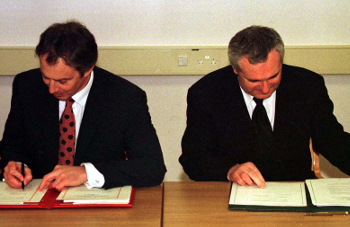
Signing of the Good Friday Agreement

After nearly two years of talks, the Good Friday Agreement, a major political development in the Northern Ireland peace process of the 1990s, is signed by Irish Taoiseach Bertie Ahern and British Prime Minister Tony Blair on Good Friday, April 10, 1998 in Belfast, Northern Ireland.

The Good Friday Agreement brings to an end the 30 years of sectarian conflict in Northern Ireland known as “The Troubles.”  Northern Ireland’s present devolved system of government is based on the Agreement.

The Agreement is made up of two inter-related documents: (1) a multi-party agreement by most of Northern Ireland’s political parties and (2) an international agreement between the British and Irish governments called the British-Irish Agreement.

The Agreement sets out a complex series of provisions relating to a number of areas including the status and system of government of Northern Ireland within the United Kingdom (Strand 1), the relationship between Northern Ireland and the Republic of Ireland (Strand 2), and the relationship between the Republic of Ireland and the United Kingdom (Strand 3).

Issues relating to civil and cultural rights, decommissioning of weapons, justice and policing are central to the Agreement.

The Agreement is approved by voters across the island of Ireland in two referendums held on May 22, 1998. The people of both Northern Ireland and the Republic of Ireland need to approve the Agreement in order for it to come into effect. In Northern Ireland, voters are asked whether they support the multi-party agreement. In the Republic of Ireland, voters are asked whether they will allow the state to sign the agreement and allow necessary constitutional changes to facilitate it.

The British-Irish Agreement comes into force on December 2, 1999. The Democratic Unionist Party (DUP) is the only major political group in Northern Ireland to oppose the Good Friday Agreement.


Leave a comment

The Bloody Sunday Inquiry Convenes

bloody-sunday-inquiry-1

The Bloody Sunday Inquiry, the biggest public inquiry in British history, opens properly on March 27, 2000, when formal public hearings begin at the Guildhall in Derry. The Inquiry holds public hearings on 116 days over the year, clocking up more than 600 hours of evidence. The vast majority of the evidence is from eyewitnesses.

The Bloody Sunday Inquiry, also known as the Saville Inquiry or the Saville Report after its chairman, Lord Saville of Newdigate, is established in 1998 by British Prime Minister Tony Blair after campaigns for a second inquiry by families of those killed and injured in Derry on Bloody Sunday during the peak of ethno-political violence known as The Troubles. The inquiry is set up to establish a definitive version of the events of Sunday, January 30, 1972, superseding the tribunal set up under Lord Widgery in April 1972, and to resolve the accusations of a whitewash that had surrounded it.

The inquiry takes the form of a tribunal established under the Tribunals of Inquiry (Evidence) Act 1921, and consists of Lord Saville, the former Chief Justice of New Brunswick William L. Hoyt, and John L. Toohey, a former Justice of the High Court of Australia. The judges retire on November 23, 2004, and reconvene once again on December 16 to listen to testimony from another key witness, known only as Witness X.

The results are published on June 15, 2010. The report states, “The firing by soldiers of 1 PARA on Bloody Sunday caused the deaths of 13 people and injury to a similar number, none of whom was posing a threat of causing death or serious injury.” It also says, “The immediate responsibility for the deaths and injuries on Bloody Sunday lies with those members of Support Company whose unjustifiable firing was the cause of those deaths and injuries.”

Saville states that British paratroopers “lost control”, fatally shooting fleeing civilians and those who tried to aid the civilians who had been shot by the British soldiers and that the civilians had not been warned by the British soldiers that they intended to shoot. Saville also says British soldiers should not have been ordered to enter the Bogside area as “Colonel Wilford either deliberately disobeyed Brigadier MacLellan’s order or failed for no good reason to appreciate the clear limits on what he had been authorised to do.”

The report states five British soldiers aimed shots at civilians they knew did not pose a threat and two other British soldiers shot at civilians “in the belief that they might have identified gunmen, but without being certain that this was the case.” It also states that British soldiers had concocted lies in their attempt to hide their acts and, contrary to the previously established belief, that none of the soldiers fired in response to attacks by petrol bombers or stone throwers, and that the civilians were not posing any threat. The report finds that Martin McGuinness, “did not engage in any activity that provided any of the soldiers with any justification for opening fire.”

bloody-sunday-inquiry-2

On the morning that the report is published, thousands of people walk the path that the civil rights marchers had taken on Bloody Sunday, holding photos of those who had been shot. The families of the victims receive advance copies of the report inside the Guildhall. British Prime Minister David Cameron addresses the House of Commons that afternoon where he acknowledges, among other things, that the paratroopers had fired the first shot, had fired on fleeing unarmed civilians, and shot and killed one man who was already wounded. He then apologises on behalf of the British Government.