Patrick “Pat” Kenny, veteran Irish broadcaster, is born in Dublin on January 29, 1948. Kenny currently hosts the daily radio show The Pat Kenny Show on Newstalk and the current affairs show Pat Kenny Tonight on TV3.
Kenny has a 41-year high-profile career at RTÉ, in which he is their highest paid presenter for several years. He presents the radio show Today with Pat Kenny on RTÉ Radio 1 each weekday morning between 10:00 and midday until 2013. He hosts The Late Late Show from September 1999 until May 2009, however, returns as a stand-in host in January 2013. He presents the current affairs programme, The Frontline, each Monday night from 2009 until its cancellation in 2013.
Kenny is the co-host of Eurovision Song Contest 1988, as well as numerous other television shows, including Today Tonight, Saturday Live, and Kenny Live, and works for both RTÉ Radio 1 and RTÉ 2fm, sometimes simultaneously, in a career that has spanned five decades. He is the holder of a Jacob’s Award and is perennially cited as the highest paid employee in RTÉ’s possession. He is named 23rd most influential person of 2009 by the magazine Village.
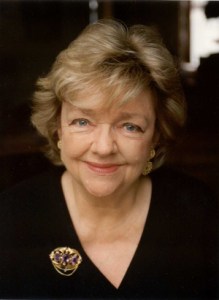
Maeve Binchy Snell, known as Maeve Binchy, Irish novelist, playwright, short story writer, columnist, and speaker best known for her sympathetic and often humorous portrayal of small-town life in Ireland, is born on May 28, 1939, in Dalkey, County Dublin.
Binchy is the oldest of four children born to William and Maureen (née Blackmore) Binchy. Educated at St. Anne’s, Dún Laoghaire, and later at Holy Child Convent, Killiney, she goes on to study at University College Dublin, where she earns a bachelor’s degree in history. She works as a teacher of French, Latin, and history at various girls’ schools.
A 1963 trip to Israel profoundly affects both her career and her faith. One Sunday, attempting to find the location of the Last Supper, she climbs a mountainside to a cavern guarded by an Israeli soldier. She weeps with despair and the soldier asks, “What’ya expect ma’am – a Renaissance table set for 13?” She replies, “Yes! That’s just what I did expect.” This experience causes her to renounce her Catholic faith and eventually turn to atheism.
In 1968, Binchy joins the staff at The Irish Times, and works there as a writer, columnist, the first Women’s Page editor, and the London editor reporting for the paper from London before returning to Ireland.
Binchy, tall and rather stout, never considers herself to be attractive. She ultimately encounters the love of her life, children’s author Gordon Snell, while recording a piece for Woman’s Hour in London. Their friendship blossoms into a cross-border romance, with her in Ireland and him in London, until she eventually secures a job in London through The Irish Times. They are married in 1977 and eventually return to live in Dalkey, not far from where she had grown up.
In all, Binchy publishes 16 novels, four short-story collections, a play, and a novella. A 17th novel, A Week in Winter, is published posthumously. Her literary career begins with two books of short stories, Central Line (1978) and Victoria Line (1980). She publishes her debut novel Light a Penny Candle in 1982.
Most of Binchy’s stories are set in Ireland, dealing with the tensions between urban and rural life, the contrasts between England and Ireland, and the dramatic changes in Ireland between World War II and the present day. Her books have been translated into 37 languages.
In 2002, Binchy suffers a health crisis related to a heart condition, which inspires her to write Heart and Soul. The book about a heart failure clinic in Dublin and the people involved with it, reflects many of her own experiences and observations in the hospital.
Binchy dies on July 30, 2012, at the age of 73, in a Dublin hospital with her husband at her side. She had suffered from various maladies, including painful osteoarthritis, which results in a hip operation. A month before her death she suffers a severe spinal infection and finally succumbs to a heart attack. Just ahead of that evening’s Tonight with Vincent Browne and TV3‘s late evening news, Vincent Browne and then Alan Cantwell, who respectively anchor these shows, announce to Irish television viewers that Binchy has died earlier in the evening.
Despite being an atheist, Binchy is given a traditional Requiem Mass which takes place at the Church of the Assumption, in her hometown of Dalkey. She is later cremated at Mount Jerome Cemetery and Crematorium.


 seamus dubhghaill