
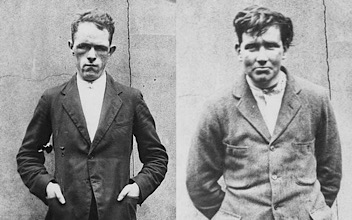
Reginald Dunne and Joseph O’Sullivan, members of the London Battalion of the Irish Republican Army (IRA), are hanged at Wandsworth Prison on August 10, 1922, for the assassination of Field Marshal Sir Henry Wilson on June 22, 1922.
Wilson, a senior British Army officer and military advisor to the Belfast Government (Stormont), is shot dead on the steps of his Eaton Square home in London as he returns from an unveiling ceremony at Liverpool Street station. Dunne and O’Sullivan, both former British Army soldiers, have joined the London IRA and are active in the anti-Treaty republican movement. O’Sullivan lost a leg at Ypres, Belgium, in 1917, while Dunne served in the Irish Guards during World War I.
The killing is widely seen as a political act, with Dunne and O’Sullivan claiming to have acted in defence of Irish nationalist principles, blaming Wilson for the “Orange Terror” and the deployment of the Ulster Special Constabulary (USC). Some historians suggest the assassination may have been intended to pressure Michael Collins to attack the Four Courts garrison, though no conclusive evidence of orders was ever established.
After the shooting, Dunne escapes but O’Sullivan is captured by a hostile crowd. Dunne attempts to rescue him but is himself arrested after wounding two police officers and a passerby. Both are tried quickly, found guilty after just three minutes of deliberation, and sentenced to death by Justice Montague Shearman.
Despite petitions from 45,000 people and appeals from figures like George Bernard Shaw, both men are executed on August 10, 1922, and buried within the prison grounds.
The executions are a major political flashpoint. It is only after the abolition of hanging that the law is changed and Joseph’s brother, with the assistance of the Irish National Graves Association, is able to arrange for the bodies of the two men to be repatriated to Ireland.
In 1967, the British government allows the bodies of Dunne and O’Sullivan to be exhumed and returned to Ireland. Former comrades accompany the bodies from England to Dublin Airport, where they place an Irish tricolour flag on Dunne’s coffin. This is the same flag that Dunne had placed on the coffin of Terence MacSwiney at Euston railway station when his body was returned to Cork in 1920.
Graveside orations are held in Dublin, attended by former comrades, Michael Collins’s associates, and representatives of Éamon de Valera, the president of Ireland. The bodies are reinterred in Dean’s Grange Cemetery outside Dublin in 1967.
Dunne’s trial speech, reprinted in the Irish Independent, remains a notable piece of republican political rhetoric, framing the act as a necessary stand for Irish rights.
(Pictured: Joseph O’Sullivan (left) and Reginald Dunne (right))


