seamus dubhghaill

Promoting Irish Culture and History from Little Rock, Arkansas, USA


Leave a comment

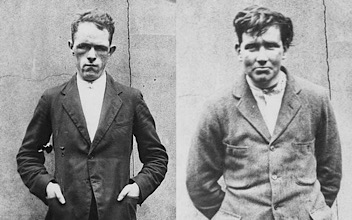
The Hanging of IRA members Reginald Dunne & Joseph O’Sullivan

Reginald Dunne and Joseph O’Sullivan, members of the London Battalion of the Irish Republican Army (IRA), are hanged at Wandsworth Prison on August 10, 1922, for the assassination of Field Marshal Sir Henry Wilson on June 22, 1922.

Wilson, a senior British Army officer and military advisor to the Belfast Government (Stormont), is shot dead on the steps of his Eaton Square home in London as he returns from an unveiling ceremony at Liverpool Street station. Dunne and O’Sullivan, both former British Army soldiers, have joined the London IRA and are active in the anti-Treaty republican movement. O’Sullivan lost a leg at Ypres, Belgium, in 1917, while Dunne served in the Irish Guards during World War I.

The killing is widely seen as a political act, with Dunne and O’Sullivan claiming to have acted in defence of Irish nationalist principles, blaming Wilson for the “Orange Terror” and the deployment of the Ulster Special Constabulary (USC). Some historians suggest the assassination may have been intended to pressure Michael Collins to attack the Four Courts garrison, though no conclusive evidence of orders was ever established.

After the shooting, Dunne escapes but O’Sullivan is captured by a hostile crowd. Dunne attempts to rescue him but is himself arrested after wounding two police officers and a passerby. Both are tried quickly, found guilty after just three minutes of deliberation, and sentenced to death by Justice Montague Shearman.

Despite petitions from 45,000 people and appeals from figures like George Bernard Shaw, both men are executed on August 10, 1922, and buried within the prison grounds.

The executions are a major political flashpoint. It is only after the abolition of hanging that the law is changed and Joseph’s brother, with the assistance of the Irish National Graves Association, is able to arrange for the bodies of the two men to be repatriated to Ireland.

In 1967, the British government allows the bodies of Dunne and O’Sullivan to be exhumed and returned to Ireland. Former comrades accompany the bodies from England to Dublin Airport, where they place an Irish tricolour flag on Dunne’s coffin. This is the same flag that Dunne had placed on the coffin of Terence MacSwiney at Euston railway station when his body was returned to Cork in 1920.

Graveside orations are held in Dublin, attended by former comrades, Michael Collins’s associates, and representatives of Éamon de Valera, the president of Ireland. The bodies are reinterred in Dean’s Grange Cemetery outside Dublin in 1967.

Dunne’s trial speech, reprinted in the Irish Independent, remains a notable piece of republican political rhetoric, framing the act as a necessary stand for Irish rights.

(Pictured: Joseph O’Sullivan (left) and Reginald Dunne (right))

Leave a comment

Birth of Joseph O’Sullivan, Irish Republican Army Volunteer

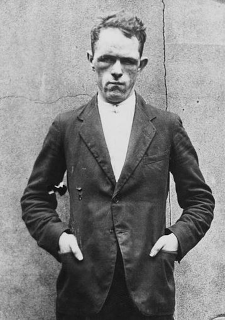
Joseph O’Sullivan, Irish Republican Army (IRA) volunteer, is born in London on January 25, 1897. Along with fellow IRA (London Battalion) volunteer Reginald Dunne, shoot dead Field Marshal Sir Henry Wilson outside Wilson’s home at 36 Eaton Place, Belgravia, London on June 22, 1922. Convicted by a jury, he is sentenced to death by Justice Montague Shearman. Despite a petition of 45,000 signatures, and a plea for clemency from many prominent figures at the time, including playwright George Bernard Shaw, O’Sullivan and Dunne are hanged for the murder on August 10, 1922, at Wandsworth Prison. The event provides the inspiration for the 1947 film Odd Man Out.

O’Sullivan’s father, John, is originally from Bantry, County Cork, and moves to London as a young man where he eventually becomes a successful tailor. His mother, Mary Ann O’Sullivan (née Murphy), is born in Inniscarra, County Cork. He is the youngest of thirteen children, all born in London, although only eleven survive to adulthood. As a boy he attends St. Edmund’s College, Ware. On January 25, 1915, his eighteenth birthday, he enlists into the Royal Munster Fusiliers, and later transfers to the London Regiment and serves with the rank of lance corporal during World War I, losing a leg at Ypres in 1917.

Upon being discharged from the army in 1918, O’Sullivan is employed by the Ministry of Munitions and, when the war ends, is transferred to the Ministry of Labour where he works as a messenger. The Ministry of Labour is located in Montagu House, adjacent to Scotland Yard, and later demolished and replaced by the present-day Ministry of Defence.

O’Sullivan becomes a member of the IRA detachment in London and is named by Rex Taylor as being responsible for the execution of Vincent Fovargue as a British spy at the Ashford Golf Links, Middlesex, on April 2, 1921. Fovargue is left with a label pinned to his body stating, “Let spies and traitors beware, IRA.” Fovargue had been an officer in the Dublin brigade of the IRA.

O’Sullivan’s brother, Patrick, is the first Vice-Commandant of the London IRA during its early days in 1919 but is seconded to the Cork No. 1 Brigade during the Irish War of Independence. Patrick also serves in the London Regiment during World War I, along with another brother, Aloysius, who is discharged from the army in 1916 suffering from shell shock. Patrick is also wounded in a gas attack during World War I. He fights with the Anti-Treaty IRA during the Irish Civil War and is wounded ten days after his brother is executed. Shortly before that, he crosses over to England to participate in an abortive attempt to rescue Dunne and his brother.

In 1923, John O’Sullivan tries to have the remains of his son and Dunne released for a funeral Mass. But it is not until after the abolition of capital punishment in the United Kingdom that Patrick O’Sullivan, with the assistance of the Irish Republican National Graves Association, is able to arrange for the bodies of O’Sullivan and Dunne to be sent to Ireland for burial. In mid-August 1929, Irish Republicans in London unveil a plaque commemorating Dunne and O’Sullivan. In 1967, after some political and diplomatic debate by the British and Irish governments, the British Government allows the bodies of Dunne and O’Sullivan to be exhumed. They are subsequently reburied in Dean’s Grange Cemetery, County Dublin.

(Pictured: Photograph of IRA member Joseph O’Sullivan taken before his 1922 execution)