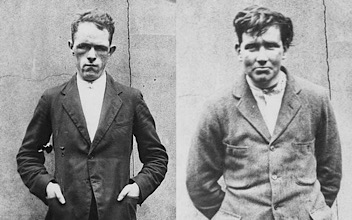
The killing is widely seen as a political act, with Dunne and O’Sullivan claiming to have acted in defence of Irish nationalist principles, blaming Wilson for the “Orange Terror” and the deployment of the Ulster Special Constabulary (USC). Some historians suggest the assassination may have been intended to pressure Michael Collins to attack the Four Courts garrison, though no conclusive evidence of orders was ever established.
After the shooting, Dunne escapes but O’Sullivan is captured by a hostile crowd. Dunne attempts to rescue him but is himself arrested after wounding two police officers and a passerby. Both are tried quickly, found guilty after just three minutes of deliberation, and sentenced to death by Justice Montague Shearman.
Despite petitions from 45,000 people and appeals from figures like George Bernard Shaw, both men are executed on August 10, 1922, and buried within the prison grounds.
The executions are a major political flashpoint. It is only after the abolition of hanging that the law is changed and Joseph’s brother, with the assistance of the Irish National Graves Association, is able to arrange for the bodies of the two men to be repatriated to Ireland.
Dunne’s trial speech, reprinted in the Irish Independent, remains a notable piece of republican political rhetoric, framing the act as a necessary stand for Irish rights.
(Pictured: Joseph O’Sullivan (left) and Reginald Dunne (right))
Kennedy meets his future wife, Jacqueline Lee “Jackie” Bouvier (1929–1994), while he is a congressman. Charles L. Bartlett, a journalist, introduces the pair at a dinner party. They are married a year after he is elected senator, on September 12, 1953. Following a miscarriage in 1955 and a stillbirth in 1956, they produce three children, Caroline, John, Jr., and Patrick, who dies of complications two days after birth.
In the 1960 presidential election, Kennedy narrowly defeats Republican opponent Richard Nixon, who is the incumbent vice president. His humor, charm, and youth in addition to his father’s money and contacts are great assets in the campaign. His campaign gains momentum after the first televised presidential debates in American history. He is the first Catholic elected president of the United States.
Kennedy’s administration includes high tensions with communist states in the Cold War. As a result, he increases the number of American military advisors in South Vietnam. The Strategic Hamlet Program begins in Vietnam during his presidency. In April 1961, he authorizes an attempt to overthrow the Cuban government of Fidel Castro in the failed Bay of Pigs Invasion. He authorizes the Cuban Project, also known as Operation Mongoose, in November 1961. He rejects Operation Northwoods, plans for false flag attacks to gain approval for a war against Cuba, in March 1962. However, his administration continues to plan for an invasion of Cuba in the summer of 1962.
In October 1962, U.S. spy planes discover Soviet missile bases have been deployed in Cuba. The resulting period of tensions, termed the Cuban Missile Crisis, nearly results in the breakout of a global thermonuclear conflict. He also signs the first nuclear weapons treaty in October 1963.
After Kennedy’s death, Congress enacts many of his proposals, including the Civil Rights Act of 1964 and the Revenue Act of 1964. Despite his truncated presidency, he ranks highly in polls of U.S. presidents with historians and the general public. His personal life has also been the focus of considerable sustained interest following public revelations in the 1970s of his chronic health ailments and extramarital affairs. He is the last U.S. President to have been assassinated as well as the last U.S. president to die in office.
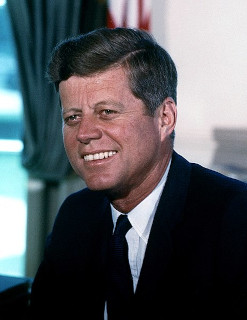
(Pictured: John F. Kennedy, photograph in the Oval Office, July 11, 1963)