
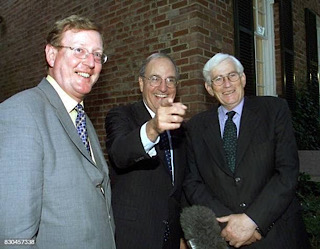
A key meeting takes place in Northern Ireland on September 27, 1998, as part of the post-Good Friday Agreement peace process. The principal participants are British Prime Minister Tony Blair, David Trimble, leader of the Ulster Unionist Party (UUP) and First Minister-designate, Seamus Mallon, deputy leader of the Social Democratic and Labour Party (SDLP) and Deputy First Minister-designate, and George Mitchell, former United States Senator and appointed international mediator (often referred to as the United States Special Envoy for Northern Ireland)
The primary objectives of the meeting include:
- Progressing the Peace Process – the parties are consolidating steps needed to establish Northern Ireland’s new devolved Assembly, following the Good Friday Agreement signed in April 1998.
- Confirming Executive Arrangements and Cross-Community Cooperation – discussion focuses on how the new Northern Ireland Assembly and Executive can function on a cross-community basis, ensuring Unionist and Nationalist representation in governance and decision-making.
- Addressing the Controversial Role of the Queen – newly declassified documents show that Tony Blair and Secretary of State for Northern Ireland Mo Mowlam explored whether Queen Elizabeth II should officially open the new Assembly, a sensitive question due to nationalist perception. They propose consulting privately with Seamus Mallon before final decisions are made with David Trimble.
- Ensuring the Implementation of Key Good Friday Agreement Provisions – including Irish Republican Army (IRA) decommissioning of weapons, parity in representation for Unionists and Nationalists in the Assembly, and planning for the full transfer of powers from the UK Government to the Assembly, which is scheduled for December 1999.
Key outcomes and discussions coming out of the meeting include:
- Commitment to Institutions: Blair, Trimble, and Mallon agree on the importance of setting up a shadow Assembly that can transition to full devolved powers once cross-party agreements are stable.
- Cross-Community Provisions: Blair emphasizes that sensitive issues require cross-community approval in the Assembly, warning that majority-rule-only systems could lead to collapse if abused.
- International Support: George Mitchell, as U.S. envoy, reaffirms American support for the peace process and encourages local leaders to uphold commitments.
- Political Sensitivities of the Queen’s Role: Blair and Mowlam note the potential nationalist backlash if the Queen’s presence is prominent, suggesting alternative ceremonial openings.
- Security and Prisoner Issues: Discussions also cover paramilitary decommissioning, with particular concern over Sinn Féin and IRA compliance to allow the formation of the shadow Executive safely.
The meeting is part of a broader diplomatic effort. It occurs after the signing of the Good Friday Agreement (April 10, 1998) but before formal referendums in Northern Ireland and the Republic of Ireland approving the Agreement (May 22 and 23, 1998). It highlights the delicate balancing act between Unionists and Nationalists, the role of the UK and Irish governments, and international mediation, notably from the U.S. via George Mitchell.
Declassified documents at the Public Record Office of Northern Ireland (PRONI) in Belfast detail concerns over cross-community decision-making and the Queen’s status in ceremonial openings. The CAIN: Irish Peace Process Chronology confirms Blair, Trimble, and Mallon are engaging in preparatory discussions to implement the Agreement’s provisions and ensure the Assembly’s initial functionality. U.S. involvement through George Mitchell underscores the international commitment to maintaining peace and political stability during the transitional period.
In summary, the September 27, 1998 meeting is a crucial step in operationalizing the Good Friday Agreement, demonstrating cooperative leadership among British, Unionist, and Nationalist figures, with strategic oversight from the United States. It sets the stage for the new Northern Ireland Assembly, addressing ceremonial, legislative, and security challenges central to the successful devolution of powers.
Key participants demonstrate cautious diplomacy, foresight in cross-community governance, and recognition of the international dimension crucial to Northern Ireland’s peace process.
(Pictured: (L to R) David Trimble, George Mitchell and Seamus Mallon)


