Blair tells Sinn Féin he needs assurance that its members are committed to “exclusively peaceful means” for the peace process to succeed, and stresses that all parties must recognise their obligations under the 1998 Good Friday Agreement.
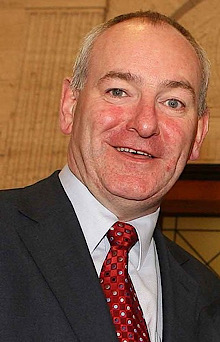
Durkan warns that while the power sharing government might be suspended, the agreement itself should not be “crippled” but only “injured.” He says the SDLP will not support a motion to exclude Sinn Féin from the Executive, but acknowledges that the Ulster Unionists cannot be expected to continue sitting alongside Sinn Féin under the current circumstances.
Durkan also stresses that the best way to reassure communities is to end IRA-related concerns, calling for an end to IRA activity. He urges both governments to avoid an “orgy of mutual recrimination” and to keep the political agenda focused on protecting the peace process.
This moment is a critical test for the Good Friday Agreement, as the suspension of the Executive risks undermining the democratic path it has established, but Durkan’s stance reflects the SDLP’s commitment to preserving the framework of the peace deal even amid political turmoil.
Progressing the Peace Process – the parties are consolidating steps needed to establish Northern Ireland’s new devolved Assembly, following the Good Friday Agreement signed in April 1998.
Confirming Executive Arrangements and Cross-Community Cooperation – discussion focuses on how the new Northern Ireland Assembly and Executive can function on a cross-community basis, ensuring Unionist and Nationalist representation in governance and decision-making.
Addressing the Controversial Role of the Queen – newly declassified documents show that Tony Blair and Secretary of State for Northern IrelandMo Mowlam explored whether Queen Elizabeth II should officially open the new Assembly, a sensitive question due to nationalist perception. They propose consulting privately with Seamus Mallon before final decisions are made with David Trimble.
Ensuring the Implementation of Key Good Friday Agreement Provisions – including Irish Republican Army (IRA) decommissioning of weapons, parity in representation for Unionists and Nationalists in the Assembly, and planning for the full transfer of powers from the UK Government to the Assembly, which is scheduled for December 1999.
Key outcomes and discussions coming out of the meeting include:
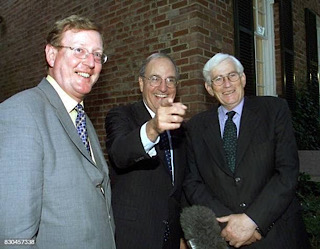
Commitment to Institutions: Blair, Trimble, and Mallon agree on the importance of setting up a shadow Assembly that can transition to full devolved powers once cross-party agreements are stable.
Cross-Community Provisions: Blair emphasizes that sensitive issues require cross-community approval in the Assembly, warning that majority-rule-only systems could lead to collapse if abused.
International Support: George Mitchell, as U.S. envoy, reaffirms American support for the peace process and encourages local leaders to uphold commitments.
Political Sensitivities of the Queen’s Role: Blair and Mowlam note the potential nationalist backlash if the Queen’s presence is prominent, suggesting alternative ceremonial openings.
Security and Prisoner Issues: Discussions also cover paramilitary decommissioning, with particular concern over Sinn Féin and IRA compliance to allow the formation of the shadow Executive safely.
The meeting is part of a broader diplomatic effort. It occurs after the signing of the Good Friday Agreement (April 10, 1998) but before formal referendums in Northern Ireland and the Republic of Ireland approving the Agreement (May 22 and 23, 1998). It highlights the delicate balancing act between Unionists and Nationalists, the role of the UK and Irish governments, and international mediation, notably from the U.S. via George Mitchell.
Declassified documents at the Public Record Office of Northern Ireland (PRONI) in Belfast detail concerns over cross-community decision-making and the Queen’s status in ceremonial openings. The CAIN: Irish Peace Process Chronology confirms Blair, Trimble, and Mallon are engaging in preparatory discussions to implement the Agreement’s provisions and ensure the Assembly’s initial functionality. U.S. involvement through George Mitchell underscores the international commitment to maintaining peace and political stability during the transitional period.
In summary, the September 27, 1998 meeting is a crucial step in operationalizing the Good Friday Agreement, demonstrating cooperative leadership among British, Unionist, and Nationalist figures, with strategic oversight from the United States. It sets the stage for the new Northern Ireland Assembly, addressing ceremonial, legislative, and security challenges central to the successful devolution of powers.
Key participants demonstrate cautious diplomacy, foresight in cross-community governance, and recognition of the international dimension crucial to Northern Ireland’s peace process.
(Pictured: (L to R) David Trimble, George Mitchell and Seamus Mallon)
The march is orchestrated by networks of Ulster Unionist victims’ groups, Protestant clergy, parties, and cultural organizations. The mobilization draws from what scholars term the Unionist Victims Movement, which seeks to highlight perceived mistreatment of Protestant Unionists in the post-agreement political settlement. Groups involved include the Northern Irish Victims of Terrorism Association (NIVTA) and affiliated organizations. They frame the protest in terms of civil rights for Protestants, drawing analogies with global civil rights movements to legitimize their cause.
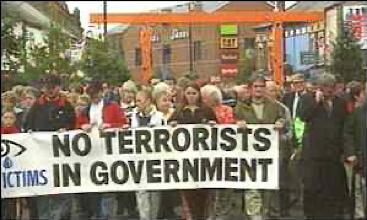
The September 25 march aims to lay a wreath at the cenotaph in Belfast to commemorate victims of the Troubles. This act is symbolic, emphasizing that Protestant victims of the conflict feel ignored or marginalized in the ongoing peace process. The march is also referred to as “The Long March,” which is structured to traverse central areas of Belfast, culminating in a rally at the grounds of Stormont Parliament. Organizers promote messages such as “pride, not prejudice” and “heritage, not hatred” to frame the march as a civic, rights-based demonstration rather than sectarian agitation.
Belfast City Council issues a ban on the march, restricting access to certain areas. Nevertheless, the Protestant marchers blatantly defy this prohibition. This act of defiance is deliberate, signaling a protest against perceived institutional bias and asserting the visibility of the Protestant community’s grievances.
The march reflects ongoing tensions within Northern Irish society during a period of post-conflict transition, where newly established power sharing mechanisms are perceived by some Unionist factions as disadvantaging Protestant communities. The event is emblematic of a strategy used by the Unionist Victims Movement to mobilize public attention and articulate a collective identity rooted in historical victimhood, despite being part of a locally dominant ethno-national group.
Contemporary news accounts note the boldness of defying official restrictions and the wider sociopolitical implications for the peace process. The Long March serves as both a commemorative act and a political statement, uniting a range of Protestant organizations in a conflictual social movement for civil rights recognition.
In summary, the September 25, 1999 Protestant civil rights march in Belfast is a strategically organized demonstration by Protestant and Unionist groups that deliberately defies a municipal ban to assert the civil rights of their community. The event combines symbolic commemoration of the Troubles’ victims with a broader protest against perceived post-Good Friday Agreement injustices, highlighting the complex dynamics of post-conflict mobilization and identity politics in Northern Ireland.
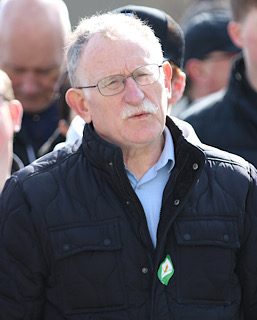
Ellis is from an Irish republican family, and both of his grandfathers fought in the Easter Rising in 1916. He later owns a television repair business.
Ellis is a former Provisional Irish Republican Army prisoner. He is arrested in 1981, when explosives and bomb making equipment are found under his bed. He is charged with possession of explosives. He jumps bail, but is arrested in Buffalo, New York in February 1982 and extradited to the Republic of Ireland, where in April 1983, he is sentenced to ten years’ imprisonment in Portlaoise Prison. He is convicted of possessing multiple power-timer units for IRA bombs, including those suspected of being used in the Hyde Park and Regent’s Park bombings. In 1983, his fingerprints are found on a huge cache of IRA explosives found in a forest outside the Berkshire town of Pangbourne. The cache is linked to the Harrods and Hyde Park bombings. On November 14, 1990, after thirty-five days on hunger strike, he becomes the first person extradited from the Republic of Ireland to the United Kingdom under the 1987 Extradition Act. He goes on hunger strike to protest efforts to send him to Britain, but is extradited in the sixth week of his fast. His hunger strike draws considerable domestic and international attention, and at one point TaoiseachCharles Haughey intervenes, asking Ellis’ parents to ask him to give it up, but they refuse. He is acquitted at his trial in London in October 1991.
Ellis is first elected to Dublin City Council in 1999, for the Finglas local electoral area. He unsuccessfully contests the 2002 Irish general election in the Dublin North-West constituency, and receives 4,781 first-preference votes (18.3%). He is again unsuccessful at the 2007 Irish general election in the same constituency, receiving 4,873 votes (15.7%). At the 2011 Irish general election, he is elected to the 31st Dáil with 7,115 (21.7%) of the first-preference votes.
In October 2014, following claims made by Máiría Cahill that she had been raped as a 17-year-old by a member of the Provisional IRA, Ellis states that “If an allegation was made against a volunteer it would have to be investigated [internally]…To be honest they were not qualified to deal with something like sexual abuse”. Based on this, Philip Ryan of the Irish Independent accuses Ellis of admitting that the IRA ran “kangaroo courts.”
In September 2016, a bill is put forward, which if passed would criminalise hare coursing. Sinn Féin supports the legalisation of hare coursing and decides to apply the party whip. As Ellis opposes it he declines to vote. He defies party instructions by not informing party whip Aengus Ó Snodaigh that he will not be taking part in the vote so he could be excused. He is subsequently given a written warning.
In December 2016, during a session of the Dáil, Ellis and his fellow Sinn Féin TD Martin Ferris are accused by Fine Gael TD Alan Farrell of having information in relation to the shooting of Brian Stack, the chief prison officer at PortlaoisePrison, in 1983. Sinn Féin leader Gerry Adams had just delivered an address to the Dáil in relation to Stack when Farrell rises and uses Dáil privilege to state Gerry Adams had listed Ellis and Ferris as amongst people who may have information about the Stack death in an e-mail to the Garda Commission in February 2014, and ask that the two should also address the Dáil on the matter. Ellis immediately responds by stating, “I refute [sic] any allegations. For the information, the man in question claims to be a solicitor, I was actually in jail for the period. In Portlaoise, and before that in America, so you should check your facts. You’re a disgrace.” Ferris follows Ellis, and states, “On the record of this house; In 2013, I met with gardaí at their request regarding the death of Brian Stack, I co-operated fully with them and I have nothing to answer for, and it’s a disgrace what you have come in here naming. You should be ashamed of yourself.” In December 2016, Ellis states he had received death threats following the exchange in the Dáil.
In February 2018, Ellis is censured by Sinn Féin after he states publicly that fellow party member and councillor for Ballymun Noeleen Reilly is “not fit to represent Sinn Féin” and that she had waged a social media campaign against him. For her part, Reilly is suspended by the party for six months.
At the 2020 Irish general election Ellis is again elected with 14,375 first-preference votes (44.4%). He is a poll topper in the 2020 general election along with many Sinn Féin TDs in the 2020 election. He is criticised for joining his supporters singing “Come Out, Ye Black and Tans” at the count, but he dismisses the suggestion it is inappropriate.
In 2012, the Irish Independent, citing released internal documents held by the British government that were previously sealed for 30 years, alleges that by 1982 British authorities believe Ellis to be linked to “50 murders” as part of his time in the Provisional IRA. The allegation specifically cites a telegraph from the British embassy in Washington, D.C., to American counterparts in which they claim that Ellis is linked by “forensic evidence to some 50 murders” across Northern Ireland and the Republic of Ireland. The Irish Independent claims another document states that Ellis is a “leading member” of the Provisional IRA.
Sinn Féin denounces the allegations as an “Indo Smear” and releases a statement declaring, “This is not the first time such unsubstantiated allegations have been made and Dessie Ellis rejects them as he has repeatedly done. Following a prolonged hunger strike in the 1990s to protest his extradition to Britain, Dessie successfully beat these trumped-up charges in court. Dessie Ellis has made no secret of his involvement in the republican struggle over many decades, including within the ranks of the IRA. Dessie has also been an important persuader for the Peace Process for many years.” Ellis does not make any personal statement on the allegations and refers journalists to Sinn Féin’s official statement.
Ellis is proficient in karate, holding a black belt, and teaches martial arts to young people. He is married to Anne Ellis (née Dunne) with grown up children.
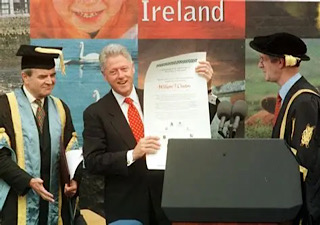
On September 5, 1998, United States PresidentBill Clinton becomes a Freeman of Limerick, following in the footsteps of John F. Kennedy, who had received the honor in 1963. The ceremony marks the last day of Clinton’s official visit to Ireland, which had begun earlier in the month and included stops in Dublin, Adare, Limerick, and Kerry.
On September 5, thousands gather on O’Connell Street to hear Clinton speak to an estimated 40,000 people. His address references the Good Friday Agreement and the peace process, saying: “Because of what you have done in Ireland in 1998, you have made it possible for me to tell every warring, feuding hating group of people trapped in the prison of their past conflicts to look at Ireland and know there can be a better day.”
The speech is broadcast worldwide and is delivered during a period when Clinton is facing political challenges in the United States, but he is still held in high esteem in Ireland for his role in the Northern Ireland peace process.
By being granted the Freedom of the City of Limerick, Clinton joins a distinguished list of U.S. presidents honored by Irish cities, underscoring the strong ties between the United States and Ireland. The visit and ceremony are symbolic of reconciliation, mutual respect, and the shared history of Irish Americans in U.S. politics.
In short, September 5, 1998, is both a personal milestone for Clinton and a moment of national and international significance, blending political diplomacy with public celebration.
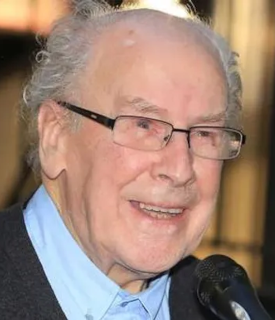
Wilson begins his priestly career as a hospital chaplain, where he becomes aware of the systemic neglect and exploitation of women. This experience shapes his later advocacy for marginalized groups. In 1966, he is assigned to St. John’s parish in Ballymurphy, a heavily working class and nationalist area. Confronted with poverty, deprivation, and social neglect, he rejects a purely clerical role and chooses to live among his parishioners, earning deep community trust.
Wilson facilitates grassroots initiatives such as the Springhill Community House and the Conway Education Centre, establishing spaces for alternative education, vocational training, small business incubators, and cultural engagement. These efforts emphasize the empowerment of local communities, adult education, and economic development, drawing inspiration from liberation theology and Worker Priest models.
Wilson’s ministry coincides with some of the most violent years of the Northern Ireland Troubles. He provides support to families affected by violence, offers shelter and practical assistance, and maintains dialogue channels between republican and loyalist communities. He criticizes the Catholic Church for its detachment from the struggles of working class Catholics and refuses to condemn paramilitary groups acting as “alternative police and armies,” reflecting his nuanced approach to community protection and justice. Alongside figures like Fr. Alec Reid, he is instrumental in mediating discussions that contribute toward the peace process.
Wilson’s work earns widespread admiration for his courage, humanity, and commitment to justice. He hosts Mother Teresa in west Belfast, helping to establish charitable outreach in the community. Despite periods of estrangement with his bishop and being barred from celebrating Mass in churches, he continues his ministry at home and through community projects.
Wilson is also a prolific writer, recording diaries, pamphlets, and weekly columns, later commemorated in the documentary “Fr. Des – The Way He Saw It” narrated by Stephen Rea, and in theatre productions celebrating his life. PresidentMichael D. Higgins and countless individuals recognize his significant role in civil rights, education, and peacemaking.
Wilson dies in Belfast on November 5, 2019, at the age of 94, leaving a lasting impact on Belfast and a model for socially committed clergy worldwide. His approach to ministry stands as a testament to living faith in solidarity with marginalized communities, emphasizing education, dialogue, and justice over institutional authority.
The institutions Wilson helps create, notably the Springhill Community House and Conway Mill, continue to support education, enterprise, and community engagement in Belfast, embodying Wilson’s vision of an empowered, inclusive society. His life remains an inspiration for those committed to social justice, peacebuilding, and community-centered ministry.
Wilson is remembered as a priest,educator, community activist, and mediator, whose dedication to the underprivileged and commitment to peace has left an indelible mark on Northern Ireland.
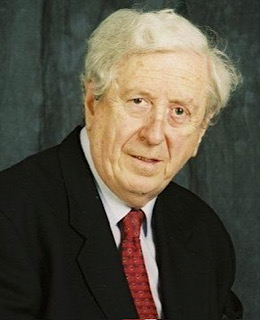
FitzGerald joins Fine Gael, attaching himself to the liberal wing of the party. and in 1969 is elected to Dáil Éireann, the lower house of the Oireachtas, the Irish parliament. He later gives up his university lectureship to become Minister for Foreign Affairs in the coalition government of Liam Cosgrave (1973–77). When the coalition government is resoundingly defeated in the 1977 Irish general election, Cosgrave yields leadership of Fine Gael to FitzGerald. In his new role as Leader of the Opposition and party leader, he proceeds to modernize and strengthen the party at the grass roots. He briefly loses power in 1982 when political instability triggers two snap elections.
By the time of the 1981 Irish general election, Fine Gael has a party machine that can easily match Fianna Fáil. The party wins 65 seats and forms a minority coalition government with the Labour Party and the support of a number of Independent TDs. FitzGerald is elected Taoiseach on June 30, 1981. To the surprise of many, FitzGerald excludes Richie Ryan, Richard Burke and Tom O’Donnell, former Fine Gael stalwarts, from the cabinet.
On May 5, 2011, it is reported that FitzGerald is seriously ill in a Dublin hospital. Newly elected Fine Gael Taoiseach Enda Kenny sends his regards and calls him an “institution.” On May 6 he is put on a ventilator. On May 19, after suffering from pneumonia, he dies at the Mater Private Hospital in Dublin at the age of 85.
In a statement, Irish PresidentMary McAleese hails FitzGerald as “a man steeped in the history of the State who constantly strove to make Ireland a better place for all its people.” Taoiseach Enda Kenny pays homage to “a truly remarkable man who made a truly remarkable contribution to Ireland.” Henry Kissinger, the former United States Secretary of State, who serves as an opposite number to FitzGerald in the 1970s, recalls “an intelligent and amusing man who was dedicated to his country.”
FitzGerald’s death occurs on the third day of Queen Elizabeth II‘s state visit to the Republic of Ireland, an event designed to mark the completion of the Northern Ireland peace process that had been “built on the foundations” of FitzGerald’s Anglo-Irish Agreement with Margaret Thatcher in 1985. In a personal message, the Queen offers her sympathies and says she is “saddened” to learn of FitzGerald’s death.
On his visit to Dublin, United States PresidentBarack Obama offers condolences on FitzGerald’s death. He speaks of him as “someone who believed in the power of education; someone who believed in the potential of youth; most of all, someone who believed in the potential of peace and who lived to see that peace realised.”
FitzGerald is the author of a number of books, including Planning in Ireland (1968), Towards a New Ireland (1972), Unequal Partners (1979), All in a Life: An Autobiography (1991), and Reflections on the Irish State (2003).
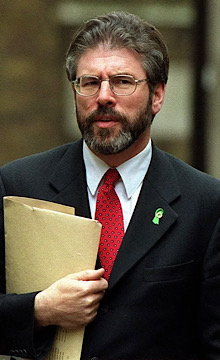
Adams tells reporters, “I don’t intend to spend the rest of my life trying to shore up a process that is going to be in perpetual crisis.” His words are taken as those of an exhausted and deeply frustrated politician, angry that the bulk of the blame for the impasse has been directed at him and his colleagues.
They also raise, in a very stark way, the question of what effect the suspension of the new political institutions will have on Sinn Féin. In the days leading up to Adams’s announcement, the efforts of London and Dublin are primarily directed at saving David Trimble‘s leadership of his party. Peter Mandelson, MP for Hartlepool, emphasises the importance of this in the House of Commons on February 8. To abandon Trimble at this time would be seen as a betrayal that would even further harden political attitudes in the broad unionist community.
This leads to both governments putting a degree of pressure on the republican movement, Sinn Féin as well as the Irish Republican Army (IRA), which is having entirely predictable and dangerous results. The old, familiar sense of beleaguered isolation, summed up in the party’s name, is reasserting itself. Adams has told the British government that he believes his position as Sinn Féin’s president will very quickly become untenable if the political institutions are suspended. The most common reaction to this news is, “Well, he would, wouldn’t he?” The inference is that Adams is firing a warning shot across the bows of both governments, that there are two parties to this dispute and both need to be protected.
There is deep pessimism among republicans about what will happen if the Executive is suspended for any length of time. The fear is that it will be extremely difficult, probably impossible, to put it together again. Over a period of weeks and months, confidence in the political process, already pretty fragile at grass roots level, will likely ebb even further. Adams, Martin McGuinness, Mitchel McLauglin and others closely identified with the move to a political strategy will be seen to have failed.
One Sinn Féin source, a staunch supporter of the peace process, says, “Already there’s a widespread suspicion that we’ve been suckered into this by the British government, helped by Dublin. The long-term aim has always been to destroy Sinn Féin politically. There’s no pressure on the loyalists to disarm because they don’t represent a political threat. If Adams is seen to have misjudged this, what else can he do but resign?”
Many dismiss this as the old republican paranoia coming once again into play. But it is important to understand how this crisis appears to very many people within Sinn Féin. It is not just a matter of a hundred or so IRA activists seeing the hand-over of weapons as a surrender. There has always been a profound suspicion of politics, not only within the IRA, but at many other levels. Politics has always failed to deliver the holy grail of a united Ireland.
Some of these people believe that Gerry Adams and Martin McGuinness are cynical opportunists who have sold out for the rewards of office. Many more see them as sincere, but mistaken, in their strategy. They genuinely believe that they have been seduced by the British government, probably with the active co-operation of Dublin, by the promise of political progress. Now they are in a position where Sinn Féin is carrying all the opprobrium for the breakdown.
If, as seems likely, it is necessary to hold an election for a new assembly, Sinn Féin will be greatly weakened. The party’s hopes of taking Dáil seats will also be diminished. As Sinn Féin is seen to lose ground, there will almost certainly be a drift back to violence, sporadic at first, but gathering momentum.
This conspiracy theory, and the bleak scenario it predicts probably sounds utterly fanciful to many, those who lay the blame for this threat to the peace process squarely on the IRA. Possibly the republican movement is simply preparing itself for a retreat to the political trenches, and putting forward reasons to justify this. But there is also a danger that such an interpretation of what has happened could gain much wider credibility in the nationalist community in Northern Ireland.
There is a profound sense of disappointment that the Executive is about to be suspended. It is quite striking how many professional interest groups – doctors, teachers, farmers – express their satisfaction with local politicians and a reluctance to go back to dealing with “remote, ignorant, arrogant” British ministers.
For nationalists there has been the added satisfaction of seeing their own elected representatives taking up posts in government and performing well. For the first time, many of them feel that they are equal citizens in Northern Ireland. Now, it seems, that could be put at risk, to save David Trimble’s “pretty valuable” skin.
If this does prove to be the case, sympathy will swing back to Sinn Féin. Within his own community, Adams is not seen as having betrayed the peace process. On the contrary, along with John Hume, he is seen as one of its main architects. If Adams had decided to resign the leadership of his party, or had been forced to do so, it would have been seen by many nationalists as proving that politics, within the context of Northern Ireland, cannot work.
(From: “What future if Adams walks away from peace efforts now?” by Mary Holland, The Irish Times, http://www.irishtimes.com, February 10, 2000)
With a report due on Monday, January 31, and widely expected to state that the IRA is not ready to disarm, the Northern Ireland peace process appears headed for a fresh crisis. The report by Canadian Gen. John de Chastelain, head of the province’s independent commission overseeing the handing in of weapons, is expected to confirm that no arms have been turned in.
The Ireland on Sunday newspaper says de Chastelain will tell the British and Irish governments that the IRA has put most of its weapons into secret, sealed dumps in the Republic of Ireland. Such disclosures put enormous pressure on Adams, the leader of the Irish republican political party, Sinn Féin.
The UUP, the province’s main Protestant political group, has already threatened to pull out of Northern Ireland‘s fledgling power-sharing government if the IRA does not start disarming.
The UUP calls a top-level party meeting for February 12. A negative report from the decommissioning body will heighten fears that UUP leader David Trimble will make good on his threat to resign as leader of the new government, effectively allowing his party to shut down the province’s first government in 25 years.
Of Adams’s role in the disarmament process, Trimble says, “He asked us to create the circumstances to help him … we did that … we took the risk and created the situation he asked us to create. “Now we hope he now is able to demonstrate his good faith by responding.”
Adams says, “I am concerned at what appears to be an attempt by unionists to hijack the entire process, put up unilateral demands, perhaps in the course of that, tear down the institutions that are only two months in being. I understand why unionists want decommissioning. It is just not within my grasp to deliver it on their terms, and neither is it my responsibility.”
Adams says he can give no assurances that the IRA will hand over its weapons by May 22, the date set by the 1998 Good Friday Agreement for the completion of disarmament, although he stresses he is committed to decommissioning. “No, I can’t and it isn’t up to me,” Adams tells BBC Television when asked if he can guarantee disarmament by May.
Political insiders hint that the report will not be published until Monday (January 31) afternoon, suggesting the highly sensitive document is still being worked on by de Chastelain.
Any unionist pullout from the home-rule government on February 12 will create a political vacuum. Britain may intervene before that to suspend the fledgling executive, in the hope that it can be resurrected quickly if progress eventually is made on disarmament. Sinn Féin warns that either course of action could lead to the IRA breaking off contact with de Chastelain and the ending of disarmament prospects.
Meanwhile, on the eve of the report, thousands of Roman Catholics mark an event and day that symbolizes the province’s past troubles — Bloody Sunday.
Waving Irish flags, some 5,000 protesters retrace the steps of a civil rights march in Londonderry in 1972 that ended in bloodshed when British troops fired on unarmed protesters and killed thirteen people, mostly teenagers. A fourteenth man died later from his wounds. Victims’ relatives and local children carry fourteen white crosses, photos of the dead and a banner that reads, “Bloody Sunday, the day innocence died.” The march passes the scene of the killings and ends in front of Londonderry’s city hall — a spot where the 1972 march was supposed to have finished.
Organizers issue a message to British Prime MinisterTony Blair that they want a forthcoming inquiry not to end in the same way as a probe held within months of the killings, which exonerated the British soldiers by suggesting that some of the victims had handled weapons that day. “Twenty-eight years on from Bloody Sunday, there is still no recognition of the role the British government played in the premeditated attack on unarmed demonstrators,” Barbara de Brun, a top IRA official, tells the crowd.
Relatives of those killed are upset that soldiers who took part in the shootings would be allowed to remain anonymous during the new probe. They are also concerned about a newspaper report that the army recently destroyed thirteen of the rifles used by the soldiers, complicating any ballistics tests at the inquiry.
“Once again, the political and military establishment are up to their old tricks. We won’t accept a public relations exercise,” Alana Burke, who was injured by an armored car during the Bloody Sunday march, tells the crowd.
(From: “Hopes dim for IRA disarmament, peace accord” by Nic Robertson and Reuters, CNN, cnn.com, January 30, 2000)
O’Connor is a well-known intellectual figure in contemporary Irish affairs and expresses strong opinions against censorship and the war on drugs. He contributes a regular poetry column to the Irish daily, the Evening Herald, also writes a column for the Sunday Mirror and a sporting column for TheSunday Times, as well as broadcasting on RTÉ.
O’Connor is also known for the autobiographical The Ulick O’Connor Diaries 1970-1981: A Cavalier Irishman (2001), which details his encounters with well-known Irish and international figures, ranging from political (Jack Lynch and Paddy Devlin) to the artistic (Christy Brown and Peter Sellers). It also documents the progress of the Northern Ireland peace process during the same time, and the progress of the Northern Ireland Assembly. Although he travels extensively, he lives in his parental home in Dublin’s Rathgar. He is a member of Aosdána.