seamus dubhghaill

Promoting Irish Culture and History from Little Rock, Arkansas, USA


Leave a comment

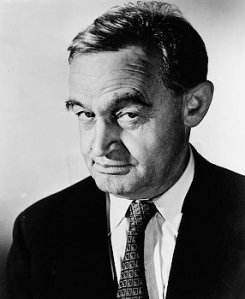
Death of Irish Actor Barry Fitzgerald

© Copyright 2010 CorbisCorporation

Barry Fitzgerald, Irish stage, film, and television actor, dies on January 14, 1961.

Fitzgerald is born William Joseph Shields in Walworth Road, Portobello, Dublin, Ireland, on March 10, 1888. He is the older brother of Irish actor Arthur Shields. He goes to Skerry’s College in Dublin before going on to work in the civil service while also working at the Abbey Theatre.

Unknown to many, Fitzgerald is also a patriot. In 1916 he is a member of the Irish Volunteers and is prepared to fight in the Easter Rising on Easter Sunday when the orders are countermanded. On Easter Monday the revolution is on again, and Shields goes to the Abbey Theatre and retrieves his rifle from under the stage. He goes around the corner to Liberty Hall and joins with James Connolly’s Irish Citizen Army.

He then marches to the General Post Office on Sackville Street where he fights before evacuating on Friday. He is sent to Stafford Prison in England with another famous rebel, Michael Collins, and from there they are both sent to the Frongoch internment camp in Wales. Both return to Dublin by the end of 1916, Collins to terrorise the British and Shields to return to the Abbey Theatre stage.

By 1929, he turns to acting full-time. He is briefly a roommate of famed playwright Sean O’Casey and stars in such plays as O’Casey’s Juno and the Paycock and the premiere of The Silver Tassie.

Fitzgerald goes to Hollywood to star in another O’Casey work, The Plough and the Stars (1936), directed by John Ford. He has a successful Hollywood career in such films as The Long Voyage Home (1940), How Green Was My Valley (1941), And Then There Were None (1945), The Naked City (1948), and The Quiet Man (1952). Fitzgerald achieves a feat unmatched in the history of the Academy Awards. He is nominated for both the Best Actor Oscar and the Best Supporting Actor Oscar for the same performance, as Father Fitzgibbon in Going My Way (1944). He wins the Best Supporting Actor Award. This feat will likely never be matched as the Academy Award rules have since been changed to prevent this. During World War II, Oscar statues are made of plaster rather than gold due to wartime metal shortages. Being an avid golfer, Fitzgerald later breaks the head off his Oscar statue while practicing his golf swing.

Fitzgerald has two stars on the Hollywood Walk of Fame, one for films located at 6220 Hollywood Blvd. and one for television located at 7001 Hollywood Blvd.

Fitzgerald returns to live in Dublin in 1959. He dies of heart failure on January 14, 1961, and is buried at Deansgrange Cemetery in Dublin.

Leave a comment

The Whiddy Island Disaster

betelgeuse

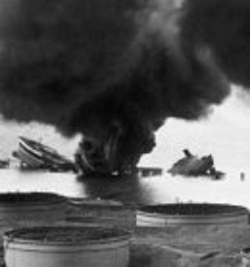
The Whiddy Island disaster, also known as the Betelgeuse incident, occurs on January 8, 1979, at around 1:00 AM, when the oil tanker Betelgeuse explodes in Bantry Bay in County Cork, at the offshore jetty for the oil terminal at Whiddy Island, while discharging its cargo of oil.

The explosion and resulting fire claim the lives of 50 people including 42 French nationals, 7 Irish nationals, and 1 United Kingdom national. Only 27 bodies are recovered. A further fatality occurs during the salvage operation with the loss of a Dutch diver.

On November 24, 1978, the Betelgeuse leaves Ras Tanura in the Persian Gulf bound for Leixões, Portugal, with a full cargo of crude oil. Originally the Betelgeuse is to call at Sines, Portugal, to lighten the load of the ship but poor weather conditions prevent the vessel from entering the harbour. Plans are further frustrated at Leixões as a ship has run aground across the harbour entrance preventing the Betelgeuse from berthing there to discharge her cargo. The Betelgeuse is then instructed to sail for Whiddy Island, Ireland.

The Betelgeuse first puts in at Vigo, Spain, to change some of her crew and then sails for Whiddy Island on December 30, 1978. During the passage the vessel encounters heavy weather in the Bay of Biscay and, after reporting a leakage of oil, is instructed to head towards Brest, France, at reduced speed. However, the origin of the leak is discovered and stopped. The vessel proceeds on its original planned course, arriving in Bantry Bay on January 4, 1979.

On the evening of January 6, 1979, the Betelgeuse has completed berthing at the offshore jetty in around 98 feet of water. At 11:30 PM the vessel commences discharging its 114,000 tonnes of mixed Arabian crude oil. This process is expected to take about 36 hours.

betelgeuse-memorial

At about 1:00 AM on Monday, January 8, a rumbling noise is heard from the vessel followed shortly by a huge explosion within its hull. The force of the explosion blows men from the jetty into the sea. Local residents report seeing the Betelgeuse engulfed in a ball of fire a few moments later. A series of further explosions follow, breaking the vessel in half. Much of the oil cargo still on board ignites. The concrete unloading jetty crumbles and firefighters, arriving on the scene from several neighbouring towns, are unable to get near the vessel. The firefighters concentrate their efforts on preventing the fire from spreading to the tanks of the storage farm and on containing the oil spillage.

About 12 hours after the explosion the Betelgeuse sinks at her moorings in 130 feet of water, which largely extinguishes the main body of the fire. In spite of this, rescue workers are not able to approach the wreck for two weeks due to clouds of toxic and inflammable gas surrounding it. After two weeks, it is possible to start recovering bodies from the wreck and pumping off the remainder of the oil cargo that is still on board.

A number of memorial services have been held to commemorate anniversaries of the incident. A memorial sculpture, incorporating the ship’s bell which was recovered from the wreck, has been erected in the hillside graveyard overlooking the harbor. The bodies of two unidentified casualties from the incident are interred nearby.


Leave a comment

Death of Phil Lynott

phil-lynott

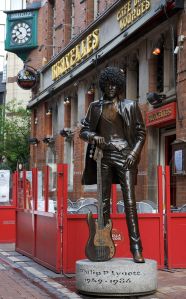
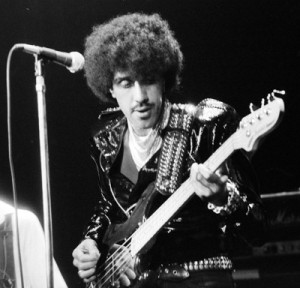
Philip Parris “Phil” Lynott, Irish musician, singer, songwriter, and a founding member, principal songwriter, lead vocalist, and bassist of Thin Lizzy, dies on January 4, 1986, in Salisbury, Wiltshire, England.

Born in West Bromwich, Staffordshire, England on August 20, 1949, Lynott goes to live with his grandmother, Sarah Lynott, in Crumlin, Dublin, when he is four years old. He is introduced to music through his uncle Timothy’s record collection and becomes influenced by Motown and The Mamas and the Papas.

Growing up in Dublin in the 1960s, Lynott fronts several bands as a lead vocalist, most notably teaming up with bassist Brendan ‘Brush’ Shiels to form Skid Row in early 1968. It is during this period that Lynott learns to play the bass guitar.

Toward the end of 1969, Lynott, now confident enough to play bass himself in a band, teams with Brian Downey, Eric Bell, and Eric Wrixon to form Thin Lizzy. The band’s first top ten hit comes in 1973 with a rock version of the well-known Irish traditional song “Whiskey in the Jar.” With the release of the Jailbreak album in 1976, Lynott and Thin Lizzy become international superstars on the strength of the album’s biggest hit, “The Boys Are Back in Town.” The song reaches the Top 10 in the United Kingdom, No. 1 in Ireland, and is a hit in the United States and Canada.

Having finally achieved mainstream success, Thin Lizzy embarks on several consecutive world tours. However, the band suffers from personnel changes. By the early 1980s, Thin Lizzy is starting to struggle commercially and Lynott starts showing symptoms of drug abuse, including regular asthma attacks. After the resignation of longtime manager Chris O’Donnell, Lynott decides to disband Thin Lizzy in 1983.

phil-lynott-statue

In 1984, Lynott forms a new band, Grand Slam, with Doish Nagle, Laurence Archer, Robbie Brennan, and Mark Stanway. The band tours various clubs but suffers from being labeled a poor version of Thin Lizzy due to the inclusion of two lead guitarists. Grand Slam disbands at the end of the year due to a lack of money and Lynott’s increasing addiction to heroin.

Lynott’s last years are dogged by drug and alcohol dependency leading to his collapse on December 25, 1985, at his home in Kew. He is taken to Salisbury Infirmary where he is diagnosed as suffering from septicemia. His condition worsens by the start of the new year, and he is put on a respirator. He dies of pneumonia and heart failure due to septicemia in the hospital’s intensive care unit on January 4, 1986, at the age of 36.

Lynott’s funeral is held at St. Elizabeth of Portugal Church, Richmond, London, on January 9, 1986, with most of Thin Lizzy’s ex-members in attendance, followed by a second service at Church of the Assumption, Howth, on January 11. He is buried in St. Fintan’s Cemetery, Sutton, Dublin.