seamus dubhghaill

Promoting Irish Culture and History from Little Rock, Arkansas, USA


Leave a comment

Sinking of the RMS Titanic

The RMS Titanic, four days into her maiden voyage from Southampton to New York City, sinks in the north Atlantic Ocean at 2:20 AM on the morning of April 15, 1912, after striking an iceberg just before midnight on April 14.

Titanic, the largest ship afloat at the time it enters service on April 2, 1912, is the second of three Olympic class ocean liners operated by the White Star Line, and is built by the Harland & Wolff shipyard in Belfast, Northern Ireland.

Titanic‘s maiden voyage, commanded by 62-year-old Captain Edward John Smith, begins shortly after noon on April 10, 1912 when she leaves Southampton on the first leg of her journey to New York City. A few hours later she reaches Cherbourg in France, where she takes on passengers. Her next port of call is Queenstown (now Cobh) in Ireland, which she reaches around midday on April 11. After taking on more passengers and stores, Titanic departs in the afternoon with an estimated 2,224 people on board.

Titanic receives six warnings of sea ice on April 14 but is traveling near her maximum speed when her lookouts sight the iceberg. Unable to turn quickly enough, the ship suffers a glancing blow that buckles her starboard side and opens five of her sixteen compartments to the sea. Titanic has been designed to stay afloat with four of her forward compartments flooded but not more, and the crew soon realises that the ship is going to sink. They use distress flares and wireless radio messages to attract help as the passengers are put into lifeboats. However, in accordance with existing practice, Titanic‘s lifeboat system is designed to ferry passengers to nearby rescue vessels, not to hold everyone on board simultaneously. With the ship sinking quickly and help still hours away, there is no safe refuge for many of the passengers and crew. Compounding this, poor management of the evacuation means many boats are launched before they are totally full.

At about 2:15 AM, Titanic‘s angle in the water begins to increase rapidly as water pours into previously unflooded parts of the ship through deck hatches. Her suddenly increasing angle causes a giant wave to wash along the ship from the forward end of the boat deck, sweeping many people into the sea. Titanic‘s stern lifts high into the air as the ship tilts down in the water, reaching an angle of 30–45 degrees. After another minute, the ship’s lights flicker once and then permanently go out, plunging Titanic into darkness. Shortly after the lights go out, the ship splits apart at one of the weakest points in the structure, the area of the engine room hatch. The submerged bow likely remains attached to the stern by the keel for a short time, pulling the stern to a high angle before separating and leaving the stern to float for a few minutes longer. The forward part of the stern floods very rapidly, causing it to tilt and then settle briefly before sinking.

Titanic sinks with over a thousand passengers and crew still on board. Almost all those who jump or fall into the water die from hypothermia within minutes. RMS Carpathia arrives on the scene about 90 minutes after the sinking and has rescued the last of the survivors by 9:15 AM on April 15, some nine and a half hours after the collision with the iceberg.

The death toll has been put at 1,513, including many Irish, although the number of casualties remains somewhat unclear due to a number of factors, including confusion over the passenger list, which includes some names of people who cancelled their trip at the last minute, and the fact that several passengers traveled under aliases for various reasons and were double-counted on the casualty lists.

The disaster causes widespread outrage over the lack of lifeboats, lax regulations, and the unequal treatment of the three passenger classes during the evacuation. Subsequent inquiries recommend sweeping changes to maritime regulations, leading to the establishment in 1914 of the International Convention for the Safety of Life at Sea (SOLAS), which still governs maritime safety today.


Leave a comment

RMS Titanic Arrives At Queenstown

The RMS Titanic arrives at Queenstown, known today as Cobh, in County Cork on April 11, 1912, at 11:30 AM. The ship, on her maiden and only voyage, anchors two miles offshore at Roches Point as the port cannot accommodate a ship of its size. Queenstown is the last port of call for RMS Titanic prior to her transatlantic crossing.

Tenders are necessary to ferry goods and passengers from ship to shore and vice versa. One hundred twenty-three passengers are waiting on the White Star Line pier to board the tenders Ireland and America. Of the 123 passengers, three are traveling first class, seven are traveling second class, and the remainder are traveling third class (steerage). Seven passengers disembark at Queenstown.

After the passengers board, the tenders proceed to the deep-water quay to load 1,395 sacks of mail as well as many emigrants. The two tenders travel out to the anchored RMS Titanic to offload the mail.

At 1:30 PM, with all passengers and mail now on board, RMS Titanic gives three mighty blasts of her whistles signaling she is now ready to depart. The anchors are raised, and the engines slowly turn over. The ship makes a graceful turn to starboard and heads back out into the Irish Sea destined for her next port of call, New York City, where she is scheduled to arrive early the following Wednesday morning.

Of the 123 passengers who embark at Queenstown, only 44 survive the disaster of the horrible night of April 15, 1912.

(Pictured: The RMS Titanic as she departs Queenstown, quite possibly the last photograph ever taken of the liner)


Leave a comment

The SS Aud Begins Gun-Running Voyage to Ireland

the-ss-aud

The German merchant steam ship SS Libau, also known as SS Castro and masquerading under the cover name of SS Aud, sets sail from the Baltic port of Lübeck on April 9, 1916, loaded with guns and ammunition for the Irish Republican Brotherhood (IRB) as part of the preparation for the Easter Rising.

Masquerading as SS Aud, an existing Norwegian vessel of similar appearance, SS Libau sets sail from the port of Lübeck, under the command of Karl Spindler, bound for the southwest coast of Ireland. Under Spindler is a crew of 22 men, all of whom are volunteers. SS Libau, laden with an estimated twenty thousand rifles, one million rounds of ammunition, ten machine guns, and explosives under a camouflage of a timber cargo, evade patrols of both the British 10th Cruiser Squadron and local Auxiliary patrols.

After surviving violent storms off Rockall, SS Libau arrives in Tralee Bay on April 20. There they are due to meet Roger Casement and others, with Casement having been landed nearby by the German submarine U-19. The SS Libau has no communications equipment aboard, giving them no means of contacting the Irish while en route. As a result, they are unaware that the date for its arrival off Fenit has been altered from Thursday, April 20 to Sunday, April 23.

One of the two cars carrying Volunteers who are supposed to meet SS Libau crash into the River Laune, many miles away, at Ballykissane pier, Killorglin, resulting in the death of three of the four occupants of the car. This leads to no hope of an organised transfer of arms and the gun-running plan nears an end.

SS Libau, attempting to escape the area, is trapped by a blockade of British ships. Captain Spindler allows himself to be escorted towards Cork Harbour, in the company of the Acacia-class sloop HMS Bluebell. The German crew then scuttles the ship. Spindler and his crew are interned for the duration of the war. Roger Casement and his companions are captured in an old ringfort or rath between Ardfert and Tralee.

A number of rifles are recovered from SS Libau before the vessel is scuttled. Several examples exist in various museums in Britain and Ireland. Among these are the Cork Public Museum in Fitzgerald’s Park in Cork, a museum in Lurgan County Armagh, the National Museum of Ireland in Dublin, and the Imperial War Museum in London.


Leave a comment

Birth of Edward J. Smith, Captain of the RMS Titanic

edward-john-smith

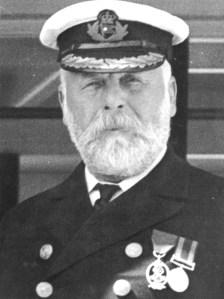
Edward John Smith, English naval reserve officer best known as the captain of the ill-fated RMS Titanic, is born on Well Street, Hanley, Staffordshire, England, on January 27, 1850.

Smith attends the Etruria British School until the age of 13, when he leaves school for a job at the Etruria Forge. In 1867, at the age of 17, he goes to Liverpool in the footsteps of his half-brother Joseph Hancock, a captain on a sailing ship. He begins his apprenticeship on Senator Weber, owned by A. Gibson & Co. of Liverpool.

Smith joins the White Star Line in March 1880 as Fourth Officer on the SS Celtic. He serves aboard the company’s liners to Australia and New York City, where he quickly rises in status. In 1887, shortly after his marriage to Sarah Eleanor Pennington, he receives his first White Star command on the SS Republic.

Beginning in 1895, Smith serves as captain of the SS Majestic for nine years. When the Second Boer War starts in 1899, Majestic is called upon to transport troops to Cape Colony. Smith makes two trips to South Africa, both without incident. From 1904 on, Smith commands the White Star Line’s newest ships on their maiden voyages, including RMS Baltic, RMS Adriatic, RMS Olympic, and RMS Titanic.

The RMS Titanic is built at the Harland & Wolff shipyard in Belfast. On April 10, 1912, Smith boards RMS Titanic at 7:00 AM to prepare for a noon departure. It’s final point of departure on the Atlantic crossing is Queenstown (now Cobh), County Cork, on April 11, 1912.

edward-john-smith-statue

The first four days of the voyage pass without incident, but shortly after 11:40 PM on April 14, Smith is informed by First Officer William McMaster Murdoch that the ship has just collided with an iceberg. It is soon apparent that the ship is seriously damaged with all of the first five watertight compartments having been breached. Smith, aware that there are not enough lifeboats for all of the passengers and crew, does everything in his power to prevent panic and assist in the evacuation. Just minutes before the ship sinks, Smith is still busy releasing Titanic‘s crew from their duties.

At 2:10 AM, Steward Edward Brown sees the captain approach with a megaphone in his hand. He is heard to say, “Well boys, do your best for the women and children, and look out for yourselves.” He then watches as Captain Smith walks onto the bridge alone. This is the last reliable sighting of Smith. Ten minutes later the ship disappears beneath the waves. His body is never recovered.

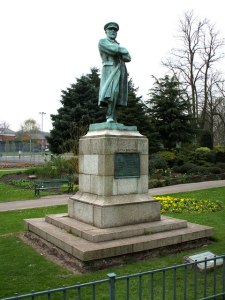
A statue, sculpted by Kathleen Scott, wife of Antarctic explorer Robert Falcon Scott, is unveiled in July 1914 at the western end of the Museum Gardens in Beacon Park, Lichfield. The pedestal is made from Cornish granite and the figure is bronze. Lichfield is chosen as the location for the monument because Smith was a Staffordshire man and Lichfield is the centre of the diocese.


Leave a comment

Sinking of the RMS Tayleur

rms-tayleurThe RMS Tayleur, a full rigged iron clipper ship, sinks on January 21, 1854 while on her maiden voyage. Many people know the fate of the RMS Titanic but history forgets that she is not the first ship of the White Star Line to sink on its maiden voyage.

With a length of 230 feet and a 40-foot beam, the Tayleur is launched in Warrington, England on the River Mersey on October 4, 1853. She is named after Charles Tayleur, founder of the Vulcan Engineering Works, Bank Quay, Warrington. The ship is chartered by White Star Line to serve the booming Australian trade routes, as transport to and from the colony is in high demand due to the discovery of gold.

On January 19, 1854 the Tayleur leaves Liverpool bound for Australia with a cargo of Irish and English immigrants totaling 652 passengers and crew. Because of a faulty compass, the crew, thinking they are sailing south, actually turn the ship to the west and head toward Ireland by mistake.

The Tayleur finds herself in a storm on January 21 and being blown towards Lambay Island off Dublin. Despite dropping both anchors as soon as the rocks are sighted, she runs aground on the east coast of the island, about five miles from Dublin Bay. Initially, attempts are made to lower the ship’s lifeboats, but when the first one is smashed on the rocks, launching further boats is deemed unsafe. Tayleur is so close to land that the crew is able to collapse a mast onto the shore, and some people aboard are able to jump onto land by clambering along the collapsed mast.

With the storm and high seas continuing, the ship is then washed into deeper water and sinks to the bottom with only the tops of her masts above the surface of the sea. Tragically, of the more than 650 aboard, only 290 survive. Hundreds of poor Irish immigrants die within sight of their native home.

The ship has been described as the “First Titanic” but is largely overlooked by history perhaps due to the lack of “prominent” members of society onboard the doomed vessel.

During the inquiry that follows the tragedy, it is determined that her crew of 71 has only 37 trained seamen amongst them, and of these, ten could not speak English. It is reported in newspaper accounts that many of the crew were seeking free passage to Australia. Most of the crew survive.


Leave a comment

Death of Shipbuilding Mogul John Roach

john-roach

John Roach, an American industrialist who rises from humble origins as an Irish immigrant laborer to found the largest and most productive shipbuilding empire in the postbellum United States, John Roach & Sons, dies in New York City on January 10, 1887.

Roach is born on December 25, 1815, at Mitchelstown, County Cork, Ireland, the first of seven children to Patrick Roche, a retail salesman, and his wife Abigail Meany. In 1832, at the age of sixteen, he emigrates together with his cousin to the United States. Arriving in New York City, he is at first unable to find regular work, but eventually gains secure employment at the Howell Works of James P. Allaire on the recommendation of a former employee of his father.

In 1852, after 20 years in the employment of Allaire, Roach and three partners purchase the Etna Iron Works, a small New York City ironworks which has fallen into receivership. Roach soon becomes sole proprietor, and during the American Civil War transforms the Etna Iron Works into a major manufacturer of marine engines. He continues to prosper after the war and in 1867 he purchases the Morgan Iron Works on New York’s East River and relocates his business there.

In 1871, Roach purchases the Reaney, Son & Archbold shipyard in Chester, Pennsylvania, which has fallen into receivership and renames it the Delaware River Iron Ship Building and Engine Works. This becomes his main facility. Over the next few years, he founds a network of new companies in Chester to support the shipyard’s operations. To give his sons a stake in the business, Roach founds the firm of John Roach & Sons, which becomes the overall parent and marketing company. He also attempts to create his own shipping line with the establishment of the United States and Brazil Mail Steamship Company, but this venture is a costly failure.

From 1871 until 1885, John Roach & Sons is easily the largest and most productive shipbuilding firm in the United States, building more tonnage of ships than its next two chief competitors combined. In the mid-1880s the firm runs into trouble when a series of U.S. Navy contracts become the subject of political controversy. Roach signed the contracts under a Republican administration, but when the Democratic administration of Grover Cleveland comes to power, it voids one of the contracts. Doubts over the validity of the remaining three contracts make it impossible for John Roach & Sons to obtain loans and, in 1885, the Roach shipbuilding empire is forced into receivership.

During the contract disputes, Roach falls ill with a chronic mouth infection which is diagnosed as cancer in 1886. Roach undergoes surgery in the spring of 1886, but it provides only temporary relief. He dies at the age of 71 on January 10, 1887, while his business is still in the hands of receivers. Roach’s eldest son, John Baker Roach, assumes control of the business which continues for another 20 years, although it never regains the pre-eminent position in American shipbuilding that it had enjoyed under Roach Sr.

During its existence between 1871 and 1907, the shipyard established by Roach builds 179 iron ships, 98 under Roach’s own management and an additional 81 under that of John Baker Roach.


Leave a comment

The Whiddy Island Disaster

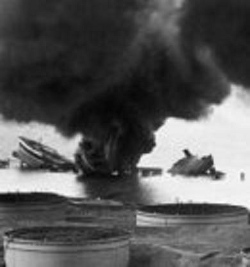
betelgeuseThe Whiddy Island disaster, also known as the Betelgeuse incident, occurs on January 8, 1979, at around 1:00 AM, when the oil tanker Betelgeuse explodes in West Cork, Ireland, at the offshore jetty of the Whiddy Island Oil Terminal while discharging its cargo of oil.

The explosion and resulting fire claim the lives of 50 people including 42 French nationals, 7 Irish nationals, and 1 United Kingdom national. Only 27 bodies are recovered. A further fatality occurs during the salvage operation with the loss of a Dutch diver.

On November 24, 1978, the Betelgeuse leaves Ras Tanura in the Persian Gulf bound for Leixões, Portugal, with a full cargo of crude oil. Originally the Betelgeuse is to call at Sines, Portugal to lighten the load of the ship but poor weather conditions prevent the vessel from entering the harbour. Plans are further frustrated at Leixões as a ship has run aground across the harbour entrance preventing the Betelgeuse from berthing there to discharge her cargo. The Betelgeuse is then instructed to sail for Whiddy Island, Ireland.

The Betelgeuse first puts in at Vigo, Spain to change some of her crew and then sails for Whiddy Island on December 30, 1978. During the passage the vessel encounters heavy weather in the Bay of Biscay and, after reporting a leakage of oil, is instructed to head towards Brest, France at reduced speed. However, the origin of the leak is discovered and stopped. The vessel proceeds on its original planned course, arriving in Bantry Bay on January 4, 1979.

On the evening of January 6, 1979, the Betelgeuse has completed berthing at the offshore jetty in around 98 feet of water. At 11:30 PM the vessel commences discharging its 114,000 tonnes of mixed Arabian crude oil. This process is expected to take about 36 hours.

At about 1:00 AM on Monday, January 8, a rumbling noise is heard from the vessel followed shortly by a huge explosion within its hull. The force of the explosion blows men from the jetty into the sea. Local residents report seeing the Betelgeuse engulfed in a ball of fire a few moments later. A series of further explosions follow, breaking the vessel in half. Much of the oil cargo still on board ignites. The concrete betelgeuse-memorialunloading jetty crumbles and firefighters, arriving on the scene from several neighbouring towns, are unable to get near the vessel. The firefighters concentrate their efforts on preventing the fire from spreading to the tanks of the storage farm and on containing the oil spillage.

About 12 hours after the explosion the Betelgeuse sinks at her moorings in 130 feet of water, which largely extinguishes the main body of the fire. In spite of this, rescue workers are not able to approach the wreck for two weeks due to clouds of toxic and inflammable gas surrounding it. After two weeks, it is possible to start recovering bodies from the wreck and pumping off the remainder of the oil cargo that is still on board.

A number of memorial services have been held to commemorate anniversaries of the incident. A memorial sculpture, incorporating the ship’s bell which was recovered from the wreck, has been erected in the hillside graveyard overlooking the harbor. The bodies of two unidentified casualties from the incident are interred nearby.