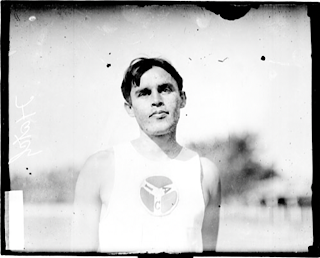
Hatch is also a well-known marathon runner. From 1904 through 1922 he runs more than 45 marathons with a score of victories including the Chicago Marathon in 1909 and the Yonkers Marathon in 1911, competing as a member of the Illinois State Gaelic Athletic Association (GAA). In 1910, he finishes in 5th place in the Yonkers Marathon, competing as a member of the Chicago Irish American Athletic Club.
Hatch never fails to finish a marathon. He is a six-time (1906, 1907, 1908, 1911, 1914, and 1915) winner of the Missouri Athletic Club‘s All Western Marathon in St. Louis including the 1908 marathon that qualifies him for the 1908 Summer Olympics in London. He competes in the marathon in two Olympics, placing 8th in 1904 at St. Louis and 14th in 1908 in London. He wins a silver medal in the 1904 Olympics Four-Mile team event.
On January 8, 1909, Hatch finishes third behind Matthew Maloney and James Crowley in an indoor marathon before 5,000 “wildly cheering” spectators held within the second Madison Square Garden with a time of 3:03:29.4. Maloney is reported to have set a new indoor record for the event (2:54:45.4).
On November 27, 1909, Hatch finishes sixth in the third edition of the Yonkers Marathon with a time of 3:00:24. In July of the same year, he wins a 100-mile race in Chicago, Illinois.
In March 1912, Hatch is one of “twenty of the best distance runners in the middle west” scheduled to participate in a 20-mile indoor marathon at Riverview Rink in Chicago. He also qualifies for the 1912 Summer Olympics but does not compete. He places in the top 10 in the Boston Marathon several times with a second-placed finish in 1917. He finishes third in the Boston Marathon in 1915 and 1916. In October 1916, he sets a record in the 96-mile Milwaukee to Chicago Run, completing the race in 14 hours, 50 minutes and 30 seconds.
Hatch serves as a U.S. Army messenger in World War I and is decorated for “extraordinary heroism” under fire near Brieulles, France, October 11, 1918. He is awarded the Purple Heart and Distinguished Service Cross as well as the French Croix de Guerre. After World War I, he returns to run two more Boston Marathons before retiring from marathon running. He is a letter carrier in River Forest, Illinois, from 1923 to 1953, retiring at age 70. He and Gertrude Morris are married in 1921 and have three children, Herbert, and twin girls June and Jane.
Hatch dies in Maywood, Illinois, on October 17, 1966. He is buried at the Chapel Hills Gardens West Cemetery, Oak Brook Terrace, Illinois.
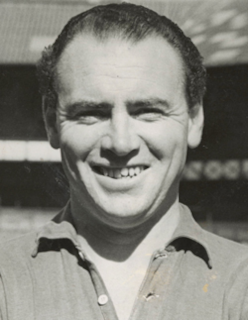
Farrell is born and raised in the Convent Road area of Dalkey and is educated at Harold Boy’s National School and the Christian Brothers in Dún Laoghaire, from which he wins a scholarship. He is playing football with Cabinteely Schoolboys when spotted by a Shamrock Rovers scout and subsequently joins Rovers on his 17th birthday in August 1939. Among his early teammates is the veteran Jimmy Dunne. With a team that also includes Jimmy Kelly, Tommy Eglington, Jimmy McAlinden and Paddy Coad, he later helps Rovers reach three successive FAI Cup finals. They win the competition in 1944 and 1945 and finish as runners up in 1946.
In July 1946, together with Tommy Eglington, Farrell signs for Everton. In eleven seasons with the club, he plays 421 league games and scores 14 goals. He also plays a further 31 games in the FA Cup and scores an additional four goals. In 1951 he is appointed Everton captain and during the 1953–54 season leads them to the runners up place in the Second Division, thus gaining promotion to the First Division. During his time with the club his teammates, apart from Eglington, also include Alex Stevenson, Peter Corr, Harry Catterick, Wally Fielding, Tommy E. Jones, Brian Labone and Dave Hickson. He is never sent off during his time at Goodison Park.
Farrell leaves Everton in October 1957 and follows Tommy Eglington to Tranmere Rovers where he becomes player-manager. He plays 114 league games for Tranmere, before leaving in December 1960. After a time as manager at Sligo Rovers, he becomes manager of Holyhead Town and, helped by a number of former Everton and Tranmere players, guides them to the Welsh Football League (North) title.
When Farrell begins his international career in 1946 there are, in effect, two Ireland teams, chosen by two rival associations. Both associations, the Northern Ireland–based IFA and the Ireland–based FAI claim jurisdiction over the whole of Ireland and select players from the entire island. As a result, several notable Irish players from this era, including Farrell, play for both teams.
Farrell makes 28 appearances and scores three goals for the FAI XI. While still at Shamrock Rovers, he captains the FAI XI on his international debut on June 16, 1946, against Portugal. On September 21, 1949, together with Johnny Carey and Con Martin, he is a member of the FAI XI that defeats England 2–0 at Goodison Park, becoming the first non-UK team to beat England at home. After Martin puts the FAI XI ahead with a penalty in the 33rd minute, Farrell makes victory certain in the 85th minute. Tommy O’Connor slips the ball to Farrell and as the English goalkeeper Bert Williams advances, he lofts the ball into the unguarded net. He scores his second goal for the FAI XI on October 9, 1949, a in 1–1 draw with Finland, a qualifier for the 1950 FIFA World Cup. His third goal comes on May 30, 1951, as Farrell scores the opening goal in a 3–2 win against Norway.
Farrell also makes seven appearances for the IFA XI between 1946 and 1949. On November 27, 1946, he makes his debut for the IFA XI in a 0–0 draw with Scotland. Together with Johnny Carey, Con Martin, Bill Gorman, Tommy Eglington, Alex Stevenson and Davy Walsh, he is one of seven players born in the Irish Free State to play for the IFA XI on that day. The draw helps the team finish as runners-up in the 1946-47 British Home Championship. He also helps the IFA XI gain some other respectable results, including a 2–0 win against Scotland on October 4, 1947, and a 2–2 draw with England at Goodison Park on November 5, 1947.
After returning to Ireland following his retirement, Farrell settles in Dublin and follows his father into the insurance business. He dies on March 16, 1999, following a long illness. He is buried in Dean’s Grange Cemetery in Deansgrange, Dún Laoghaire–Rathdown, County Dublin.
Mills is born in 31 South Square, Inchicore, Dublin, on October 8, 1923. Her mother, Winifred (née Wills), is from Inchicore and her father, Thomas, is from Glanmire, County Cork. Her father works for Great Southern Railways. She has three siblings, Gertrude, Ada and Robert. Her mother dies when she is just eighteen months old, leaving her to be raised by her maternal grandmother, Charlotte Wills, who lives at 1 Abercorn Terrace, Inchicore. She is educated at St. Vincent’s Industrial School, Goldenbridge, where she plays table tennis and association football as well as doing gymnastics. However, camogie is her first love, which she starts playing at age five. She leaves school at a young age, and goes to work in Lamb’s jam factory.
Through her father, Mills is able to participate in and avail of the sporting activities in the GSR Athletic Union. Two pence per week are deducted from the worker’s wages to go toward the financing of the sports activities in the Railway. In 1947, she marries George Hill. They run the Red Seal Handbag Company from the North Circular Road, and later Hill Street. Later they become vintners, running the Seventh Lock public house on the Grand Canal, Ballyfermot.
Mills makes her camogie debut with the Great SouthernRailways club in Dublin in 1938 at the age of fourteen, and is promoted to the senior team for her second match. Three years later she makes her debut for Dublin while still sixteen and plays in Dublin’s unsuccessful 1941 All-Ireland Senor Camogie Championship final against Cork, winning her first All-Ireland medal after a replay against Cork a year later in the 1942 All-Ireland Senior Camogie Championship final.
In 1943, the same counties meet in the All-Ireland final for the third consecutive year. Once again Mills ends up claiming an All-Ireland medal, her goal from fifty yards range being described as the highlight of the match. The following year, 1944, brings a third All-Ireland medal. In 1945 and 1946, a dispute in the camogie association keeps Dublin out of the All-Ireland championship in spite of being Leinster champions in both years. In 1948, Dublin is back on form and Mills captures a fourth All-Ireland medal. She takes no part in the 1949 championship, however, the 1950s brings much success to Mills.
From 1950 to 1955, Mills captures six consecutive All-Ireland titles. In 1956, “the Dubs” surrender their crown to Antrim but it is soon reclaimed in 1957. In 1958, she is appointed captain of the Dublin camogie team. Led by her, Dublin defeats Tipperary to capture yet another All-Ireland title. She captures three more All-Ireland medals in 1959, 1960 and 1961. The occasion of the 1961 final is special as it is her 38th birthday and her last outing in a Dublin jersey.
In her playing days Mills is regarded as one of the all-time greats. She is regarded as camogie’s first superstar she has often been described as the Christy Ring, Mick Mackey, Nicky Rackard and Lory Meagher of the camogie world. With a haul of fifteen senior All-Ireland medals, she is the most decorated player in the history of Gaelic games at the time of her retirement. Since then Rena Buckley and Briege Corkery have won more than Mills.
Mills-Hill dies on August 11, 1996, from undisclosed causes, at her home on the Naas Road, Dublin. She is buried in Palmerstown Cemetery. In 2010, the camogie trophy for the annual inter-county All-Ireland Junior Camogie Championship is named in her honour. The Kay Mills Cup is a replica of the O’Duffy Cup. A plaque to Mills is erected at her former home, 1 Abercorn Terrace, Inchicore.
Robbins advances to the finals in the 400 metres race at the 1908 Summer Olympics in London, winning his preliminary heat with a time of 50.4 seconds and his semifinal in 49.0 seconds. In the first running of the final race, he finishes in front. However, teammate John Carpenter is disqualified after being accused of obstructing British runner Wyndham Halswelle, and the race is ordered to be repeated without Carpenter. Robbins and fellow American John Taylor refuse to compete in the second final in protest of Carpenter’s disqualification. Halswelle runs the race alone and is presented with the Gold medal. This race is the only case of a walkover in Olympic history.
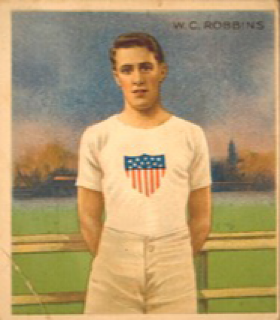
According to Robbins’ 1910 trading card, he is “one of the best quarter-milers in the United States. He was… (a) Cornell University student, and first came to prominence by the part he played in the 400-meter race held at London in 1908. ‘Yank,’ as he (was) called by his team mates, ran the first 300 yards at such a clip that it ‘pulled the great Halswell’s cork,’ the later finishing in third place. Robbins won the Metropolitan Amateur Athletic Union quarter-mile championship in September 1909, and two weeks later captured the Canadian quarter-mile title, running the distance in the great time of 48 4/5 seconds.”
At the Amateur Athletic Union metropolitan championships held at Travers Island in 1909, Robbins is part of the Irish American Athletic Club’s four-man relay team that breaks the world’s record for the one mile relay, with a time of 3 minutes 20 2/5 seconds. The other three men on the record-breaking team were C.S. Cassara, James Rosenberger, and Melvin Sheppard.
Robbins dies on July 30, 1962.
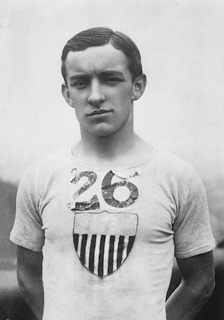
(Pictured: William C. Robbins, wearing the 1908 U.S. Olympic team shirt, from the 1910 Mecca Cigarettes Champion Athlete & Prize Fighter Series trading card)
Weld is educated at Newbridge College and University College Dublin (UCD), becoming a qualified veterinarian in 1970, at the time, the youngest qualified vet in Ireland. In 2016, he is awarded UCD Alumnus of the Year in Veterinary Medicine.
Weld starts his career as an amateur jockey, obtaining a training licence in 1972. He then takes over the stable at Rosewell House, in The Curragh, from his father, Charlie Weld, who is also a successful racehorse trainer. He goes on to win the Irish Flat Training Championship eight times in 1983, 1985, 1989, 1990, 1993, 1994, 1996 and 1998.
Weld sets a new record for the most winners trained in Ireland with 2,578 in August 2000, holding the record until Willie Mullins overtakes it in May 2024. During his training career, he saddles over 4,000 winners (to 2016).
John M. Oxx, retired Irish trainer of thoroughbred racehorses, is born on July 14, 1950. By the end of the 2009 season he had trained thirty-five Group One winners over his career, including the winners of eleven Classic races. He is best known as the trainer of Sinndar and Sea The Stars.
Oxx has been widely praised for the care and undemonstrative authority with which he approaches the training and racing of his horses. He is particularly known for being highly selective when choosing when and where his horses will run.
Oxx is the son of John Oxx Sr., who is himself a successful trainer, winning eight Irish classic races. In 1950, his father purchases Currabeg, at the southwestern end of the Curragh in County Kildare, where Oxx Jr. takes over training. He graduates from University College, Dublin, as a veterinary surgeon in 1973, and works as his father’s assistant before taking over the stable in 1979. In that year he has his first win and his first Group win with Orchestra.
The Aga Khan begins to support Oxx’s yard with a number of yearlings after Eurobird’s win in 1987. When he decides to withdraw his racehorses from England following Aliysa’s disqualification in the Epsom Oaks of 1989, he establishes a significant presence in Oxx’s yard. Without a budget of his own to spend on yearlings, Oxx continues to be reliant on horses bred by owners with whom he has an association. In some years, he concedes, “you wouldn’t have anything remotely near Group One standard.”
Many of Oxx’s major race wins have come from Aga Khan-owned horses, beginning with Manntari’s victory in the Vincent O’Brien National Stakes at the Curragh in 1993, and continuing with Timarida’s win in the Irish Champion Stakes at Leopardstown Racecourse in 1996, followed by Ebadiyla’s victory in the 1997 Irish Oaks. He also wins that race with Winona the following year. In 2000, he trains the Aga Khan’s brilliant Sinndar to wins in the Epsom Derby, the Irish Derby, and the Prix de l’Arc de Triomphe, making the colt the only horse ever to win that trio of races and at the time one of only three Irish-based horses to ever win the Arc.
Oxx comes to wider public attention when guiding Sea The Stars through a famous 2009 season in which he wins Group One races in England, Ireland and France, his six consecutive triumphs including the 2000 Guineas Stakes, the Epsom Derby and the Prix de l’Arc de Triomphe. He is typically understated when assessing the role of the trainer in the career of a great horse like Sea The Stars. “You can’t give them ability they don’t have,” he tells The Independent newspaper. “Really, it’s just a case of not messing it up – not to overtax the horse too soon, or ask it to do stupid things as a two-year-old. If you mind him sufficiently when he’s young, hopefully his ability will blossom.”
In an interview with The Observer, Oxx says of Sea The Stars: “I was always reading about racing and great horses of the past. So when you grow up with the history of racing and the history of breeding, the landmark horses that come along over a century, and more – to train one that’s in that league gives you the greatest satisfaction.”
Oxx serves as chairman of the Irish National Stud from 1985 to 1990. He is chairman of the Irish Racehorse Trainers’ Association from 1986 to 1991 and from 1993 to 1996. He serves on numerous other racing bodies and is chairman of the Racing Academy and Centre of Education. In 2008, he is given the Irish Racehorse Trainers’ Association Hall of Fame award.
Oxx marries Caitriona O’Sullivan in 1974. They have three children.
McDonald was born Patrick Joseph McDonnell in Killard, County Clare, on July 29, 1878. When his sister lands at Ellis Island after her sea voyage from Ireland, immigration officials pin a name tag on her with her name spelled “McDonald.” Taking no chances of being deported, she and all the McDonnells who come after her, accept the name McDonald.
McDonald competes for the United States in the 1912 Summer Olympics held in Stockholm, Sweden, in the shot put where he once again defeats Rose and wins the gold medal. He also takes part in the shot put competition where the distance thrown with each hand is added together. This is the only time this event is held in the Olympic program, and he finishes second behind Rose.
McDonald continues to be a nationally competitive athlete well into his 50s. At the age of 54, he beats his old rival Matt McGrath to win the weight throw for distance at the 1933 USA Outdoor Track and Field Championships. It is his 26th senior national championship meet, and the Omaha World-Herald notes that he has gray hair at the time of his last victory.
O’Reilly is one of six children of James P. O’Reilly, shopkeeper and musician, and Catherine O’Reilly (née Donegan). The family moves to Dublin when he is nine years old. He is educated at the Christian Brothers school in James’s Street, where he excels at Gaelic football and develops an interest in drama and music. Toward the end of his schooldays, he begins to participate in athletics, particularly the high jump, and is coached by Jack Sweeney, a leading athletics coach.
Always a man of many talents and interests, after leaving school O’Reilly combines working in the insurance business with an athletics career with Donore Harriers and evening drama classes. He wins several Irish titles, including the high jump, javelin, and decathlon, and sets a national record in the high jump. In 1954 he wins the British AAA Championships high jump title, beating the Commonwealth champion into second place, and setting a championship record of 6 ft. 5 in. (1.96 m). As a result, he secures a United States athletics scholarship to the University of Michigan, Ann Arbor, where he takes a degree in liberal arts, majoring in speech and drama. While at Michigan he improves his Irish record to 6 ft. 7 in. (2.007 m). His athletic career, however, is dogged with bad luck. He is selected to compete in the high jump at the European Athletics Championships in Bern, Switzerland, in 1954 but fractures an ankle in practice and fails to advance beyond the qualifying round. Although he competes at international level for ten years (1952–62), he is unlucky to never take part in the Olympic Games. A victim of sporting politics in 1952, as an NCAA athlete he is not entitled to compete. He is selected for the 1956 Summer Olympics in Melbourne but is unable to attend when, at the last minute, his club cannot provide the finance for him to attend. Earlier that year he wins the Big Ten Conference high jump title.
On leaving Michigan O’Reilly moves to New York City, where he embarks on an acting career with the Irish Players, but he returns to Dublin in 1959, where, after brief spells working as a teacher and for an advertising agency, he applies to Ireland’s new television station for a position. He is looking for an acting job but ends up being offered a position as a presenter, joining Teilifís Éireann in 1961 as an announcer/interviewer. His relaxed and unobtrusive style appeals to viewers and his light entertainment show, The Life of O’Reilly, is the most popular programme on Irish television in the day, eclipsing even a fledgling The Late Late Show. It is as a sports presenter and commentator, however, that O’Reilly is primarily remembered, as he becomes the face of sport on RTÉ Television for many years. He attends five Olympic Games as a broadcaster, from Mexico in 1968 to Los Angeles in 1984, commentating on athletics and gymnastics. The first presenter of RTÉ’s flagship Saturday afternoon sports programme Sports Stadium in 1984, he continues to present it over its fourteen-year life, co-presenting the final programme in December 1997. He also is the regular presenter of RTÉ’s Wimbledon Championships tennis coverage for many years, the sports results on news broadcasts on TV and radio, and Sunday Sport on RTÉ Radio, as well as commentating on individual sports such as ice-skating.
Although sports presenting is a natural progression for an athlete with his talents, O’Reilly’s real love is the arts. He continues to act, playing the part of Detective Inspector Michael Roarke in the classic children’s film Flight of the Doves (1971) with Ron Moody and Willie Rushton. He is also an accomplished singer and songwriter, and writes and performs his own one-man show, Across the Spectrum, comprising his own poems and songs in 1992. As well as a book of poems, The Great Explosion (1977), he releases a number of albums and tops the charts with his own song, “The Ballad of Michael Collins,” in 1981. He has a great admiration for Michael Collins, and this leads to his becoming the first non-political figure to give the oration at the annual Collins commemoration at Béal na Bláth, County Cork, in 1981. He also writes the song “Let the Nations Play” (1985), inspired by the boycotts of the Olympic games of 1980 and 1984, and the song is adopted as an anthem of the international Olympic movement.
Tall and slim in build, O’Relly is affable, modest, and self-deprecating in character. His relaxed style is no mere public affectation. He often exasperates colleagues by turning up just in time for broadcasts, and his ability to ad-lib is important in a live television environment. He once describes himself as “a champion high-jumper who could enunciate properly and keep my hair neatly combed” (The Irish Times, April 7, 2001). Despite the disappointments in his sporting career, he maintains that his other interests more than compensated. In relation to the Olympics he is quoted as saying, “If you asked me whether I’d have preferred to win a medal or have written the song, I’d honestly say I would have preferred to have written the song” (Longford Leader, April 6, 2001).
O’Reilly lives in Ranelagh, Dublin, and is married twice. He meets his first wife Linda Herbst (née Kuhl) in New York in the late 1950s. His second marriage is to Johanna Lowry. He has four children. After a lengthy illness, he dies on April 1, 2001, in St. Vincent’s Hospital, Fairview, Dublin. He is buried at Mount Venus cemetery, Rathfarnham.
(From: “O’Reilly, Brendan” by Jim Shanahan, Dictionary of Irish Biography, http://www.dib.ie, October 2009)
McParland holds a unique place in English football history as the first player in the game to score in and win both English major domestic knockout Finals. One of the finest headers and strikers of the ball of the past fifty years, he is regarded as one of the greatest players to represent both Aston Villa and Northern Ireland.
During his time with Aston Villa, McParland is influenced by Jimmy Hogan. He later wins the FA Cup in 1957, scoring twice in the final against Manchester United but also becoming involved in a controversial incident in which he shoulder-charges (at the time a legitimate form of challenge) the Manchester United keeper after only six minutes. This leaves United’s goalkeeper, Ray Wood, unconscious with a broken cheekbone. McParland’s two-goal haul is remembered fondly as an example of his all-round abilities as a player showcasing his diving header and volleying techniques.
McParland also wins the Second Division title in 1960 and the League Cup in 1961 while with Aston Villa. He is on the scoresheet for the second leg of the 1961 League Cup final, when Aston Villa overturns a 2–0 deficit against Rotherham United to win the second leg 3–0 at Villa Park, becoming the winners of the first Football League Cup.
Following Aston Villa, McParland joins local rivals Wolverhampton Wanderers for a brief period in 1962. Although he is only there for one season, he manages to score 10 goals in 21 games. The following season he moves on to Plymouth Argyle, his final English league club before hanging up his boots. In 1965, he is recruited to play for Toronto Inter-Roma FC of the Eastern Canada Professional Soccer League. He scores many memorable goals, especially one against the Hamilton Steelers to give his side the victory.
McParland represents Northern Ireland 34 times and scores twice in his debut against Wales in the 1953–54 season. He also stars for Northern Ireland in the 1958 FIFA World Cup in which he scores five goals and helps his team to the quarterfinals. France defeats Northern Ireland 4–0 in their quarterfinal match.
McParland holds the record for being the highest-scoring Northern Irish player in World Cup finals history.
In April 2015, the feature-length documentary Spirit of ’58 is screened as part of the Belfast Film Festival. It features McParland prominently alongside Billy Bingham, Billy Simpson, Jimmy McIlroy and Harry Gregg, the other surviving players at the time, as it tells the story of Northern Ireland’s journey throughout the 1950s under the managership of Peter Doherty, culminating in the 1958 World Cup.
McParland is the last surviving player from the 1957 FA Cup Final following the death of Bobby Charlton on October 21, 2023. Following the death of Billy Bingham on June 9, 2022, McParland is the last surviving member of the Northern Ireland squad from the 1958 World Cup campaign. He is one of the last surviving members of the 1958 FIFA World Cup.
Patrick “Paddy” Coad, Irish football player and manager, is born at 100 Lower Yellow Road in Waterford, County Waterford, on April 14, 1920. He plays as a forward for Waterford, Glenavon, Shamrock Rovers and Ireland. Although known, primarily, as a maker of goals, he scores 126 goals in the League of Ireland and a further 41 in the FAI Cup. In 1946–47, he is top goal scorer in the League of Ireland. As a player manager, he also guides Shamrock Rovers to three League of Ireland titles and two FAI Cups, before he returns to Waterford and guides them to their first league title in 1966. He is appointed manager of Limerick in September 1967.
Coad is educated at De La Salle College Waterford and first distinguishes himself as a sportsman playing hurling and table tennis, becoming a Munster champion at the latter sport. He also begins to play football with Corinthians, a local junior club based in the Lower Yellow Road area of Waterford. He is soon spotted by Waterford, making his League of Ireland debut in 1937 at the young age of seventeen. He then moves to the Northern Ireland Football League (NIFL) club Glenavon but returns to Waterford after the start of World War II. He is a member of the Waterford team that finishes as a runner up to Cork United in both the League of Ireland and the FAI Cup. Waterford could have won the league title, but their players refuse to turn up for a play-off game against Cork after a dispute over bonus payments.
Coad signs with Shamrock Rovers in 1942 and on February 8 makes his debut against Brideville in the FAI Cup. During his early seasons with the club, he plays alongside Peter Farrell, Tommy Eglington, Jimmy McAlinden and Tommy Breen. He also helps Rovers win the FAI Cup three times. In November 1949, after the untimely death of Jimmy Dunne, he reluctantly accepts the position of player manager. He brings in many young players, including Liam Tuohy, and the team becomes known as Coad’s Colts. The Colts win 19 trophies between 1954 and 1959. Under his guidance, Rovers win three League of Ireland titles and the FAI Cup twice. In 1957, they also make their debut in the European Cup. Despite losing 9–2 on aggregate to Manchester United, Coad at the age of 37, dominates the away game at Old Trafford. He makes two appearances in the European Cup. On May 2, 1955, he is rewarded with a benefit game against Chelsea F.C. with Rovers winning 3-2.
Coad returns home to manage the Blues in 1960. In the 1965–66 League of Ireland season Waterford wins the Championship for the first time. Coad reflects on his legacy: “To bring the first title to my native Waterford leaves everything else in the shade.”
Between 1946 and 1952, Coad also makes eleven appearances and scored three goals for Ireland. He makes his debut on September 30, 1946, in a 1–0 defeat to England. On March 2, 1947, he scores his first goal for Ireland in a 3–2 win against Spain. During this game he also sets up both of Ireland’s other goals for Davy Walsh. On May 22, 1949, he scores the only goal, a penalty, in a 1–0 win over Portugal. His third goal for Ireland comes on May 30, 1951, in 3–2 away win over Norway. Ireland is 2–0 down until Peter Farrell and Alf Ringstead level the score. Then in the 82nd minute Coad scores from 20 yards to win the game. He plays his last game for Ireland in a 6–0 away defeat against Spain on June 1, 1952.
After his professional playing career Coad works for twelve years as a commercial traveler for B. P. Ganley Ltd, a bacon and pork distributor in Waterford. He and his wife, Bud, have two daughters and a son. He is ill for six months prior to his death on March 8, 1992, at his daughter’s home in Waterford.
Coad’s brother, Seamus, plays for Waterford in the late 1960s and manages the team in the 1990s. Seamus’ sons Gary and Nigel Coad continue the family name by lining out for the Blues under their father before both going on to win many trophies locally. Amazingly, both Gary and Nigel become only the third set of second-generation brothers to play together for Waterford, following Paddy and Seamus, the Hales and Fitzgeralds. In 2012, Seamus’ grandson, Conor, becomes the latest Coad to play for Waterford United.
The Shamrock Rovers Player of the Year trophy is named after Paddy Coad.