
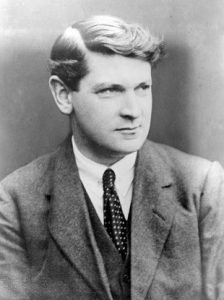
Michael Collins, soldier and politician who was a leading figure in the struggle for, and achievement of Irish independence in the early 20th century, is born near Clonakilty, County Cork, on October 16, 1890.
Michael Collins is born to a successful farmer, Michael John Collins, and Mary Anne O’Brien. When the couple marries, she is twenty-three years old, and he is sixty. The couple have eight children, with Michael being the youngest.
Raised in a beautiful but remote part of southwest Ireland, Collins is educated at local primary schools. At the Lisavair National School, Collins is inspired by his teacher, Denis Lyons, a member of a secret organization, the Irish Republican Brotherhood (IRB), whose aim is to gain Ireland’s independence from Great Britain. Collins is also influenced by the stories of local men who had taken part in the Irish Rebellion of 1798, a conflict that sparks a feud between the Irish Protestants and Catholics. From these stories Collins learns of Irish pride, rebellion, executions, and the general harsh treatment imposed on his country by the British.
In 1906 Collins goes to London to enter the civil service as a postal clerk. For ten years Collins lives in London, where he becomes active in various Irish organizations, including the Gaelic League, a society that promotes the use of the Irish language. Also, during this time, Collins is influenced by the writings of Arthur Griffith, an Irish nationalist who founded the Irish political party Sinn Féin. In 1909 Collins himself becomes a member of the IRB, and later becomes the IRB treasurer for the South of England.
Collins returns to Ireland in 1916 to take part in the Easter Rising, a rebellion against British rule. After the rebellion is crushed, Collins is interned in North Wales along with most of the other rebels from the IRB. When the internees are released in December 1916, he goes to Dublin, where his sharp intelligence and dynamic energy soon secure him a leadership position in the reviving revolutionary movement.
After their victory in the general election of December 1918, the revolutionaries establish an Irish parliament, Dáil Éireann, in January 1919. The Dáil officially announces an Irish Republic and sets up an executive to take over the government of the country. British attempts to crush the Republican movement are met with guerrilla warfare from the Irish Republican Army (IRA).
Collins plays the most important role in this struggle. As director of intelligence of the IRA, he cripples the British intelligence system in Ireland and replaces it with an effective Irish network. At the same time, he performs other important military functions, heads the IRB, and, as minister of finance in the Republican government, successfully raises and hands out large sums of money on behalf of the rebel cause. Despite constant efforts, the British are unable to capture Collins or stop his work. The “Big Fellow” becomes an idolized and near-legendary figure in Ireland, and he wins a reputation in Britain and abroad for ruthlessness, resourcefulness, and daring.
After the truce of July 1921, Collins reluctantly agrees to Irish president Éamon de Valera‘s request to serve on the peace-making talks headed by Arthur Griffith. During the autumn negotiations in London, the British government firmly rejects any settlement that involves recognition of the republic. Instead, its representatives offer Dominion status for Ireland with the right of exclusion for loyalist Northern Ireland. Collins decides to accept these terms, in the belief that rejection would mean renewal of the war and quick defeat for Ireland, and that the proposed treaty will soon lead to unity and complete freedom for his country. Using these arguments, he and Griffith persuade their side to sign the treaty on December 6, 1921, and Dáil Éireann to approve it on January 7, 1922.
De Valera and many Republicans refuse to accept the agreement, however, believing that it means a betrayal of the republic and a continued domination by Britain. As the British evacuate southern Ireland, Collins and Griffith do their best to maintain order and enforce the treaty signed with the British. They find their efforts frustrated by the opposition of an armed Republican minority. Collins seeks desperately to satisfy the forces that oppose the treaty without abandoning the treaty altogether, but he finds it impossible to make a workable compromise.
In late June 1922, after the population had supported the settlement in an election, Collins agrees to use force against the opposition. This action sparks a civil war, a bitter conflict in which the forces of the infant Irish Free State eventually overcome the extreme Republicans in May 1923. However, Collins does not live to see the end of the war. He is killed in an ambush in West Cork on August 22, 1922, just ten days after the death of Arthur Griffith.
Much of Collins’s success as a revolutionary leader is due mainly to his realism and extraordinary efficiency. He also possesses an amazing vision and humanity in his character, however, which appeals to friend and foe alike. The treaty that costs him his life does not end the argument, as he had hoped, but it does make possible the peaceful gaining of full political freedom for most of Ireland.

 seamus dubhghaill