seamus dubhghaill

Promoting Irish Culture and History from Little Rock, Arkansas, USA


Leave a comment

Death of Gordon Lambert, Businessman, Senator & Art Collector

Charles Gordon Lambert, Irish businessman, senator and art collector, dies in a Dublin hospital on January 27, 2005.

Lambert is born on April 9, 1919, in the family home at Highfield Road, Rathmines, Dublin, the youngest of four sons of Robert James Hamilton Lambert, a veterinarian and renowned cricketer, and his wife Nora (née Mitchell). His eldest brother, Noel Hamilton “Ham” Lambert, is a versatile sportsman and noted veterinary practitioner.

Lambert is educated at Sandford Park School, Dublin, and at Rossall School, Lancashire. He is steered by his mother toward a career in accountancy for which he prepares by studying commerce at Trinity College Dublin (TCD). Graduating in 1940, he joins the accounting firm Stokes Brothers and Pim, qualifying Associate Chartered Accountant in 1943. In 1944, after auditing biscuit manufacturers W. & R. Jacob and Co. Ltd, one of Ireland’s largest and most prestigious industrial companies, he is offered and accepts a £300 a year job at Jacob’s as assistant accountant.

In 1953, Lambert becomes Jacob’s chief accountant as the management grooms him for an executive career. During 1948–56, Jacob’s suffers from profit and price controls, lack of capital investment and complacency brought about by the absence of competition. The entry of Boland’s Bakery into the Irish biscuit market in 1957 is exploited by Lambert who urges the alarmed board, which has long regarded advertising as vulgar, to market its products more vigorously. This assertiveness yields his advancement to the position of commercial manager in 1958. A year later he becomes the first non-member of the Bewley and Jacob families to be appointed to the board.

Between 1959 and 1970, biscuit consumption in Ireland doubles for which Lambert can claim much credit. Recognising that the advent of self-service stores means that manufacturers can no longer rely on retailers to sell their products, he pioneers advanced promotional techniques in Ireland, particularly the use of marketing surveys and of mass advertising in newspapers, on radio and on the emerging medium of television. To further accord with retailers’ preferences, Jacob’s drives the widespread packaging of biscuits in airtight packets rather than tins and also introduces a striking red flash logo for its packets. His interest in contemporary art enables him to contribute directly to Jacob’s packaging designs.

Lambert is appointed to the board of the Electricity Supply Board (ESB) in 1964, a position he holds until 1977, and serves as president of the National Agricultural and Industrial Development Association (NAIDA) in 1964–65, spearheading a “Buy Irish” campaign. His involvement with NAIDA dates to the mid-1950s and leads to his friendship with Jack Lynch, Minister for Industry and Commerce. This relationship and his admiration for Seán Lemass incline him toward Fianna Fáil. He also believes the party is the one most likely to deliver economic growth.

In 1977, Lambert is appointed to Seanad Éireann by Taoiseach Jack Lynch. He sits as an independent but assures Lynch he will broadly support the government. Dismayed by Ireland’s economic uncompetitiveness, he uses this platform to bemoan the state’s financial profligacy and failure to control inflation, and the indifference of Irish politicians towards the business community, contending that Irish industrialists suffer and need to learn from the expert lobbying of the indigenous agricultural sector and of large multi-national companies based in Ireland. He also articulates his social liberalism, desire for peaceful reconciliation in Northern Ireland and support for cultural and environmental causes. But his commitment to the Seanad wanes as he grasps its irrelevance. When Lynch resigns in December 1979, Lambert joins the Fianna Fáil party in a futile bid to preserve his political influence.

Following Jacob’s takeover of Boland’s Bakery in 1966, Lambert becomes joint managing director of a new entity, Irish Biscuits Ltd, the manufacturing and trading company for the Boland’s and Jacob’s biscuits operations. W. & R. Jacob and Co. Ltd becomes a holding company. In 1968, he becomes the sole managing director. From 1977 he begins withdrawing from the active administration of the company, relinquishing his managing directorship in 1979 to become chairman.

Initially, Lambert views art as a hobby but he comes to see it as a calling, drawing inspiration from Sir William Basil Goulding, his predecessor as Ireland’s leading collector and advocate of modern art. From the late 1970s he serves as head of the Contemporary Irish Art Society (CIAS) and on the Arts Council of Northern Ireland, the advisory committee of the Dublin Municipal Gallery, the board of the National Gallery of Ireland, the editorial board of the Irish Arts Review and the international council of the Museum of Modern Art (MoMA) in New York City.

The Irish Museum of Modern Art (IMMA) opens in 1991 and receives through the medium of the Gordon Lambert Trust some 212 works, which form the centerpiece of its collection. Thereafter Lambert gifts another 100 works to IMMA. He sits on IMMA’s board from 1991, and the west wing of the museum is named after him in 1999.

Despite being diagnosed with Parkinson’s disease in 1988, Lambert remains relatively active and plays golf into his 80s. In 1999 he receives an honorary LLD from TCD. From 1997, he relies increasingly on Anthony Lyons, an acquaintance of longstanding, to care for him. His last years are overshadowed by the collapse in autumn 2002 of his close but complex relationship with his family. Thereafter he shuns his relations and changes his will, granting Lyons a substantial portion of his estate while curtailing the amount to be received by his family. He dies in a Dublin hospital on January 27, 2005. Relatives challenge his final will in the High Court in 2009, but it is upheld.

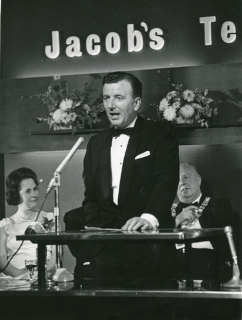
(Pictured: Photograph of director of Jacob’s Biscuits, Gordon Lambert, speaking from a podium at the first Jacob’s Television Awards. The Lord Mayor of Dublin, James O’Keefe, is sitting behind Lambert. The awards ceremony takes place at the Bishop Street factory, Dublin.)

Leave a comment

Death of Sculptor Conor Fallon

Irish sculptor Conor Hubert Fallon dies of lung cancer at the Blackrock Clinic, County Dublin, on October 3, 2007.

Fallon is born at Holles Street Hospital, Dublin, on January 30, 1939, the third of six sons of Padraic Fallon, the Irish poet and playwright, and Dorothea Maher. The family moves to Clonard, County Wexford, where he grows up. He has three surviving brothers, Brian, Ivan and Padraic, who have all had journalism careers. His early interest in literature and the arts is nourished by his father and elder brothers, and by contact with the cultured circle of writers, artists, musicians and intellectuals within which his father moves.

Fallon is educated at St. Peter’s College, Wexford, and Trinity College, Dublin. He begins painting in 1957 while at Trinity College, where he is studying natural science but is advised to pay more attention to his art. His interest in painting is probably inspired by the example of Tony O’Malley, a close family friend. As a compromise with his father, who does not see his talent, he also studies accountancy at night.

Largely self-taught in painting, he learns fundamentals of technique from Richard Kingston, to whom he is introduced by O’Malley. He largely paints landscapes in acrylic and gouache, in a manner heavily influenced by that of Jack Butler Yeats.

In 1964, Fallon visits O’Malley in St. Ives, Cornwall, where he had emigrated several years earlier, intending also to meet the Cornish abstract landscape painter Peter Lanyon, the chief creative force in the thriving artists’ colony centred on St. Ives. His arrival, however, coincides with Lanyon’s death from injuries suffered in a gliding accident. A gently sympathetic stranger amid the bereaved artistic community, he finds an immediate empathy and rapport with Nancy Wynne-Jones, a Welsh-born painter sixteen years his senior who had studied under Lanyon. They marry in 1966. They adopt two children in 1970, siblings John and Bridget.

Encouraged to take up sculpture, English sculptor Denis Mitchell becomes Fallon’s mentor in Cornwall, and with Breon O’Casey, he develops his sculpting. He becomes notable for his cast steel and bronze work, especially birds, horses and hares. He has his first solo exhibition in Newlyn in 1972, showing both painting and sculpture.

In May 1972, Fallon moves with his family back to Ireland, settling at Scilly House, on a hillside overlooking the harbour at Kinsale, County Cork. Removed from any centre of artistic activity, he devotes himself fulltime to a solitary development of his sculpture, refining his methodology and technique, and his skills in working various metals, beginning in 1974 to work in steel. In 1975, he first exhibits in Ireland at a solo show at the Emmet Gallery, Dublin, again showing both painting and sculpture, including his first steel sculptures to be exhibited.

Beginning in 1983, Fallon exhibits regularly with the Taylor Galleries, Dublin. Desiring closer proximity to Dublin art activities, and with their children attending university in the city, Fallon and his wife move in 1987 to Ballard House, Ballinaclash, Rathdrum, County Wicklow.

In 1980, Fallon is awarded the Oireachtas gold medal for sculpture. He becomes an honorary associate of the National College of Art and Design in 1993. He is secretary of the Royal Hibernian Academy, becoming a full member in 1989, and on the board of the National Gallery of Ireland. He is also elected to Aosdána in 1984.

In the summer of 2007, some six months after his wife’s death, Fallon wis diagnosed with advanced metastatic lung cancer. He dies on October 3, 2007, at the Blackrock Clinic, County Dublin, and is buried beside his wife in Ballinatone churchyard, Greenan, Rathdrum, County Wicklow.


Leave a comment

Birth of Clare Daly, Politician & Member of the European Parliament

Clare Daly, Irish politician who has been a Member of the European Parliament (MEP) from Ireland for the Dublin constituency since July 2019, is born in Newbridge, County Kildare, on April 16, 1968. She is a member of Independents 4 Change, part of The Left in the European Parliament – GUE/NGL.

Daly’s father, Kevin Daly, was a colonel in the Irish Army, where he was Director of Signals. She is an atheist, while her brother and an uncle are Catholic priests. She studies accountancy at Dublin City University (DCU). She is twice elected president of the DCU Students’ Union and is active in the students’ movement as a campaigner for abortion rights and information. On leaving college she takes a job in the catering section of Aer Lingus on a low wage and becomes SIPTU‘s shop steward at Dublin Airport when the airline is engaged in extensive cost-cutting and outsourcing.

In the 1980s Daly is a member of the Labour Party as a teenager. A member of Labour’s Militant Tendency, she is expelled alongside Joe Higgins and other members after being accused of being Trotskyists infiltrating the party using the tactic of entryism. At first calling themselves Militant Labour, in 1996 they form the Socialist Party. In the 1999 Irish local elections she is elected as a Fingal County Councillor for the Swords area, a position she holds for 12 years. She is elected as a Socialist Party TD for the Dublin North constituency at the 2011 Irish general election.

Since 2012, Daly has formed a close political association with Mick Wallace. After Wallace is condemned by left-wing TDs following the revelation his building company had avoided €2.1 million in taxes, she resigns from the Socialist Party in August 2012 in protest and redesignates herself as a United Left Alliance TD, before switching party again in 2015 to her current party, Independents 4 Change.

At the 2019 European Parliament elections, Daly is elected for the Dublin constituency. Since becoming an MEP, she has gained international attention for her foreign policy views, particularly regarding Russia and China, which have been the subject of controversy and criticism.

A report by The Irish Times in April 2022 describes Daly and Wallace’s media profile in China, and discusses how since January 2021, Daly has been featured in more Chinese-language news articles than any other Irish person, while Wallace has the second most Chinese-language news articles. In April 2022, Daly and Wallace initiate defamation proceedings against RTÉ.

On September 15, 2022, Daly is one of sixteen MEPs who vote against condemning President Daniel Ortega of Nicaragua for human rights violations, in particular the arrest of Bishop Rolando José Álvarez Lagos.


Leave a comment

Birth of Gordon Lambert, Businessman, Senator & Art Collector

Charles Gordon Lambert, Irish businessman, senator and art collector, is born on April 9, 1919, in the family home at Highfield Road, Rathmines, Dublin, the youngest of four sons of Robert James Hamilton Lambert, a veterinarian and renowned cricketer, and his wife Nora (née Mitchell). His eldest brother, Noel Hamilton “Ham” Lambert, is a versatile sportsman and noted veterinary practitioner.

Lambert is educated at Sandford Park School, Dublin, and at Rossall School, Lancashire. He is steered by his mother toward a career in accountancy for which he prepares by studying commerce at Trinity College Dublin (TCD). Graduating in 1940, he joins the accounting firm Stokes Brothers and Pim, qualifying Associate Chartered Accountant in 1943. In 1944, after auditing biscuit manufacturers W. & R. Jacob and Co. Ltd, one of Ireland’s largest and most prestigious industrial companies, he is offered and accepts a £300 a year job at Jacob’s as assistant accountant.

In 1953, Lambert becomes Jacob’s chief accountant as the management grooms him for an executive career. During 1948–56, Jacob’s suffers from profit and price controls, lack of capital investment and complacency brought about by the absence of competition. The entry of Boland’s Bakery into the Irish biscuit market in 1957 is exploited by Lambert who urges the alarmed board, which has long regarded advertising as vulgar, to market its products more vigorously. This assertiveness yields his advancement to the position of commercial manager in 1958. A year later he becomes the first non-member of the Bewley and Jacob families to be appointed to the board.

Between 1959 and 1970, biscuit consumption in Ireland doubles for which Lambert can claim much credit. Recognising that the advent of self-service stores means that manufacturers can no longer rely on retailers to sell their products, he pioneers advanced promotional techniques in Ireland, particularly the use of marketing surveys and of mass advertising in newspapers, on radio and on the emerging medium of television. To further accord with retailers’ preferences, Jacob’s drives the widespread packaging of biscuits in airtight packets rather than tins, and also introduces a striking red flash logo for its packets. His interest in contemporary art enables him to contribute directly to Jacob’s packaging designs.

Lambert is appointed to the board of the Electricity Supply Board (ESB) in 1964, a position he holds until 1977, and serves as president of the National Agricultural and Industrial Development Association (NAIDA) in 1964–65, spearheading a “Buy Irish” campaign. His involvement with NAIDA dates to the mid-1950s and leads to his friendship with Jack Lynch, Minister for Industry and Commerce. This relationship and his admiration for Seán Lemass incline him toward Fianna Fáil. He also believes the party is the one most likely to deliver economic growth.

In 1977, Lambert is appointed to Seanad Éireann by Taoiseach Jack Lynch. He sits as an independent but assures Lynch he will broadly support the government. Dismayed by Ireland’s economic uncompetitiveness, he uses this platform to bemoan the state’s financial profligacy and failure to control inflation, and the indifference of Irish politicians towards the business community, contending that Irish industrialists suffer and need to learn from the expert lobbying of the indigenous agricultural sector and of large multi-national companies based in Ireland. He also articulates his social liberalism, desire for peaceful reconciliation in Northern Ireland and support for cultural and environmental causes. But his commitment to the Seanad wanes as he grasps its irrelevance. When Lynch resigns in December 1979, Lambert joins the Fianna Fáil party in a futile bid to preserve his political influence.

Following Jacob’s takeover of Boland’s Bakery in 1966, Lambert becomes joint managing director of a new entity, Irish Biscuits Ltd, the manufacturing and trading company for the Boland’s and Jacob’s biscuits operations. W. & R. Jacob and Co. Ltd becomes a holding company. In 1968, he becomes the sole managing director. From 1977 he begins withdrawing from the active administration of the company, relinquishing his managing directorship in 1979 to become chairman.

Initially, Lambert views art as a hobby but he comes to see it as a calling, drawing inspiration from Sir William Basil Goulding, his predecessor as Ireland’s leading collector and advocate of modern art. From the late 1970s he serves as head of the Contemporary Irish Art Society (CIAS) and on the Arts Council of Northern Ireland, the advisory committee of the Dublin Municipal Gallery, the board of the National Gallery of Ireland, the editorial board of the Irish Arts Review and the international council of the Museum of Modern Art (MoMA) in New York City.

The Irish Museum of Modern Art (IMMA) opens in 1991 and receives through the medium of the Gordon Lambert Trust some 212 works, which form the centerpiece of its collection. Thereafter Lambert gifts another 100 works to IMMA. He sits on IMMA’s board from 1991, and the west wing of the museum is named after him in 1999.

Despite being diagnosed with Parkinson’s disease in 1988, Lambert remains relatively active and plays golf into his 80s. In 1999 he receives an honorary LLD from TCD. From 1997, he relies increasingly on Anthony Lyons, an acquaintance of longstanding, to care for him. His last years are overshadowed by the collapse in autumn 2002 of his close but complex relationship with his family. Thereafter he shuns his relations and changes his will, granting Lyons a substantial portion of his estate while curtailing the amount to be received by his family. He dies in a Dublin hospital on January 27, 2005. Relatives challenge his final will in the High Court in 2009 but it is upheld.

(Pictured: Photograph of director of Jacob’s Biscuits, Gordon Lambert, speaking from a podium at the first Jacob’s Television Awards. The Lord Mayor of Dublin, James O’Keefe, is sitting behind Lambert. The awards ceremony takes place at the Bishop Street factory, Dublin.)