Since December 1922 Ireland, apart from the six counties in the north, has been the Irish Free State, a British Dominion established by the Anglo-Irish Treaty of 1922. The partition leads to the civil war in Ireland that carries on into 1923, with Éamon de Valera leading the Irish Republican Army who are vehemently against the division of their country.
By 1927, however, de Valera has been brought into government and becomes Prime Minister in 1932, changing the name of the country to Éire in 1937, a symbol of its identity as separate from Britain.
In accordance with the terms of a 1938 treaty between the two states, British naval forces close their bases in southern Ireland and the Irish make a settlement of loans provided previously by the British. The two countries continue to drift apart. This separation is underlined further by Eire’s decision to remain neutral during World War II.
In February 1948, John Costello, the head of a six party coalition, ousts Fianna Fail and de Valera from power. By November of that year The Republic of Ireland Act is passed in the Dail, formally ending all Irish allegiance to Britain and its Commonwealth. The Oireachtas gathers to sign The Republic of Ireland Act on December 21, 1948, and it comes into force four months later on Easter Monday, April 18, 1949. The Act ends Ireland’s membership in the British Commonwealth of Nations and the existing basis upon which Ireland and its citizens are treated in the United Kingdom and other Commonwealth countries as “British subjects” rather than foreigners.
The Act, which has five concise sections, grants executive authority of Ireland, and its external relations, to the President of Ireland. The President will act under the advice of Government of Ireland, which will act alone without British influence. The Act is still largely in force but has been amended.
Britain accepts the Republic’s independence, but they enact the Ireland Act of 1949 which holds that citizens of the Republic will not be treated as aliens under British nationality law. They also guarantee to support Northern Ireland until the Northern Irish parliament decides they want a split.
About 200 Anti-Treaty Irish Republican Army militants led by Rory O’Connor occupy the Four Courts in the centre of Dublin on April 14, 1922 in defiance of the Provisional Government. They intend to provoke the British troops, who are still in the country, to attack them, which they believe will restart the war with Britain and re-unite the Irish Republican Army against their common enemy. They also occupy other smaller buildings regarded as being associated with the former British administration, such as the Ballast Office and the Freemasons’ Hall in Molesworth Street, but the Four Courts remains the focus of interest. On June 15, O’Connor sends out men to collect the rifles that belong to the mutineers of the Civic Guards.
Winston Churchill and the Cabinet of the United Kingdom apply pressure on the Provisional Government to dislodge the rebels in Four Courts, considering their presence there as a violation of the Anglo-Irish Treaty. Michael Collins, President of the Provisional Government Cabinet, tries desperately to persuade O’Connor and his men to leave the building over the next three months. At the Third IRA Convention, the executive is split over whether the Irish Government should demand that all British troops leave within 72 hours. The motion is defeated, but the IRA splits into two factions opposed to the government, one conciliatory, led by Liam Lynch, Sean Moylan, and Liam Deasy, and the other less moderate, led by Tom Barry and Joe McKelvey.
During the month of June 1922, the Provisional Government engages in intense negotiations with the British Cabinet, seeking to diffuse the threat of imminent civil war. However, the conservative British Cabinet refuses to cooperate.
On June 22, 1922, arch-Unionist Sir Henry Wilson is assassinated by two IRA men, both former British soldiers, Reginald Dunne and Joseph O’Sullivan. It is considered by some that this is done on the orders of Michael Collins, who has been a close friend of Dunne in the London Irish Republican Brotherhood. David Lloyd George writes an angry letter to Collins which includes the line “…still less can Mr. Rory O’Connor be permitted to remain his followers and his arsenal in open rebellion in the heart of Dublin… organizing and sending out from this centre enterprises of murder not only in the area of your Government…”
On June 28, 1922, after the Four Courts garrison has kidnapped J.J. “Ginger” O’Connell, a general in the new Free State Army, Collins begins shelling the Four Courts with borrowed British artillery. O’Connor and 130 men surrender on July 3 and are arrested and imprisoned at Mountjoy Prison. This incident sparks the Irish Civil War as fighting breaks out around the country between pro and anti-treaty factions.
The Declaration of Independence asserts that the Dáil is the parliament of a sovereign state called the “Irish Republic,” and so the Dáil establishes a cabinet called the Ministry or “Aireacht,” and an elected prime minister known both as the “Príomh Aire” and the “President of Dáil Éireann.”
When the First Dáil meets in the Round Room of the Mansion House in Dublin on January 21, 1919, de Valera is the president of Sinn Féin and thus the natural choice for leadership. However, he is imprisoned in England so, at the second meeting of the Dáil on January 22, Cathal Brugha is elected as the first Príomh Aire on a temporary basis. De Valera escapes Lincoln Gaol in February and is then elected to replace Brugha at the Dáil’s third meeting.
As leader, de Valera visits the United States from June 1919 to December 1920. His aim is to gain both popular and official recognition for the Republic and to obtain a loan to finance Dáil Éireann and the War of Independence. By the time of his return, de Valera has won public but not official support for the Republic and has raised a loan of $6 million.
After the election of the Second Dáil in 1921, de Valera resigns on August 26 and is immediately re-elected under the new title of President of the Republic. He then remains in office until January 1922 when, against his wishes, the Dáil votes to ratify the Anglo-Irish Treaty. De Valera resigns and submits his name for re-election but is rejected by the house, which instead elects Arthur Griffith, who supports the Treaty, by a vote of 60-58.
On January 16, 1922, the British government implements the Treaty and appoints a new Irish administration called the Provisional Government. The Dáil decides that the new administration will operate in parallel with the existing institutions of the Irish Republic, which the British do not recognise. Therefore, as the Irish Civil War begins the country has two leaders, Arthur Griffith as President of Dáil Éireann and Michael Collins as Chairman of the Provisional Government. Collins is also Minister for Finance in Griffith’s cabinet. This anomalous situation continues until Griffith and Collins both died suddenly in August 1922, Collins being assassinated by anti-Treaty irregulars and Griffith dying of natural causes. W.T. Cosgrave becomes Chairman of the Provisional Government on August 25 and, when he is also elected as President of Dáil Éireann in September, the two administrations are merged.
On December 6, both the Irish Republic and the Provisional Government come to an end as the new Constitution of the Irish Free State comes into force. The new Irish Free State has three leaders, the King as head of state, the Governor-General as the King’s representative, and the President of the Executive Council as head of government. W.T. Cosgrave is appointed as the first President of the Executive Council on the same day.
Healy is born in Bantry, County Cork, the second son of Maurice Healy, clerk of the Bantry Poor Law Union, and Eliza Healy (née Sullivan). His father is transferred in 1862 to a similar position in Lismore, County Waterford. Timothy is educated at the Christian Brothers school in Fermoy, and is otherwise largely self-educated, in 1869, at the age of fourteen, he goes to live with his uncle Timothy Daniel Sullivan in Dublin.
Healy then moves to England in 1871, working first as a railway clerk and then from 1878 in London as parliamentary correspondent of The Nation, writing numerous articles in support of Charles Stewart Parnell, the newly emergent and more militant home rule leader, and his policy of parliamentary obstructionism. Healy takes part in Irish politics and becomes associated with Parnell and the Irish Parliamentary Party. After being arrested for intimidation in connection with the Irish National Land League, he is promptly elected as member of Parliament for Wexford Borough in 1880.
In Parliament, Healy becomes an authority on the Irish land question. The “Healy Clause” of the Land Act of 1881, which protects tenant farmers’ agrarian improvements from rent increases imposed by landlords, not only makes him popular throughout nationalist Ireland but also wins his cause seats in Protestant Ulster. He breaks with Parnell in 1886 and generally remains at odds with subsequent leaders of the Irish Parliamentary Party, though he is a strong supporter of proposals for Irish Home Rule. Meanwhile, he is called to the Irish bar in 1884 and becomes a queen’s counsel in 1899.
Healy believes that he has been awarded the Governor-Generalship for life. However, the Executive Council of the Irish Free State decides in 1927 that the term of office of Governors-General will be five years. As a result, he retires from the office and public life in January 1928 and publishes his extensive two volume memoirs later in that year. Throughout his life he is formidable because he is ferociously quick-witted, because he is unworried by social or political convention, and because he knows no party discipline. Towards the end of his life, he becomes more mellowed and otherwise more diplomatic.
Healy dies on March 26, 1931, at the age of 75, in Chapelizod, County Dublin. He is buried in Glasnevin Cemetery in Dublin.
The Gore-Booths are known as model landlords in County Sligo as they provide free food for the tenants on their estate. Perhaps being raised in this atmosphere of concern for the common man has something to do with the way Constance and her younger sister, Eva, conduct their later lives.
Gore-Booth decides to train as a painter and, in 1892, she enters the Slade School of Art in London because, at the time, only one art school in Dublin accepts female students. While in school in London Gore-Booth first becomes politically active and joins the National Union of Women’s Suffrage Societies.
She later moves to Paris and enrolls at the prestigious Académie Julian where she meets her future husband, Count Casimir Markievicz. They are married in London on September 29, 1900, making her Countess Markievicz. The Markieviczes relocate to Dublin in 1903 and move in artistic and literary circles, with Constance being instrumental in founding the United Artists Club.
In 1908, Markievicz becomes actively involved in nationalist politics in Ireland and joins Sinn Féin and Inghinidhe na hÉireann (Daughters of Ireland), a revolutionary women’s movement founded by Maud Gonne. In the same year, Markievicz plays a dramatic role in the women’s suffrage campaigners’ tactic of opposing Winston Churchill‘s election to Parliament during the Manchester North West by-election. Churchill ultimately loses the election to Conservative candidate William Joynson-Hicks.
In 1909, Markievicz founds Fianna Éireann, a para-military nationalist scouts organisation that instructs teenage boys and girls in the use of firearms. Patrick Pearse says that the creation of Fianna Éireann is as important as the creation of the Irish Volunteers in 1913. She is jailed for the first time in 1911 for speaking at an Irish Republican Brotherhood demonstration organised to protest against George V’s visit to Ireland.
As a member of the Irish Citizen Army, Markievicz takes part in the 1916 Easter Rising. Under Michael Mallin and Christopher Poole, she supervises the erection of barricades as the Rising begins and is in the middle of the fighting all around Stephen’s Green. Mallin and Poole and their men and women, including Markievicz, hold out for six days, ending the engagement when the British bring them a copy of Patrick Pearse’s surrender order.
They are taken to Dublin Castle and Markievicz is transported to Kilmainham Gaol, where she is the only one of 70 women prisoners who is put into solitary confinement. At her court martial on May 4, 1916, Markievicz is sentenced to death, but General Maxwell commutes this to life in prison on “account of the prisoner’s sex.” It is widely reported that she tells the court, “I do wish your lot had the decency to shoot me.” Markievicz is transferred to Mountjoy Prison and then to Aylesbury Prison in England in July 1916. She is released from prison in 1917, along with others involved in the Rising.
In the 1918 general election, Markievicz is elected for the constituency of Dublin St Patrick’s, making her the first woman elected to the British House of Commons. However, in line with Sinn Féin abstentionist policy, she does not take her seat in the House of Commons. She is re-elected to the Second Dáil in the elections of 1921. Markievicz serves as Minister for Labour from April 1919 to January 1922, holding cabinet rank from April to August 1919, becoming both the first Irish female Cabinet Minister and only the second female government minister in Europe.
Markievicz leaves government in January 1922 along with Éamon de Valera and others in opposition to the Anglo-Irish Treaty. She fights actively for the Republican cause in the Irish Civil War. She is returned in the 1923 general election for the Dublin South constituency but again, in common with other Republican candidates, she does not take her seat.
She joins Fianna Fáil on its foundation in 1926, chairing the inaugural meeting of the new party in La Scala Theatre. In the June 1927 general election, she is re-elected to the 5th Dáil as a candidate for the new Fianna Fáil party, which is pledged to return to Dáil Éireann.
Before she can take up her seat, Markievicz dies at the age of 59 on July 15, 1927, in a public ward “among the poor where she wanted to be” of complications related to appendicitis. One of the doctors attending her is her revolutionary colleague, Kathleen Lynn. Also at her bedside are Casimir and Stanislas Markievicz, Éamon de Valera, and Hanna Sheehy-Skeffington. Refused a state funeral by the Free State government, Markievicz is buried at Glasnevin Cemetery, Dublin, and de Valera gives the funeral oration.

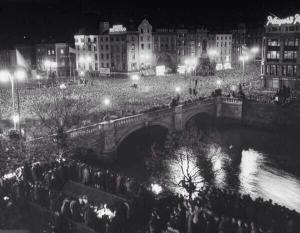 Ireland declares its total independence and withdraws from the British Commonwealth on April 18, 1949, officially becoming the Republic of Ireland rather than the Irish Free State within the British Commonwealth.
 About 200 Anti-Treaty


 seamus dubhghaill