seamus dubhghaill

Promoting Irish Culture and History from Little Rock, Arkansas, USA


Leave a comment

Pickett’s Charge

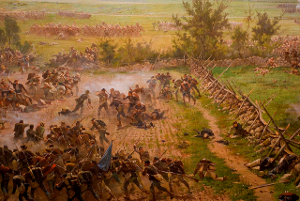
On July 3, 1863, at Gettysburg, Pennsylvania, as the sun rises behind the men of Colonel Dennis O’Kane’s Irish 69th Pennsylvania Volunteer Infantry on Cemetery Ridge, the most famous assault of the American Civil War is being prepared across the mile of open field in front of them. The 69th Pennsylvania will be at the very vortex of that assault, now known to posterity as Pickett’s Charge.

Pickett’s Charge is an infantry assault ordered by Confederate General Robert E. Lee against Major General George G. Meade‘s Union positions on the last day of the Battle of Gettysburg during the American Civil War. Its futility is predicted by the charge’s commander, Lt. General James Longstreet, and it is arguably an avoidable mistake from which the Southern war effort never fully recovers militarily or psychologically. The farthest point reached by the attack has been referred to as the high-water mark of the Confederacy.  The charge is named after Maj. General George Pickett, one of three Confederate generals who lead the assault under Longstreet.

Pickett’s charge is part of Lee’s “general plan” to take Cemetery Hill and the network of roads it commands. On the night of July 2, Meade correctly predicts at a council of war that Lee will attack the center of his lines the following morning.

At 1:00 PM on July 3, a massive artillery bombardment by the Confederate guns sails mostly over the heads of the 69th. The bombardment is meant to soften up the Union defense and silence its artillery but is largely ineffective. About 3:00 PM the barrage slackens, and the rebel infantrymen begin their assault. “And let your work this day be for victory or to the death,” Colonel Dennis O’Kane tells his men as the furious rebel onslaught approaches. Approximately 12,500 men in nine infantry brigades advance over open fields for three-quarters of a mile under heavy Union artillery and rifle fire.

Soon the 69th is forced to refuse both flanks as the Confederate tide rolls up to them and laps around both sides. While many around them run, the 69th stands fast. Although some Confederates are able to breach the low stone wall that shields many of the Union defenders, they cannot maintain their hold and are repulsed with over 50% casualties. The regiment’s tenacious stand in front of the famous copse of trees is a pivotal part of the crucial Union victory and a decisive defeat for the Confederacy that ends the three-day battle and Lee’s campaign into Pennsylvania.

Good to his word, Colonel O’Kane is killed and, lying dead near the 69th’s position, wearing gray lay Pvt. Willie Mitchel of the 1st Virginia Infantry, son of Irish patriot John Mitchel. At the most crucial battle of America’s Civil War, Irish are killing Irish on a foreign field once again.

Years later, when asked why his charge at Gettysburg failed, Pickett replies, “I’ve always thought the Yankees had something to do with it.”


2 Comments

The Battle of Foulksmills

During the Irish Rebellion of 1798, the Battle of Foulksmills, known locally as the Battle of Horetown and also known as the Battle of Goff’s Bridge, takes place on June 20, 1798 between advancing British forces seeking to stamp out the rebellion in County Wexford and a rebel army assembled to oppose them.

By June 19 the threat of the United Irish rebellion spreading outside County Wexford had been largely contained and Crown forces were positioned to move against rebel held territory. A force of about 1,500 men under Sir John Moore move out of New Ross toward Wexford as part of an overall encirclement operation in conjunction with General Gerard Lake‘s forces moving from the north.

Moore’s force is to link up and combine with the isolated garrison holding Duncannon before moving deeper into County Wexford, but after waiting several hours with no sign of their arrival, Moore decides to press ahead to the village of Taghmon alone. Upon nearing Goff’s Bridge at Foulkesmill, his scouts report a rapidly moving rebel force of some 5,000 moving along the road with the intent to give battle. Moore despatches a force of riflemen from the 60th Regiment to hold the bridge until artillery can be brought up in support.

The rebels however, led by Father Philip Roche, spot this move and move away from the road to the high ground on the left intending to outflank Moore’s force. The 60th are forced to engage the rebels on the roads, fields and forests of the area and the rebel flanking move briefly threatens to overturn Moore’s left. Moore has to personally rally his fleeing troops to hold the line and lead them in a successful counter-attack. As more troops begin to arrive the rebels are flushed out of their concealed positions, allowing the artillery to be brought into play and the rebels’ move is foiled. The rebels are gradually pushed back field by field but are able to withdraw the bulk of their force safely.

The road to Wexford is opened and the town recaptured by the Crown the next day but during this battle followers of rebel captain Thomas Dixon massacre up to 100 loyalist prisoners at Wexford bridge.

Casualties are estimated at 500 on the rebel side and 100 of the military.


Leave a comment

The Battle of the Yellow Ford

battle-of-the-yellow-ford

The Battle of the Yellow Ford is fought in western County Armagh, near the River Blackwater on August 14, 1598, during the Nine Years War. It is fought between the Gaelic native Irish army under Hugh O’Neill, Earl of Tyrone, and Hugh Roe O’Donnell and a crown expeditionary force from Dublin under Henry Bagenal. The crown forces are marching from Armagh to resupply a besieged fort on the Blackwater when they fall into an ambush and are routed with heavy losses.

The crown forces are organized in six regiments — two forward, two centre, and two rear, and with cavalry at centre. As soon as they leave Armagh garrison, they are all harassed with gunfire from rebel forces concealed in the woods. As a result, the different regiments become separated from one another as they pause to deal with the hit and run attacks. The problem is accentuated when one of their ox-drawn artillery pieces becomes stuck in the bog with a damaged wheel and a rear regiment stays behind to guard it as it is slowly coaxed through the bog. The regiment at the front of the march encounters a mile-long trench, 4 feet wide and 5 feet deep. The regiment succeeds in crossing the trench but then comes under heavy attack from large forces and decides to retreat back across the trench, suffering significant losses during the retreat. This regiment then merges into the ranks of the other forward regiment.

At this point, Henry Bagenal is killed by a shot through the head. Command of the army is assumed by Thomas Maria Wingfield. Further demoralising the crown troops and causing chaos, their gunpowder store explodes, apparently ignited accidentally by the fuse of a matchlock musket. Daunted, Wingfield decides to retreat to Armagh. The commander of the forward part either doesn’t get the command or refuses to obey it or is unable to execute an orderly retreat and judges it necessary to maintain his forward position. Seeing their enemy in confusion, the O’Neill cavalry rushes at the head of the forward part, followed by swordsmen on foot. Crown troops in this part of the field are cut to pieces and any wounded left on the field after the battle are slain as well. The rest of the crown forces have to struggle their way back to the Armagh garrison. They reach it largely intact but are harried all the way by the Irish.

Crown forces lose approximately 1,500 men in the battle, including 18 “captains” or officers. Three hundred soldiers desert to the rebels including two English recruits. Out of 4,000 soldiers who set out from Armagh, just over 2,000 reach the town after the battle and become virtual prisoners inside. The cavalry breaks out and dashes south escaping the Irish.

After three days of negotiations, it is agreed that the crown troops can leave Armagh as long as they leave their arms and ammunition behind and that the garrison of the Blackwater Fort surrenders. O’Neill’s forces suffer perhaps 200 to 300 casualties in the battle, though sources for the number lost on O’Neill’s side are very scanty. In light of the battle’s outcome, the court at London greatly and rapidly increase its military forces in Ireland. Simultaneously, many in Ireland who have been neutral on the sidelines begin to support the rebellion. Thus, the ultimate outcome of the battle is an escalation of the war.