seamus dubhghaill

Promoting Irish Culture and History from Little Rock, Arkansas, USA


Leave a comment

The Assassination of Tomás Mac Curtain

Tomas-mac-curtain

Tomás Mac Curtain, Sinn Féin Lord Mayor of Cork, is assassinated in Cork, County Cork on March 20, 1920, which is also his 36th birthday.

Thomas Curtin is born at Ballyknockane, Mourne Abbey, County Cork, on March 20, 1884, the son of Patrick Curtin, a farmer, and Julia Sheehan. He attends Burnfort National School. In 1897 the family moves to Cork City, where he attends the North Monastery school.

Mac Curtain, as he later becomes known, is active in a number of cultural and political movements beginning around the turn of the 20th century. He joins the Blackpool, Cork branch of Conradh na Gaeilge, becoming its secretary in 1902. He has interests in music, poetry, history, archaeology and Irish history. He works in his early career as a clerk, and in his free time teaches Irish. In 1911 he joins Fianna Éireann and is a member of the Irish Volunteers.

He meets Elizabeth Walsh (Eibhlís Breathnach) at a Gaelic League meeting, and they marry on June 28, 1908. They have six children, five of whom survive into adulthood. The family lives over 40 Thomas Davis Street, where Mac Curtain runs a small clothing and rainwear factory.

In April 1916, at the outset of the Easter Rising, Mac Curtain commands a force of up to 1,000 men of the Irish Volunteers who assemble at various locations around County Cork. From the volunteer’s headquarters at Sheares Street in the city, Mac Curtain and his officers await orders from the volunteer leadership in Dublin, but conflicting instructions and confusion prevail and as a result the Cork volunteers never enter the fray. A tense stand-off develops when British forces surround the volunteer hall and continued for a week until a negotiated agreement leads to the surrender of the volunteers’ arms to the then Lord Mayor of Cork Thomas Butterfield on the understanding that they will be returned at a later date. This does not happen however, and Mac Curtain is jailed in Wakefield Prison, in the Frongoch internment camp in Wales, and in Reading Gaol. After the general amnesty of participants in the Rising 18 months later, Mac Curtain returns to active duty as a Commandant of what is now the Irish Republican Army.

By 1918 Mac Curtain is a brigade commander, the highest and most important rank in the IRA. During the Conscription Crisis of 1918, he actively encourages the hiring of the women of Cumann na mBan to cater for Volunteers. He is personally involved with Michael CollinsSquad that, along with a Cork battalion, attempt to assassinate Lord John French, whose car is missed as the convoy passes through the ambush positions. Despite the setback he remains brigadier of No.1 Cork when he is elected Lord Mayor. He is elected in the January 1920 council elections as the Sinn Féin councillor for NW Ward No. 3 of Cork and is chosen by his fellow councillors to be the Lord Mayor. He begins a process of political reform within the city.

In January 1919, the Irish War of Independence starts, and Mac Curtain becomes an officer in the IRA. On March 20, 1920, his 36th birthday, Mac Curtain is shot dead in front of his wife and son by a group of men with blackened faces, who are found to be members of the Auxilaries along with unknown members of the Royal Irish Constabulary (RIC) by the official inquest into the event. In the wake of the killing, which is in revenge for the shooting of a policeman, Mac Curtain’s house in Blackpool is ransacked.

The killing causes widespread public outrage. The coroner’s inquest passes a verdict of willful murder against British Prime Minister David Lloyd George and against certain members of the RIC. Michael Collins later orders his squad of assassins to uncover and assassinate the police officers involved in the attack. RIC District Inspector Oswald Swanzy, who had ordered the attack, is fatally shot, with Mac Curtain’s own revolver, while leaving a Protestant church in Lisburn, County Antrim on August 22, 1920, sparking what is described by Tim Pat Coogan as a “pogrom” against the Catholic residents of the town.

Tomás Mac Curtain is buried in St. Finbarr’s Cemetery, Cork.

Leave a comment

The Selton Hill Ambush

selton-hill-ambush-memorial

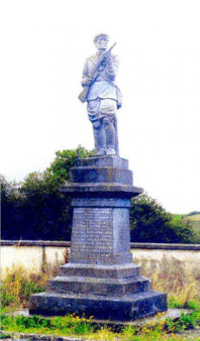
The Selton Hill Ambush takes place on March 11, 1921, during the Irish War of Independence. An Irish Republican Army (IRA) flying column is ambushed by members of the Royal Irish Constabulary (RIC) Auxiliary Division at Selton Hill, County Leitrim. Six IRA officers of the Leitrim Brigade are killed.

Seán Connolly is an IRA activist from County Longford, but he is also used by IRA GHQ to organise the surrounding areas of County Roscommon and County Leitrim. When Michael Collins orders Connolly into the county, he warns that it is “the most treacherous county in Ireland.” As Connolly is running a training camp at Selton Hill in early 1921, his position is given to the RIC. The RIC District Inspector, Thomas Gore-Hickman, has been alerted to Connolly’s position by a local doctor who had served in the British Army. The doctor had reportedly been told of the training camp by a local member of the Orange Order.

The events at Selton Hill take place one week after the Sheemore ambush, in which British troops from the Bedfordshire and Hertfordshire Regiment, based in Boyle suffer several casualties and at least one fatality. On March 11, at Selton Hill, a large force of RIC and Auxiliaires, based in Mohill and troops from the Bedfordshire and Hertfordshire Regiment surround and then attack the IRA camp. Six IRA volunteers are killed. The RIC suffers no losses. The IRA dead are Sean Connolly, Seamus Wrynne, Joseph O’Beirne, John Reilly, Joseph Reilly, and Capt. M.E. Baxter.

Ernie O’Malley later claims the volunteers’ bodies are “taken to Mohill by soldiers who shouted, “fresh meat!” as they were driving through the town.” He is also quoted as saying, “Men from the Bedfordshire Regiment were seen by a badly wounded IRA officer, Bernie Sweeney who survived, to use rifle butts on the skulls of two wounded men.” He also states that the location of the column was given to the local District Inspector of the RIC by a doctor who had been in the British Army, who received the information by a local Orangeman. The IRA officer who survives is Bernie Sweeney, from Ballinamore, who survives by hiding in a drain, where the cold water prevents him from bleeding to death. He is rescued and hidden from the Black and Tans and Auxiliaries by locals.

The IRA learn their position had been given away by the doctor and the Orangeman. The latter is later killed by the IRA. The doctor escapes to England and later dies in an accident.

The border country of the north midlands often proves to be a treacherous place for IRA training camps. On May 8, 1921, a camp of Belfast IRA volunteers based in the Lappanduff hills in neighbouring County Cavan, is also surprised. One volunteer is killed, thirteen captured, and arms and ammunition are seized by the British forces.

(Pictured: Selton Hill Ambush Memorial, south of the village of Fenagh, County Leitrim)


2 Comments

Disappearance of Father Michael Griffin

father-michael-griffin

Father Michael Griffin, a Catholic priest, disappears on November 14, 1920, after he leaves his residence at St. Joseph’s Church, in Galway. His housekeeper hears him talking to someone at the door and assumes that Fr. Griffin is going to visit a sick parishioner. He never returns.

Griffin is born in Gurteen, East Galway and ordained at St. Patrick’s College, Maynooth in 1917. A priest of the Diocese of Clonfert, he serves in the Diocese of Galway, Kilmacduagh and Kilfenora. In June 1918, the curate is transferred from the parish of Ennistymon, County Clare, to Rahoon, Galway City.

Fr. Griffin is known to the Crown Forces as a republican sympathiser. On the night of September 8, 1920, he is called out to attend Seamus Quirke, a First Lieutenant in the local Irish Republican Army (IRA) after he is shot seven times at the docks. He also takes part in the funeral mass of Michael Walsh of the Old Malt House following his murder on the night of October 19, 1920.

On November 14, Fr. Griffin is lured from the presbytery by British forces. He is taken to Lenaboy Castle where he is questioned. After being interrogated, he is shot through the head and his body is taken away by lorry and buried in an unmarked grave at Cloghscoltia near Barna. His disappearance is reported to the police the following day.

Fr. Griffins’ remains are discovered by a local man, William Duffy, while he is attending cattle on November 20.

Frank Percy Crozier, commander of the Auxiliary Division of the Royal Irish Constabulary, travels to Galway on November 22 and finds that Fr. Griffin has been murdered by his men, and that a plot is afoot to murder Dr. Michael Fogarty, Bishop of Killaloe. Crozier writes in Ireland For Ever:

“I found out that the military inquiry into the murder of Father Griffin (held in lieu of an inquest) was fast with a ‘frame up’ and that a verdict of murder against persons, or somebody ‘unknown’ would result. I told the military commander this and the name of the real murderer but was informed that a senior official of Dublin Castle had been to Galway in front of me to give instructions as to ‘procedure’ in this murder investigation. At Killaloe next day I received further evidence that the hidden hand was still at work and was told in confidence that instructions had been received to kill Dr. Fogarty, Roman Catholic Bishop of Killaloe, by drowning him in a sack from the bridge over the River Shannon, so as to run no further risk of detection by having his body found.”

On November 23, Fr. Griffin’s funeral mass takes place at St. Joseph’s Church, Presentation Road. The funeral cortege moves through the streets of Galway, with three bishops, 150 priests, and in excess of 12,000 mourners participating. The priest is buried in the grounds of Loughrea Cathedral.

A group of enthusiasts gather together in Galway in the spring of 1948 to form a football club and they decide unanimously to name the club “Father Griffins” and they grow and flourish to be a major force in Galway football. There is also a road in Galway City called “Father Griffin Road.”