
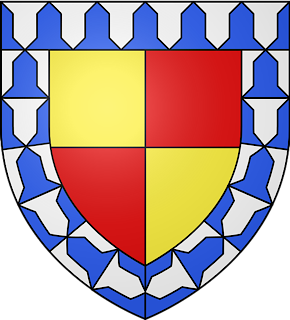
John Fitzgeoffrey, Lord of Shere, Justiciar of Ireland, English nobleman and Crown official, dies on November 23, 1258.
Fitzgeoffrey is born around 1205 in Shere, Surrey, son of Geoffrey Fitz Peter, 1st Earl of Essex and Aveline de Clare, daughter of Roger de Clare, 2nd Earl of Hertford and his wife, Maud de Saint-Hilaire.
Fitzgeoffrey is appointed Justiciar of Ireland, serving from 1245 to 1255. He proves to be a strong, energetic and capable viceroy. The fact that an unusual number of Anglo-Norman lordships at the time are held by minors gives him an opportunity to assert the royal authority more forcefully than previous viceroys, especially in Ulster and Connacht. His interest in Irish affairs is no doubt partly due to his own large landholdings in Ireland, acquired by his marriage to Isabel Bigod, whose mother Maud Marshal is a great Anglo-Irish heiress. He holds an assize in Ulster in 1247–48, during which he reorganises the government of the province. He builds a bridge over the River Bann at Coleraine, and a fort nearby. He is determined to subdue the powerful Northern Uí Néill dynasties and has some success in doing so.
In 1258, Fitzgeoffrey is one of the leaders of the baronial opposition to king Henry III. On April 1,1258, Aymer de Valence, Bishop of Winchester, sends a posse to attack Fitzgeoffrey’s men at Shere in Surrey, killing one of them. When a parliament opens at Westminster a week later, Fitzgeoffrey demands justice from the king. Henry III excuses Aymer, his half-brother, and refuses justice thus angering the barons. On April 12, Fitzgeoffrey forms an alliance with six other magnates to achieve reform.
Fitzgeoffrey is not entitled to succeed his half-brother as Earl of Essex in 1227, the earldom having devolved from his father’s first wife. He is the second husband of Isabel Bigod, daughter of Hugh Bigod, 3rd Earl of Norfolk and his wife Maud Marshal of Pembroke and widow of Gilbert de Lacy. They have six children, one being Maud, who marries William de Beauchamp, 9th Earl of Warwick.
Fitzgeoffrey dies suddenly on November 23, 1258, and, despite his hostility to the king, Henry III orders a mass to be celebrated for his soul and donates a cloth of gold to shroud his coffin. He has four daughters and three sons. The eldest of the latter predeceases his father, who is succeeded in turn by younger sons, first John and then Richard.

