seamus dubhghaill

Promoting Irish Culture and History from Little Rock, Arkansas, USA


Leave a comment

St. Patrick’s Cathedral Designated National Cathedral

st-patricks-cathedral-dublin

St. Patrick’s Cathedral, Dublin, is designated the National Cathedral of the Church of Ireland on May 2, 1872. Chapter members at St. Patrick’s are drawn from each of the twelve dioceses of the Church of Ireland.

St. Patrick’s Cathedral is dedicated on March 17, 1191. With its 141-foot spire, it is the tallest church (not cathedral) in Ireland and the largest.

St. Patrick’s Cathedral is founded on the spot where St. Patrick himself is believed to have baptized the first Irish believers into the Christian faith. The sacred well which St. Patrick used has been lost, but the Cathedral is built in the area where the conversions are believed to have taken place.

The first church is constructed here in the 5th century but St. Patrick’s as it stands now is built between 1191 and 1270. In 1311, the Medieval University of Dublin is founded here, and the church begins a place of higher education as well as a place of worship.

By the 16th century, however, St. Patrick’s falls into disrepair following the English Reformation, a time when the Church of England breaks away from the Roman Catholic Church. In 1537, St. Patrick’s becomes designated as an Anglican Church of Ireland, and it remains a part of the Church of Ireland to this day.

Repairs to the cathedral begin in the 1660s and continued in phases over the following decades to save it from falling into complete ruin.

As its status grows, St. Patrick’s begins to rival Christ Church Cathedral in importance. This is where the history of St. Patrick’s Cathedral takes a bit of a complicated turn in term of church definitions. The current cathedral building is often hailed as one of the best examples of medieval architecture in Dublin, however, it is only fair to point out that the structure went through a massive rebuild in the 1860s, mainly financed by money from Benjamin Guinness.

As one of Dublin’s two Church of Ireland cathedrals, St. Patrick’s is actually designated as the “National Cathedral of Ireland.” However, it lacks the one thing that usually makes a church a cathedral – a bishop. The Archbishop of Dublin actually has his seat at Christ Church Cathedral, which is designated as the local cathedral of the Diocese of Dublin and Glendalough. St. Patrick’s is instead headed by a dean who is the ordinary for the cathedral. This office has existed since 1219 with its most famous office holder being Jonathan Swift.

Today St. Patrick’s Cathedral plays host to a number of public national ceremonies. Ireland’s Remembrance Day ceremonies, hosted by the Royal British Legion and attended by the President of Ireland, take place there every November. Its carol service (the Service of Nine Lessons and Carols), celebrated twice in December, including every December 24, is a colourful feature of Dublin life. On Saturdays in autumn the cathedral hosts the graduation ceremonies of Technological University Dublin.

The funerals of two Irish presidents, Douglas Hyde and Erskine Childers, take place in St. Patrick’s Cathedral in 1949 and 1974 respectively. In 2006, the cathedral’s national prominence is used by a group of 18 Afghan migrants seeking asylum, who occupied it for several days before being persuaded to leave without trouble.

Leave a comment

Use of the “Book of Common Prayer” Ordered in Ireland

The Book of Common Prayer, the short title of a number of related prayer books, is ordered to be used in Ireland on June 9, 1549.

The Book of Common Prayer is used in the Anglican Communion, as well as by the Continuing Anglican movement, Anglican realignment and other Anglican churches. The original book, published in 1549 during the reign of Edward VI, is a product of the English Reformation following the break with the Roman Catholic Church. Prayer books, unlike books of prayers, contain the words of structured, or liturgical, services of worship.

The work of 1549 is the first prayer book to include the complete forms of service for daily and Sunday worship in English. It contains Morning Prayer, Evening Prayer, the Litany, and Holy Communion and also the occasional services in full such as the orders for Baptism, Confirmation, Marriageanointing of the sick and a Funeral service. It also sets out in full the “propers,” that is the parts of the service which vary week by week or, at times, daily throughout the Church’s Year. Old Testament and New Testament readings for daily prayer are specified in tabular format as are the Psalms.

The 1549 book is soon succeeded by a more reformed revision in 1552 under the same editorial hand, that of Thomas Cranmer, Archbishop of Canterbury. It is used only for a few months, as after Edward VI’s death in 1553, his half-sister Mary I restores Roman Catholic worship. Mary dies in 1558, and, in 1559, Elizabeth I reintroduces the 1552 book with a few modifications to make it acceptable to more traditionally minded worshippers, notably the inclusion of the words of administration from the 1549 Communion Service alongside those of 1552.

In 1604, James I orders some further changes, the most significant of these being the addition to the Catechism of a section on the Sacraments. William Bedell undertakes an Irish translation of the Book of Common Prayer in 1606. Following the tumultuous events leading to and including the English Civil War, another major revision is published in 1662. This edition has remained the official prayer book of the Church of England, although in the 21st century, alternative provision under the title Common Worship has largely displaced the Book of Common Prayer at the main Sunday worship service of most English parish churches. An Irish translation of the revised prayer book of 1662 is affected by John Richardson and published in 1712.

A Book of Common Prayer with local variations is used in churches inside and outside the Anglican Communion in over 50 different countries and in over 150 different languages. In many parts of the world, other books have replaced it in regular weekly worship.

Traditional English Lutheran, Methodist and Presbyterian prayer books have borrowed from the Book of Common Prayer and the marriage and burial rites have found their way into those of other denominations and into the English language. Like the King James Version of the Bible and the works of William Shakespeare, many words and phrases from the Book of Common Prayer have entered common parlance.

(Pictured: A 1760 printing of the 1662 “Book of Common Prayer”)


Leave a comment

Death of Vergilius of Salzburg, Churchman & Astronomer

virgilius-of-salzburg

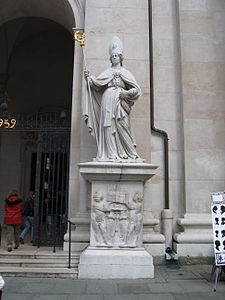
Vergilius of Salzburg, also known as Virgilius, Feirgil or Fergal, Irish churchman and early astronomer, dies on November 27, 784, in Salzburg, Austria. He serves as abbot of Aghaboe, bishop of Ossory and bishop of Salzburg. He is called “the Apostle of Carinthia” and “the geometer.”

He originates from a noble family of Ireland, where his name is Feirgil, and is said to have been a descendant of Niall of the Nine Hostages. Feirgil is likely educated at the Iona monastery.

In the Annals of the Four Masters and the Annals of Ulster he is mentioned as Abbot of Aghaboe, in County Laois, where he is known as “the Geometer” because of his knowledge of mathematics.

Around 745 Vergilius leaves Ireland, intending to visit the Holy land but, like many of his countrymen who seem to have adopted this practice as a work of piety, he settles down in France, where he is received with great favour by Pepin the Short, who is then Mayor of the Palace under Childeric III of Franconia. He serves as an adviser to Pepin. He probably uses a copy of the Collectio canonum Hibernensis, an Irish collection of canon law, to advise him to receive royal unction in 751, to assist his recognition as king Pippin III after the deposition of Childeric. After spending two years at Cressy, near Compiègne, he goes to Bavaria, at the invitation of Duke Odilo, where he founds the monastery of Chiemsee, and within a year or two is made Abbot of St. Peter’s at Salzburg. Among his notable accomplishments is the conversion of the Alpine Slavs and the dispatching of missionaries to Hungary.

While Abbot of St. Peter’s, Vergilius comes into collision with Saint Boniface. A priest, through ignorance, confers the Sacrament of Baptism using, in place of the correct formula, the words “Baptizo te in nomine patria et filia et spiritu sancta.” Vergilius holds that the sacrament has been validly conferred, but Boniface complains to Pope Zachary. The latter, however, decides in favour of Vergilius. Later on, Boniface accuses Vergilius of spreading discord between himself and Duke Odilo of Bavaria and of teaching a doctrine in regard to the rotundity of the earth, which is “contrary to the Scriptures.” Pope Zachary’s decision in this case is that “if it shall be clearly established that he professes belief in another world and other people existing beneath the earth, or in another sun and moon there, thou art to hold a council, and deprive him of his sacerdotal rank, and expel him from the church.”

Unfortunately, we no longer possess the treatise in which Vergilius expounds his doctrine. Two things, however, are certain: first, that there is involved the problem of original sin and the universality of redemption; secondly, that Vergilius succeeds in freeing himself from the charge of teaching a doctrine contrary to Scripture. It is likely that Boniface, already biased against Vergilius because of the preceding case, misunderstands him, taking it for granted, perhaps, that if there are antipodes, the “other race of men” are not descendants of Adam and are not redeemed by Christ.

After the martyrdom of Boniface, Vergilius is made Bishop of Salzburg in 766 or 767. Until his death in 784, he labours successfully for the upbuilding of his diocese as well as for the spread of Christianity in neighbouring heathen countries, especially in Carinthia.

Vergilius is venerated as a saint in the Orthodox Church and the Roman Catholic Church. In 1233 he is formally canonized by Pope Gregory IX. Aside from being personally associated with Abbey of Aghaboe and Salzburg Cathedral, a number of parishes around the world are dedicated to him, mostly being founded by small populations of far-flung Irish Catholics, like himself. There is a church still bearing his name dedicated to him in Broad Channel, Queens, New York. A parish in Morris Plains, New Jersey is also dedicated to him.