seamus dubhghaill

Promoting Irish Culture and History from Little Rock, Arkansas, USA


Leave a comment

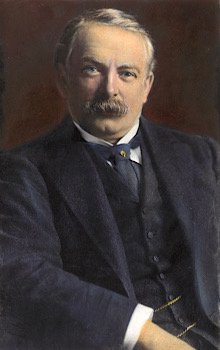
Lloyd George Proposes a Boundary Commission During Anglo-Irish Treaty Negotiations

On November 8, 1920, during the Anglo-Irish Treaty negotiations of late 1920 and early 1921, British Prime Minister David Lloyd George proposes the creation of a Boundary Commission to determine the precise border between Northern Ireland and the Irish Free State. This idea is part of a broader set of compromises aimed at resolving the “Irish Question” after the Irish War of Independence.

The Government of Ireland Act 1920 has partitioned Ireland into Northern Ireland (a United Kingdom home rule territory) and Southern Ireland (a separate home rule entity). The 1921 Treaty, signed on December 6, 1921, allows Northern Ireland to opt out of the Irish Free State after a one-month period. On December 6, 1922, the unionist-dominated Parliament of Northern Ireland exercises that right, triggering the formation of the Boundary Commission.

The Treaty’s Article 12 provides for the commission if Northern Ireland chooses to secede. Its role is to review the provisional border set by the 1920 Act, recommend adjustments based on political majorities in border areas and produce a final, legally binding boundary between the Free State and Northern Ireland.

The commission is to be jointly nominated by the United Kingdom, the Irish Free State, and Northern Ireland governments. When Northern Ireland refuses to cooperate, the British government appoints a Belfast Unionist newspaper editor, Joseph R. Fisher, to represent Northern interests.

The commission’s 1924–25 report recommends relatively small territorial transfers in both directions, contrary to nationalist expectations. The findings are leaked in 1925, causing protests from both unionists and nationalists. To avoid further disputes, the three governments agree to suppress the report and instead confirm the existing 1920 border on December 3, 1925, with the border fixed in law.

Lloyd George’s proposal reflects a pragmatic British approach: using a neutral commission to manage the sensitive issue of partition and prevent further conflict. While the commission’s recommendations are not implemented, the process helps formalize the border that remains in place until the 1960s, shaping the political and sectarian divide in Ireland for decades.


Leave a comment

Birth of Eddie McGrady, SDLP Politician & Member of Parliament

Edward Kevin McGrady, Irish nationalist politician of the Social Democratic and Labour Party (SDLP), is born on June 3, 1935, in Downpatrick, County Down, Northern Ireland. He serves as the Member of Parliament (MP) for South Down from 1987 to 2010. He is also a Member of the Northern Ireland Assembly (MLA) for South Down from 1998 to 2003.

McGrady, one of eleven children, is educated at St. Patrick’s Grammar School, Downpatrick and at Belfast Technical College, where he trains as a chartered accountant, subsequently entering his family’s accountancy firm.

McGrady enters politics in 1961 as an Independent Nationalist councillor on Downpatrick Urban Council, serving as chairman from 1964 until the council is replaced by Down District Council in 1973.

In the late 1960s he joins the National Democrats and stands for the party in the 1969 Northern Ireland general election to the Parliament of Northern Ireland in East Down, losing to the sitting MP and future Prime Minister of Northern Ireland Brian Faulkner.

In 1970, McGrady becomes a founder member of the SDLP, later serving as its first chairman (1971–73). He sits on Down District Council from 1973 to 1989, serving as chairman from 1974–1975 and is also elected to all three regional assemblies in 1973, 1975 and 1982 representing South Down. In the 1973 power-sharing executive he is appointed as Head of the Department of Executive Planning and Co-ordination, serving from January to May 1974.

In Westminster elections McGrady contests South Down unsuccessfully in 1979, 1983 and at the by-election of January 1986, losing on each occasion to Enoch Powell, the sitting MP. He succeeds at the fourth attempt in the 1987 United Kingdom general election and holds the seat until his retirement in 2010. His tenure is briefly threatened in the mid-1990s when the Boundary Commission suggests merging much of his constituency with the neighbouring Newry and Armagh constituency to form a new “Newry and Mourne” constituency. This is overturned during a local review, which preserves his seat and actually removes more Unionist sections such as Dromore. His support holds solid over the years despite talk of a slippage, and this is reinforced in the 2005 United Kingdom general election with his re-election to the House of Commons.

McGrady formerly sits on the Northern Ireland Policing Board and is a member of the Northern Ireland Assembly between 1998 and 2003.

On February 25, 2010, McGrady announces that he will stand down at the 2010 General Election. He continued to be chairperson of the Lecale Branch of the SDLP.

McGrady dies at the age of 78 in Downpatrick on November 11, 2013.