seamus dubhghaill

Promoting Irish Culture and History from Little Rock, Arkansas, USA


Leave a comment

Birth of Norman Whiteside, Northern Ireland Footballer

norman-whiteside

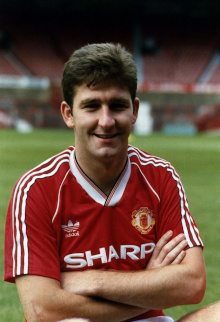
Norman Whiteside, former Northern Ireland international footballer who played in two World Cups, is born in Belfast, Northern Ireland on May 7, 1965. He plays both as a midfielder and as a striker.

Whiteside grows up on Shankill Road, and because of his aggressive, physical playing style he is later nicknamed the “Shankill Skinhead” by Manchester United supporters. The family later moves to 10 Danube Street. He remains relatively unscathed by The Troubles as his Protestant parents keep a firm watch on their children to ensure that they do not stray far from home and that none of them become involved with Ulster loyalism. At around seven years of age, he joins the Boys’ Brigade, and quickly shows his natural talent for football, scoring ten goals in a game against boys almost twice his age. He is educated at Cairnmartin High School and becomes famous in the Shankill area as a footballing prodigy by the age of eleven.

Whiteside is said to have been discovered by Ipswich Town scout Jim Rodgers, who is told by manager Bobby Robson to wait until Whiteside grows older. Instead, it is Manchester United’s 80-year-old Ulster scout Bob Bishop, who previously unearthed Belfast-born George Best and Sammy McIlroy for the club, who first offers him a trial at an English club. He finds that he has been offered schoolboy terms at the club during a school trip to the United States, on which he and his classmates meet President Jimmy Carter in the Oval Office, a rare and extraordinary occasion for children from a disadvantaged background.

Whiteside signs professional forms in 1982 at the age of 17 and quickly becomes a key member of the Manchester United club. He scores 68 goals in 278 league and cup appearances for the club over the next seven years, picking up two FA Cup winners medals in 1983 and 1985, as well as playing in the 1982 FA Youth Cup final, the 1983 League Cup final, and the FA Charity Shield in 1983.

Whiteside remains with United until July 1989, when he is sold to Everton F.C. for £600,000. However intense running sessions run by coach Mick Lyons take their toll on his right knee, and on September 20, 1990, he takes a knock in a practice match, which requires him to have another operation on his right knee. After the return of Howard Kendall as manager in November 1990, he manages to appear in a few reserve team games, but this only delays the inevitable, and he is forced to retire from the game at the age of 26 in June 1991.

Upon retirement, Whiteside studies to become a podiatrist, graduating with a degree from the University of Salford, and serves Northwich Victoria F.C. as their assistant manager/physio from October 1991 until March 1992. He quits the role as he does not enjoy the amount of time spent travelling between games. He instead became an after-dinner speaker and also works for the Professional Footballers’ Association, while taking a postgraduate course at Manchester Metropolitan University. He later takes up private practice as a podiatrist in Manchester. Since 1994, he has also worked at the corporate hospitality department at Old Trafford. In 2003, he releases a book entitled My Memories of Manchester United. With the help of writer Rob Bagchi, he releases his autobiography entitled Determined in August 2007, published by Headline Publishing Group, and with a foreword by actor James Nesbitt.

Whiteside holds records as the youngest player to take part in a World Cup, the youngest player to score in a League Cup and FA Cup final, and the youngest player to score a senior goal for Manchester United. Winning 38 caps for Northern Ireland, he plays at the 1982 and 1986 World Cups and also helps his country to win the last ever British Home Championship in 1983–1984.


Leave a comment

The Remembrance Day Bombing

remembrance-day-bombing

The Remembrance Day bombing, also known as the Enniskillen bombing or Poppy Day massacre, takes place on November 8, 1987, in Enniskillen, County Fermanagh, Northern Ireland. A Provisional Irish Republican Army (IRA) bomb explodes near the town’s war memorial during a Remembrance Sunday ceremony, which is being held to commemorate British military war dead. Eleven people, many of them old age pensioners, are killed and 63 are injured.

The bomb explodes as a parade of Ulster Defence Regiment (UDR) soldiers is making its way to the memorial and as people wait for the ceremony to begin. It blows out the wall of the Reading Rooms, where many of the victims are standing, burying them under rubble and hurling masonry towards the gathered crowd. Bystanders rush to free those trapped in the rubble.

Eleven people, all Protestant, are killed by the Provisional IRA that day, including three married couples. The dead are Wesley and Bertha Armstrong, Kitchener and Jessie Johnston, William and Agnes Mullan, John Megaw, Georgina Quinton, Marie Wilson, Samuel Gault, and Edward Armstrong. Armstrong is a serving Royal Ulster Constabulary (RUC) officer and Gault has recently left the force. Gordon Wilson, whose daughter Marie dies in the blast and who is himself injured, goes on to become a peace campaigner and member of Seanad Éireann. The twelfth fatality, Ronnie Hill, dies after spending 13 years in a coma. Sixty-three people are injured, including thirteen children. Ulster Unionist politicians Sam Foster and Jim Dixon are among the crowd. Dixon receives extensive head injuries but recovers. A local businessman captures the immediate aftermath of the bombing on video camera. His footage, showing the effects of the bombing, is broadcast on international television.

A few hours after the blast, the IRA calls a radio station and says it has abandoned a 150-pound bomb in Tullyhommon, twenty miles away, after it failed to detonate. That morning, a Remembrance Sunday parade, which includes many members of the Boys’ and Girls’ Brigades, has unwittingly gathered near the Tullyhommon bomb. Soldiers and RUC officers were also there, and the IRA says it attempted to trigger the bomb when soldiers were standing beside it. The bomb is defused by security forces and is found to have a command wire leading to a “firing point” across the border.

The IRA apologises, saying it had made a mistake and that the target had been the UDR soldiers who were parading to the memorial. The bombing leads to an outcry among politicians in the Republic of Ireland and the United Kingdom. British Prime Minister Margaret Thatcher says, “It’s really desecrating the dead and a blot on mankind.” The Secretary of State for Northern Ireland, Tom King, denounces the “outrage” in the House of Commons, as does the Irish Minister for Foreign Affairs, Brian Lenihan, in Dáil Éireann. Seanad Éireann Senator Maurice Manning speaks of people’s “total revulsion.” It also facilitates the passing of the Extradition Act, which makes it easier to extradite IRA suspects from the Republic of Ireland to the United Kingdom.

The bombing is seen by many Northern Irish Protestants as an attack on them, and loyalist paramilitaries ″retaliate″ with attacks on Catholic civilians. The day after the bombing, five Catholic teenagers are wounded in a shooting in Belfast, and a Protestant teenager is killed by the Ulster Defence Association after being mistaken for a Catholic. In the week after the bombing, there are fourteen gun and bomb attacks on Catholics in Belfast.

The Remembrance Day bombing has been described as a turning point in the Troubles and an incident that shook the IRA “to its core.”