seamus dubhghaill

Promoting Irish Culture and History from Little Rock, Arkansas, USA


Leave a comment

The 1918 Irish General Election & Rise of Sinn Féin

The 1918 Irish general election is the part of the 1918 United Kingdom general election which takes place in Ireland on December 14, 1918. It is a key moment in modern Irish history because it sees the overwhelming defeat of the moderate nationalist Irish Parliamentary Party (IPP), which had dominated the Irish political landscape since the 1880s, and a landslide victory for Sinn Féin. Sinn Féin had never previously stood in a general election but had won six seats in by-elections in 1917–18. The party vows in its manifesto to establish an independent Irish Republic. In Ulster, however, the Irish Unionist Alliance (IUA) is the most successful party.

In 1918, a system called plural voting is in place in both Britain and Ireland. Plural voting is a practice whereby one person might be able to vote multiple times in an election. Property and business owners can vote both in the constituency where their property lay and that in which they live, if the two are different. In the newly formed Irish Free State this system is ended by the Electoral Act 1923 and is abolished in the United Kingdom by the Representation of the People Act 1948. Plural voting remains in effect in Northern Ireland until 1969.

The 1918 election is held in the aftermath of World War I, the Easter Rising and the Conscription Crisis. It is the first general election to be held after the Representation of the People Act 1918. It is thus the first election in which women over the age of 30, and all men over the age of 21, can vote.

Sinn Féin is founded by Arthur Griffith in 1905. He believes that Irish nationalists should emulate the Ausgleich of Hungarian nationalists who, in the 19th century under Ferenc Deák, had chosen to boycott the imperial parliament in Vienna and unilaterally establish their own legislature in Budapest.

Griffith initially favours a peaceful solution based on “dual monarchy” with Britain, that is two separate states with a single head of state and a limited central government to control matters of common concern only. However, by 1918, under its new leader, Éamon de Valera, Sinn Féin has come to favour achieving separation from Britain by means of an armed uprising if necessary and the establishment of an independent republic.

In the aftermath of the 1916 Easter Rising, the party’s ranks are swelled by participants and supporters of the rebellion as they are freed from British gaols and internment camps. At its 1917 Ardfheis (annual conference) de Valera is elected leader, and the new, more radical policy is adopted.

Prior to 1916, Sinn Féin had been a fringe movement having a limited cooperative alliance with William O’Brien‘s All-for-Ireland League and enjoyed little electoral success. However, between the Easter Rising of that year and the 1918 general election, the party’s popularity increases dramatically. This is due to the failure to have the Home Rule Bill implemented when the IPP resists the partition of Ireland demanded by Ulster Unionists in 1914, 1916 and 1917, but also popular antagonism towards the British authorities created by the execution of most of the leaders of the 1916 rebels and by their botched attempt to introduce Home Rule on the conclusion of the Irish Convention linked with military conscription in Ireland (see Conscription Crisis of 1918).

Sinn Féin demonstrates its new electoral capability in four by-election successes in 1917 in which George Noble Plunkett, Joseph McGuinness, de Valera and W. T. Cosgrave are each elected, although it loses three by-elections in early 1918 before winning two more with Patrick McCartan and Arthur Griffith. In one case there are unproven allegations of electoral fraud. The party benefits from a number of factors in the 1918 elections, including demographic changes and political factors.

In the aftermath of the elections, Sinn Féin’s elected members refuse to attend the British Parliament in Westminster, and instead form a parliament in Dublin, Dáil Éireann (“Assembly of Ireland”), which declares Irish independence as a republic. The Irish War of Independence is conducted under this revolutionary government which seeks international recognition and sets about the process of state-building. The next election is part of 1921 Irish elections.

(Pictured: L to R, Éamon de Valera of Sinn Féin, Sir Edward Carson on the Irish Unionist Alliance, and John Dillon of the Irish Parliamentary Party)

Leave a comment

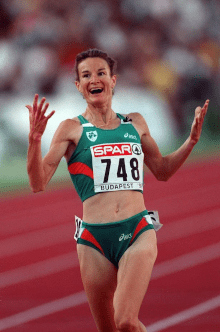
Sonia O’Sullivan Wins 10,000m at European Championships

Sonia O’Sullivan, track and field athlete, wins the 10,000 metres at the European Athletics Championships in Budapest, Hungary on August 19, 1998.

Born on November 28, 1969, in Cobh, County Cork, O’Sullivan is educated in Cobh Community College. She completes her leaving certificate in 1987. Her first major international competition is the 1990 European Athletics Championships at Split, Yugoslavia where she finishes 11th in the 3,000 metres.

O’Sullivan first comes to prominence when winning the 1,500 metres at the 1991 Summer Universiade, before going on to finish fourth in the 3,000 metres final at the 1992 Summer Olympics in Barcelona. She then wins a silver medal in the 1,500 metres at the 1993 World Championships and a gold medal in the 5,000 metres at the 1995 World Championships. She is the favourite for the 5,000 metres title at the 1996 Summer Olympics in Atlanta but drops out of the final due to illness. Her 2,000 metres world record of 5:25.36, set in 1994, stands until 2017.

After a disappointing end to her 1997 season, O’Sullivan makes an impressive comeback in 1998. At the World Athletics Cross Country Championships at Marrakesh in March, she enters both the short course (4 km) and long course (8 km) events. On successive days, she wins both events, and her 4 km time of 12:20 is 14 seconds ahead of her nearest rival. She continues this form into the track season, where her performances in the 1,500 metres, 3,000 metres and 5,000 metres are close to those she had produced at her peak in 1994 and 1995.

At the European Athletics Championships in Budapest, the 1,500 metres and 5,000 metres finals, events at which O’Sullivan usually doubles at major championships, are scheduled to be run on the same day, thus denying her the opportunity of competing in both events. Undeterred, she enters the 5,000 metres and 10,000 metres, having never run the latter event before on the track. In the 10,000 metres final, on August 19, she shadows the leaders and then produces an astonishing 28.1 second final 200 metres to win the gold medal in 31:29.33 in her debut at the distance. Four days later, in the more familiar territory of the 5,000 metres, the pace is set by Romanian Gabriela Szabo, but again, O’Sullivan produces an explosive finishing sprint to defeat Szabo in 15:06.50.

At the IAAF World Cup held the following month in Johannesburg, South Africa, O’Sullivan wins her second major international 5,000 metres competition of the year, again sprinting clear of the opposition following a very slow pace. She concludes her year by winning the Bupa Great North Run.

At the 2000 Summer Olympics in Sydney, O’Sullivan wins a silver medal in the 5,000 metres. She wins silver medals in the 5,000 metres and 10,000 metres at the 2002 European Athletics Championships, and competes at her fourth Olympic Games in 2004. She is known for her dramatic kick, clocking 28-second final 200 metre splits in some of her races.

O’Sullivan is only one of two women (the other being Tirunesh Dibaba) who have won the short and long course World Cross Country title at the same championship (1998 in Marrakesh).


Leave a comment

Birth of James Owen Hannay, Clergyman & Novelist

Generated by IIPImage

James Owen Hannay, Irish clergyman and prolific novelist who writes under the pen name of George A. Birmingham, is born on July 16, 1865, in Belfast. Today the house where he is born is a part of the administration building of Queen’s University Belfast.

Hannay receives his education in England. He enters Temple Grove School near the River Thames at the age of nine, and later studies at a public school called Haileybury School. He then returns to Ireland to enter the Divinity School of Trinity College Dublin. He is ordained in 1889 as a Church of Ireland (Anglican) minister and starts working as a curate for Delgany, County Wicklow, a seaside town south of Dublin.

To make up for a deficiency in their living Hannay writes a short story and sends it to a London publisher. It is accepted for publication, and he receives a check of £10. On his wife’s advice, he gives up writing fiction and commits himself to the study of Christian theology with her. This bears fruit with the publications of The Spirit and Origin of Christian Monasticism (1903) and The Wisdom of the Desert (1904).

Hannay then serves as rector of Holy Trinity Church in Westport, County Mayo. It is here that he makes his debut as a novelist. His early writings raise the ire of nationalist Catholics, and he withdraws from the Gaelic League in the wake of ongoing protests about the tour of his successful play General John Regan.

Hannay becomes rector of Kildare parish from 1918 to 1920, and after serving as chaplain to the Lord Lieutenant of Ireland, he joins the British ambassadorial team in Budapest in 1922. He returns to officiate at Mells, Somerset from 1924 to 1934, after which he is appointed vicar of Holy Trinity Church in the London suburb of Kensington where he serves from 1934 until his death in London on February 2, 1950.

Hannay enjoys sailing and is taught the rudiments by his father and grandfather in Belfast. When he is based in Westport, the financial success of his writing enables him to purchase a boat, a Dublin Bay Water Wag. In recognition of Hannay, the Water Wag Club of Dun Laoghaire returns to Westport and Clew Bay in 2016. In the frontispiece of his book The Inviolable Sanctuary Hannay includes a picture of the Water Wag.


Leave a comment

Birth of Marcus O’Sullivan, Middle Distance Runner

marcus-osullivan

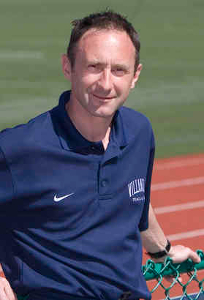
Marcus O’Sullivan, Irish middle distance runner, is born in Cork, County Cork, on December 22, 1961. Although he does not plan to enroll at any of Ireland’s universities, his running encourages him to go to Villanova University. After four years of education at Villanova, he graduates with a degree in accounting and later attains an MBA and a CPA.

O’Sullivan quickly becomes a world class runner and takes part in four summer Olympic Games. He wins three gold medals at the IAAF World Indoor Championships over 1500m in Indianapolis (1987), Budapest (1989), and Toronto (1993). In his victories in 1987 and 1989, he sets championship records. He is third all-time in total sub-4 minute miles with 101, trailing Steve Scott (137) and John Walker (127).

At the 1985 European Athletics Indoor Championships, O’Sullivan wins a silver medal in the 1500m. He finishes 4th in the 1991 IAAF World Indoor Championships in Seville, Spain. He qualifies for Ireland for Olympic Games in 1984, 1988, 1992, and 1996, at both 800 metres and 1500 metres. He reaches the 1500 metre finals at the 1988 Summer Olympics in Seoul, South Korea.

O’Sullivan sets an indoor 1500 metres world record of 3:35.4 on February 10, 1989, and is generally regarded as a better competitor running indoors. This is evidenced by the fact that he wins the prestigious Wanamaker Mile in Madison Square Garden‘s Millrose Games six times (1986, 1988, 1989, 1990, 1992, and 1996).

O’Sullivan’s personal best for the mile, which is set indoors in 1988, is 3:50.94. His personal best for the 1500 metres, which is set outdoors in 1996, is 3:33.61.

O’Sullivan, along with Irish runners Ray Flynn, Eamonn Coghlan, and Frank O’Mara (who ran collegiately at the University of Arkansas) establish the still standing world record in the 4 x 1 mile relay, when they combine in Dublin on August 17, 1985 to run 15:49.08.

O’Sullivan now runs the Running Works cross country summer camp in Canadensis, Pennsylvania, along with Cricket Batz, and is the head coach of Villanova cross country and track and field. He is coached by Tom Donnelly of Haverford College and advises Bob Kennedy in the later years before Kennedy’s retirement.

In addition to his ties to American record holder Bob Kennedy, O’Sullivan has coached elite professional runners such as Canadian indoor world silver medalist Carmen Douma-Hussar and New Zealander Adrian Blincoe.