seamus dubhghaill

Promoting Irish Culture and History from Little Rock, Arkansas, USA


Leave a comment

Birth of James FitzJames Butler, 2nd Duke of Ormonde

James FitzJames Butler, 2nd Duke of Ormonde, KG, Irish statesman and soldier, is born into a Protestant family on April 29, 1665, at Dublin Castle. He is the third of the Kilcash branch of the family to inherit the earldom of Ormond. He serves in the campaign to put down the Monmouth Rebellion, in the Williamite War in Ireland, in the Nine Years’ War and in the War of the Spanish Succession but is accused of treason and goes into exile after the Jacobite rising of 1715.

Butler is the second but eldest surviving son, and one of eleven children, of Thomas Butler by his wife Emilia van Nassau-Beverweerd. His father is known as Lord Ossory. His father is heir apparent of James Butler, 1st Duke of Ormond but predeceases him and so never becomes duke. His father’s family, the Butler dynasty, is Old English and descends from Theobald Walter, who had been appointed Chief Butler of Ireland by King Henry II in 1177. His mother is Dutch. She descends from a cadet branch of the House of Nassau.

Butler is educated in France and afterwards at Christ Church, Oxford. On the death of his father on July 30, 1680, he becomes Baron Butler in the peerage of England and the 7th Earl of Ossory in the peerage of Ireland.

Butler obtains command of a cavalry regiment in Ireland in 1683 and having received an appointment at court on the accession of James II, he serves against the Duke of Monmouth at the Battle of Sedgemoor in July 1685. Having succeeded his grandfather as 2nd Duke of Ormonde on July 21, 1688, he is appointed a Knight of the Order of the Garter on September 28, 1688. In 1688, he also becomes Chancellor of the University of Dublin and Chancellor of the University of Oxford.

In January and February 1689, Butler votes against the motion to put William of Orange and Mary on the throne and against the motion to declare that James II has abdicated it. Nevertheless, he subsequently joins the forces of William of Orange, by whom he is made colonel of the 2nd Troop of Horse Guards on April 20, 1689. He accompanies William in his Irish campaign, debarking with him in Carrickfergus on June 14, 1690, and commands this troop at the Battle of the Boyne in July 1690. In February 1691 he becomes Lord Lieutenant of Somerset.

Butler serves on the continent under William of Orange during the Nine Years’ War and, having been promoted to major general, he fights at the Battle of Steenkerque in August 1692 and the Battle of Landen in July 1693, where he is taken prisoner by the French and then exchanged for the Duke of Berwick, James II’s illegitimate son. He is promoted to lieutenant general in 1694.

After the accession of Queen Anne in March 1702, Butler becomes commander of the land forces co-operating with Sir George Rooke in Spain, where he fights in the Battle of Cádiz in August 1702 and the Battle of Vigo Bay in October 1702 during the War of the Spanish Succession (1701–1714). Having been made a Privy Councillor, he succeeds Lord Rochester as Lord Lieutenant of Ireland in 1703. In 1704, he leases and rebuilds a property that becomes known as Ormonde Lodge in Richmond outside London.

Following the dismissal of the Duke of Marlborough, Butler is appointed Commander-in-Chief of the Forces and colonel of the 1st Regiment of Foot Guards on January 4, 1712, and Captain General on February 26, 1712. In the Irish Parliament he and the majority of peers support the Tory interest.

Butler plays a dramatic role at the notorious meeting of the Privy Council on March 8, 1711, when Antoine de Guiscard, a French double agent who is being questioned about his treasonable activities, attempts to assassinate Robert Harley, 1st Earl of Oxford, against whom he has a personal grudge for drastically cutting his allowance, by stabbing him with a penknife. Harley is wounded, but not seriously, due largely to the fact that he is wearing a heavy gold brocade waistcoat in which the knife gets stuck. Several Councillors, including Butler, stab Guiscard in return. Guiscard implores Butler to finish the deed, but he replies that it is not for him to play the hangman. In any case, he has the sense to see that Guiscard must be kept alive at least long enough to be questioned, although as it turns out Guiscard’s wounds are fatal, and he dies a week later.

On April 23, 1712, Butler leaves Harwich for Rotterdam to lead the British troops taking part in the war. Once there he allows himself to be made the tool of the Tory ministry, whose policy is to carry on the war in the Netherlands while giving secret orders to him to take no active part in supporting their allies under Prince Eugene. In July 1712, he advises Prince Eugene that he can no longer support the siege of Le Quesnoy and that he is withdrawing the British troops from the action and instead intends to take possession of Dunkirk. The Dutch are so exasperated at the withdrawal of the British troops that they close the towns of Bouchain on Douai to British access, despite the fact that they have plenty of stores and medical facilities available. Butler takes possession of Ghent and Bruges as well as Dunkirk, in order to ensure his troops are adequately provided for. On April 15, 1713, he becomes Lord Lieutenant of Norfolk.

Ormonde’s position as Captain-General makes him a personage of much importance in the crisis brought about by the death of Queen Anne and, during the last years of Queen Anne, he almost certainly has Jacobite leanings and corresponds with the Jacobite Court including his cousin, Piers Butler, 3rd Viscount Galmoye, who keeps barrels of gunpowder at Kilkenny Castle. King George I, on his accession to the throne in August 1714, institutes extensive changes and excludes the Tories from royal favour. Butler is stripped of his posts as Captain-General, as colonel of the 1st Regiment of Foot Guards and as Commander in Chief of the Forces with the first two posts going to the Duke of Marlborough and the role of Commander-in-Chief going to John Dalrymple, 2nd Earl of Stair. On November 19, 1714, Butler is instead made a member of the reconstituted Privy Council of Ireland.

Accused of supporting the Jacobite rising of 1715, Butler is impeached for high treason by Lord Stanhope on June 21, 1715. He might avoid the impending storm of Parliamentary prosecution, if he remains in England and stands trial but instead, he chooses to flee to France in August 1715 and initially stays in Paris with Lord Bolingbroke. On August 20, 1715, he is attainted, his estate forfeited, and honours extinguished. The Earl Marshal is instructed to remove the names and armorial bearings of Butler and Bolingbroke from the list of peers and his banner as Knight of the Garter is taken down in St. George’s Chapel.

On June 20, 1716, the Parliament of Ireland passes an act extinguishing the regalities and liberties of the county palatine of Tipperary; for vesting Butler’s estate in the crown and for giving a reward of £10,000 for his apprehension, should he attempt to land in Ireland. But the same parliament passes an act on June 24, 1721, to enable his brother, Charles Butler, 1st Earl of Arran, to purchase his estate, which he does accordingly.

Butler subsequently moves to Spain where he holds discussions with Cardinal Giulio Alberoni. He later takes part in a Spanish and Jacobite plan to invade England and puts James Francis Edward Stuart on the British throne in 1719, but his fleet is disbanded by a storm in the Bay of Biscay. In 1732, he moves to Avignon, where he is seen in 1733 by the writer Lady Mary Wortley Montagu. He dies at Avignon in exile on November 16, 1745, but his body is returned to London and buried in Westminster Abbey on May 22, 1746.

On July 20, 1682, Butler, then called Lord Ossory, marries Lady Anne Hyde, daughter of Laurence Hyde, who is then Viscount Hyde of Kenilworth but becomes Earl of Rochester in November. The couple has a daughter, Mary, who dies young in 1688.

Following the death of his first wife in 1685, Butler plans to marry again in order to secure a male heir. He gains permission from the House of Lords for the arranging of a jointure for another marriage in May 1685, and in August of that year, he marries Lady Mary Somerset, daughter of the Duke of Beaufort and Mary Capel. The couple has a son, Thomas (1686–1689), and two daughters, Elizabeth (1689–1750) and Mary (1690–1713). His second wife is a Lady of the Bedchamber to Queen Anne. Their younger daughter, Mary, marries John Ashburnham, 1st Earl of Ashburnham.

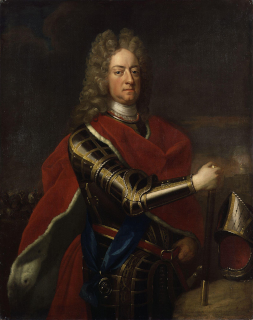
(Pictured: Portrait of James Butler, 2nd Duke of Ormonde, by Michael Dahl, National Portrait Gallery)


Leave a comment

Death of James Butler, 2nd Duke of Ormonde

James FitzJames Butler, 2nd Duke of Ormonde, KG, Irish statesman and soldier, dies in Avignon on November 16, 1745. He is the third of the Kilcash branch of the family to inherit the earldom of Ormond. He serves in the campaign to put down the Monmouth Rebellion, in the Williamite War in Ireland, in the Nine Years’ War and in the War of the Spanish Succession but is accused of treason and goes into exile after the Jacobite rising of 1715.

Butler is born into a Protestant family on April 29, 1665, at Dublin Castle. He is the second but eldest surviving son, and one of eleven children, of Thomas Butler by his wife Emilia van Nassau-Beverweerd. His father is known as Lord Ossory. His father is heir apparent of James Butler, 1st Duke of Ormond but predeceases him and so never becomes duke. His father’s family, the Butler dynasty, is Old English and descends from Theobald Walter, who had been appointed Chief Butler of Ireland by King Henry II in 1177. His mother is Dutch. She descends from a cadet branch of the House of Nassau.

Butler is educated in France and afterwards at Christ Church, Oxford. On the death of his father on July 30, 1680, he becomes Baron Butler in the peerage of England and the 7th Earl of Ossory in the peerage of Ireland.

Butler obtains command of a cavalry regiment in Ireland in 1683 and having received an appointment at court on the accession of James II, he serves against the Duke of Monmouth at the Battle of Sedgemoor in July 1685. Having succeeded his grandfather as 2nd Duke of Ormonde on July 21, 1688, he is appointed a Knight of the Order of the Garter on September 28, 1688. In 1688, he also becomes Chancellor of the University of Dublin and Chancellor of the University of Oxford.

In January and February 1689, Butler votes against the motion to put William of Orange and Mary on the throne and against the motion to declare that James II has abdicated it. Nevertheless, he subsequently joins the forces of William of Orange, by whom he is made colonel of the 2nd Troop of Horse Guards on April 20, 1689. He accompanies William in his Irish campaign, debarking with him in Carrickfergus on June 14, 1690, and commands this troop at the Battle of the Boyne in July 1690. In February 1691 he becomes Lord Lieutenant of Somerset.

Butler serves on the continent under William of Orange during the Nine Years’ War and, having been promoted to major general, he fights at the Battle of Steenkerque in August 1692 and the Battle of Landen in July 1693, where he is taken prisoner by the French and then exchanged for the Duke of Berwick, James II’s illegitimate son. He is promoted to lieutenant general in 1694.

After the accession of Queen Anne in March 1702, Butler becomes commander of the land forces co-operating with Sir George Rooke in Spain, where he fights in the Battle of Cádiz in August 1702 and the Battle of Vigo Bay in October 1702 during the War of the Spanish Succession (1701–1714). Having been made a Privy Councillor, he succeeds Lord Rochester as Lord Lieutenant of Ireland in 1703. In 1704, he leases and rebuilds a property that becomes known as Ormonde Lodge in Richmond outside London.

Following the dismissal of the Duke of Marlborough, Butler is appointed Commander-in-Chief of the Forces and colonel of the 1st Regiment of Foot Guards on January 4, 1712, and Captain General on February 26, 1712. In the Irish Parliament he and the majority of peers support the Tory interest.

Butler plays a dramatic role at the notorious meeting of the Privy Council on March 8, 1711, when Antoine de Guiscard, a French double agent who is being questioned about his treasonable activities, attempts to assassinate Robert Harley, 1st Earl of Oxford, against whom he has a personal grudge for drastically cutting his allowance, by stabbing him with a penknife. Harley is wounded, but not seriously, due largely to the fact that he is wearing a heavy gold brocade waistcoat in which the knife gets stuck. Several Councillors, including Butler, stab Guiscard in return. Guiscard implores Butler to finish the deed, but he replies that it is not for him to play the hangman. In any case, he has the sense to see that Guiscard must be kept alive at least long enough to be questioned, although as it turns out Guiscard’s wounds are fatal, and he dies a week later.

On April 23, 1712, Butler leaves Harwich for Rotterdam to lead the British troops taking part in the war. Once there he allows himself to be made the tool of the Tory ministry, whose policy is to carry on the war in the Netherlands while giving secret orders to him to take no active part in supporting their allies under Prince Eugene. In July 1712, he advises Prince Eugene that he can no longer support the siege of Le Quesnoy and that he is withdrawing the British troops from the action and instead intends to take possession of Dunkirk. The Dutch are so exasperated at the withdrawal of the British troops that they close the towns of Bouchain on Douai to British access, despite the fact that they have plenty of stores and medical facilities available. Butler takes possession of Ghent and Bruges as well as Dunkirk, in order to ensure his troops are adequately provided for. On April 15, 1713, he becomes Lord Lieutenant of Norfolk.

Ormonde’s position as Captain-General makes him a personage of much importance in the crisis brought about by the death of Queen Anne and, during the last years of Queen Anne, he almost certainly has Jacobite leanings and corresponds with the Jacobite Court including his cousin, Piers Butler, 3rd Viscount Galmoye, who keeps barrels of gunpowder at Kilkenny Castle. King George I, on his accession to the throne in August 1714, institutes extensive changes and excludes the Tories from royal favour. Butler is stripped of his posts as Captain-General, as colonel of the 1st Regiment of Foot Guards and as Commander in Chief of the Forces with the first two posts going to the Duke of Marlborough and the role of Commander-in-Chief going to John Dalrymple, 2nd Earl of Stair. On November 19, 1714, Butler is instead made a member of the reconstituted Privy Council of Ireland.

Accused of supporting the Jacobite rising of 1715, Butler is impeached for high treason by Lord Stanhope on June 21, 1715. He might avoid the impending storm of Parliamentary prosecution, if he remains in England and stands trial but instead, he chooses to flee to France in August 1715 and initially stays in Paris with Lord Bolingbroke. On August 20, 1715, he is attainted, his estate forfeited, and honours extinguished. The Earl Marshal is instructed to remove the names and armorial bearings of Butler and Bolingbroke from the list of peers and his banner as Knight of the Garter is taken down in St. George’s Chapel.

On June 20, 1716, the Parliament of Ireland passes an act extinguishing the regalities and liberties of the county palatine of Tipperary; for vesting Butler’s estate in the crown and for giving a reward of £10,000 for his apprehension, should he attempt to land in Ireland. But the same parliament passes an act on June 24, 1721, to enable his brother, Charles Butler, 1st Earl of Arran, to purchase his estate, which he does accordingly.

Butler subsequently moves to Spain where he holds discussions with Cardinal Giulio Alberoni. He later takes part in a Spanish and Jacobite plan to invade England and puts James Francis Edward Stuart on the British throne in 1719, but his fleet is disbanded by a storm in the Bay of Biscay. In 1732, he moves to Avignon, where he is seen in 1733 by the writer Lady Mary Wortley Montagu. He dies at Avignon in exile on November 16, 1745, but his body is returned to London and buried in Westminster Abbey on May 22, 1746.

On July 20, 1682, Butler, then called Lord Ossory, marries Lady Anne Hyde, daughter of Laurence Hyde, who is then Viscount Hyde of Kenilworth but becomes Earl of Rochester in November. The couple has a daughter, Mary, who dies young in 1688.

Following the death of his first wife in 1685, Butler plans to marry again in order to secure a male heir. He gains permission from the House of Lords for the arranging of a jointure for another marriage in May 1685, and in August of that year, he marries Lady Mary Somerset, daughter of the Duke of Beaufort and Mary Capel. The couple has a son, Thomas (1686–1689), and two daughters, Elizabeth (1689–1750) and Mary (1690–1713). His second wife is a Lady of the Bedchamber to Queen Anne. Their younger daughter, Mary, marries John Ashburnham, 1st Earl of Ashburnham.

(Pictured: Portrait of James Butler, 2nd Duke of Ormonde, by Michael Dahl, National Portrait Gallery)


Leave a comment

Birth of Luis de Lacy, Spanish Soldier of Irish Descent

Luis Roberto de Lacy, a Spanish professional soldier of Irish descent who serves in the Spanish and French Imperial armies, is born on January 11, 1775, in San Roque, Cádiz, Spain.

De Lacy is born to Lieutenant-Colonel Patrick de Lacy, an officer in the Ultonia or Ulster Regiment, a foreign unit or Infantería de línea extranjera of the Spanish army. Patrick dies sometime before 1785 and his wife, Antonia, remarries Jean Gautier, another Ultonia officer. His grandfather, General Patrick de Lacy y Gould, came from Limerick. Along with many relatives, he was part of the post-1691 Irish diaspora known as the Flight of the Wild Geese.

De Lacy is commissioned into the Ultonia regiment when he is ten, although his age is recorded as thirteen to satisfy minimum requirements. Issuing commissions to children is not unusual, as they are considered private investments and often used to provide pensions for orphans. Although by now the Ultonia is no longer “Irish,” many of the officers are Spanish-born descendants of the original Irish emigrants, including his uncle Francis and various cousins.

In 1789, de Lacy joins an expedition to Puerto Rico, accompanied by his stepfather. They apparently quarrel and, on their return, de Lacy walks to Porto, in Portugal, intending to take ship to the Maluku Islands, before his stepfather brings him home.

Promoted captain, de Lacy takes part in the War of the Pyrenees against France, which ends with the April 1795 Peace of Basel. He is posted to the Canary Islands in 1799, where he fights a duel with the local Capitán-General. Despite being transferred to El Hierro, he continues their feud. He is court-martialed as a result and sentenced to one year in the Royal Prison at the Concepción Arsenal at Cádiz.

De Lacy’s jailers allegedly consider him mentally unbalanced. As a result, he is stripped of his commission and barred from re-enlisting in the Spanish army. He moves to France in order to continue his career and is appointed captain in the Irish Legion, a French army unit formed in Brittany and intended to support an Irish rising. Although many of its officers are Irish exiles or of Irish descent, the rank and file are mostly Polish.

When the proposed rebellion fails to materialise, the Legion is posted to the Netherlands, where it remains until the War of the Third Coalition ends in 1806. De Lacy is appointed commandant of the second battalion, which participates in the 1807 Invasion of Portugal. In March 1808, Charles IV of Spain abdicates in favour of his son, Ferdinand, who is replaced in May by Joseph Bonaparte and held in France.

De Lacy arrives in Madrid shortly before the May 1808 revolt known as the Dos de Mayo. He deserts and is reinstated in the Spanish army as colonel of the Burgos regiment.

In July 1809, de Lacy is given command of the Isla de León, an important defensive position in Cádiz, home of the Regency Council that rules Spain in Ferdinand’s absence. He leads the 1st Division at the Battle of Ocaña on November 19, 1809. The collapse of the Spanish cavalry under Manuel Freire de Andrade exposes him to a flank attack that practically annihilates his division. A second defeat at Alba de Tormes on November 29 leaves the Spanish unable to confront the French in open battle and they resort to guerrilla tactics.

Although Cádiz is besieged by the French from February 1810 to August 1812, support from the Royal Navy allows the Council to send small amphibious expeditions intended to bolster resistance elsewhere. De Lacy leads landings in Algeciras, Ronda, Marbella and Huelva and although unable to hold them, this absorbs French resources. In March 1811, his troops support an Anglo-Spanish attempt to break the siege of Cádiz. The resulting Battle of Barrosa is a significant victory, although command failures mean the siege continues.

After the loss of Tarragona in June 1811, de Lacy replaces the Marquess of Campoverde as Capitán-General of Catalonia, a position held by his uncle Francis from 1789 to 1792. French efforts to capture Valencia weaken them elsewhere and provide the Spanish opportunities for partisan warfare. He leads a series of incursions into the French departments of Haute-Garonne and Ariège. These restore local morale and force the French to send reinforcements.

Most major towns, including Barcelona, Tarragona and Lleida, remain in French hands and in early 1812, Napoleon makes Catalonia part of France. The focus on guerrilla tactics lead to an increasingly bitter war of reprisals and executions by both sides, which severely impact the civilian population. Many of the partisan bands are beyond central control and their operations often indistinguishable from simple brigandage. This leads to conflict between de Lacy and local Catalan leaders and in January 1813, he moves to Santiago de Compostela as Captain General of the Kingdom of Galicia. He assumes command of the Reserva de Galicia, which he focuses on disciplining and reorganising. Following Allied victory at Vitoria in June 1813, the French withdraw from Spain and Ferdinand returns to Madrid in April 1814.

Ferdinand rejects a previous commitment to accept the Spanish Constitution of 1812 and establishes an absolutist regime. Spain also faces colonial wars in the Americas, which begin in 1810 and continue until 1833. This destabilises the regime and leads to a series of attempted coups, by military officers like de Lacy backed by progressive civilian elements, often linked by Freemasonry.

Following failed attempts in 1815 and 1816, de Lacy returns to Barcelona and assisted by a former subordinate, Francisco Milans del Bosch, plan another. This begins on April 5, 1817, but quickly collapses. De Lacy is captured, court-martialed, and sentenced to death. Following public protests against the sentence, he is secretly taken to Palma de Mallorca, held at Bellver Castle and executed there by firing squad on July 5, 1817.

In 1820, a revolt led by Colonel Rafael del Riego forces Ferdinand to restore the 1812 Constitution. This begins the Trienio Liberal, a period of liberalisation that ends in 1823, when a French army allows Ferdinand to re-assert control. However, in 1820 the reconstituted Cortes Generales declares de Lacy a martyr. Along with others including Riego, he is commemorated on a plaque in the Palacio de las Cortes, Madrid, which can still be seen today. De Lacy is buried at the Cementiri de Sant Andreu, in Barcelona.