
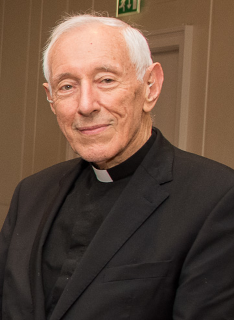
Patrick Coveney, Irish prelate of the Catholic Church who works in the diplomatic service of the Holy See from 1966 to 2009, is born in Tracton, County Cork, on July 29, 1934. He becomes an archbishop in 1985 and fulfills several assignments as Apostolic Nuncio, including stints in Zimbabwe, Ethiopia, New Zealand, and Greece.
Coveney obtains the academic degree of Bachelor of Arts in classical languages and literature at Maynooth College, and the Licentiate of Sacred Theology at the Pontifical Irish College in Rome, Italy. He is ordained as a priest at the age of twenty-four on February 21, 1959, by the archbishop vicegerent (deputy vicar general of Rome) Luigi Traglia in the Archbasilica of Saint John Lateran.
After doing parish work in Kidlington, England, Coveney teaches in St. Finbarr’s College, the minor seminary of the Diocese of Cork and Ross in Cork from 1960 to 1966. When use of the vernacular language is introduced into the celebration of the Roman Rite Mass, he edits a lectionary in English.
In September 1966, Coveney goes to work in the English-language section of the Secretariat of State in the Vatican. This sometimes involves acting as interpreter at audiences of Pope Paul VI, as when the Pope receives the three astronauts of the Apollo 11 mission that first lands human beings on the Moon.
At the Pontifical Lateran University Coveney obtains the degree of Doctor of Canon Law in 1969.
To prepare for a diplomatic career Coveney enters the Pontifical Ecclesiastical Academy in 1969 and enters the diplomatic service of the Holy See in 1971.
Coveney serves with the rank of Secretary in the Apostolic Nunciature in Buenos Aires from 1972 to 1976, returning then to the Secretariat of State in the Vatican. He is counselor of the nunciatures in New Delhi (1982–1984) and Khartoum (1984–1985).
On July 27, 1985, Coveney is appointed titular Archbishop of Satrianum and Apostolic Pro-Nuncio to Zimbabwe and Apostolic Delegate to Mozambique. He is ordained to the episcopate on September 15, 1985, in the Cathedral of St. Mary and St. Anne, Cork. The principal consecrator is the Cardinal Secretary of State Agostino Casaroli. The principal co-consecrators are Archbishop Gaetano Alibrandi, Apostolic Nuncio to Ireland, and Bishop Michael Murphy, Bishop of Cork and Ross. In Harare, capital of Zimbabwe, he represents the Holy See at the 8th Summit Conference of the Non-Aligned Movement on September 1–6, 1986.
On January 25, 1990, Coveney is appointed Nuncio to Ethiopia and also becomes Apostolic Delegate to Djibouti on March 26, 1992, and Nuncio to Eritrea on September 30, 1995.
Coveney becomes Apostolic Nuncio to New Zealand, Tonga, the Marshall Islands, and Samoa, and Apostolic Delegate for Oceania on hpril 27, 1996. His remit is expanded to include Apostolic Nuncio to Fiji, Kiribati, the Federated States of Micronesia, and Vanuatu on October 15, 1996, and Apostolic Nuncio to Nauru on December 7, 1996. He is also named Apostolic Nuncio to the Cook Islands and Palau on July 14, 2001. As the longest-serving resident diplomatic representative to New Zealand, Archbishop Coveney serves for a time as Dean of the Diplomatic Corps. While based in Wellington, he also represents the Holy See at the inauguration of Chen Shui-bian as president of the Republic of China (Taiwan) on May 18, 2004.
Coveney’s last diplomatic appointment is as Apostolic Nuncio to Greece on January 25, 2005. On November 5, 2008, he officiates at the presentation to the Acropolis Museum in Athens of a fragment of the Parthenon Frieze on loan from the Vatican Museums. He resides in Athens until his retirement in 2009.
Coveney returns to the Diocese of Cork and Ross to reside in Crosshaven Parish. He assists in Crosshaven parish and celebrates the Sacrament of Confirmation in many parishes throughout the Diocese of Cork and Ross. He dies at the age of 88 on October 22, 2022.

 seamus dubhghaill