seamus dubhghaill

Promoting Irish Culture and History from Little Rock, Arkansas, USA


Leave a comment

Death of Chicago May

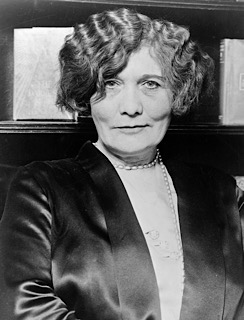
Chicago May, the nickname of Mary Anne Duignan, an Irish-born criminal who becomes notorious in the United StatesUnited Kingdom and France, dies in Philadelphia, Pennsylvania, on May 30, 1929. She refers to herself as the “queen of crooks” and sometimes uses the name May Churchill.

Duignan is born in Edenmore, BallinamuckCounty Longford, on December 26, 1871. In 1890, at the age of 19, she steals the proceeds earned by her parents from a recent cattle fair and runs away to Liverpool, England where she buys new clothes and books a ticket to America. Upon arrival in New York City she supports herself by prostitution and picking pockets.

She moves to Chicago to take advantage of the large influx of visitors at the 1893 World’s Columbian Exposition. She teams up with another prostitute. One robs customers while the other is having sex with them. She returns to New York City, where she works as a dancer, but is soon arrested for stealing a wallet, earning her first jail sentence. She briefly marries friend Jim Sharpe but the couple soon separates. After this, she calls herself May Churchill Sharpe. She soon establishes herself with the local criminal underworld, becoming involved in various crimes, mostly of a petty nature, including fraud, assault, brawling, drunk and disorderly behaviour, beggary and pickpocketing.

Duignan has various criminal lovers, but she graduates from petty criminality to major crime when she meets Eddie Guerin, who organises a robbery of the American Express office in Paris. She is imprisoned for her role in the crime. She operates her schemes on four continents and in nine countries. She reaches the height of her career in England when she is taken up by aristocrat Sir Sidney Hamilton Gore, who supposedly proposes marriage to her, shortly before he shoots himself.

After Guerin escapes from a French prison island, he makes his way to London where he meets Duignan again, but the relationship turns sour. She takes up with a burglar named Charley Smith. In 1907, during an altercation with Guerin, Smith shoots him, wounding him in the foot. Smith and Duignan are both accused of attempted murder. She is convicted and sentenced to 15 years. She is released in 1917, and returns to the United States.

By the 1920s, Duignan is living in Detroit and has become destitute. No longer young, she is reduced to propositioning men on the streets and is repeatedly arrested for soliciting and common prostitution. She hopes to make money from her former notoriety by writing magazine articles and an autobiography with the help of a journalist, which is published in 1928 as Chicago May, Her Story, by the Queen of Crooks. Her former lover Guerin publishes his own life story at the same time, under the title I Was a Bandit. She dies at the age of 58 in Philadelphia on May 30, 1929.


Leave a comment

Birth of Nuala O’Faolain, Journalist, TV Producer, Teacher & Writer

Nuala O’Faolain, Irish journalist, television producer, book reviewer, teacher and writer, is born in Clontarf, Dublin on March 1, 1940. She becomes well known after the publication of her memoirs Are You Somebody? and Almost There. She also writes a biography of Irish criminal Chicago May and two novels.

O’Faolain is the second eldest of nine children. Her father, known as ‘TerryO’ is a well-known Irish journalist, writing the “Dubliners Diary” social column under the pen name Terry O’Sullivan for the Evening Press. She is educated at University College Dublin (UCD), the University of Hull, and the University of Oxford. She teaches for a time at Morley College in London and works as a television producer for the BBC and Raidió Teilifís Éireann.

O’Faolain describes her early life as growing up in a Catholic country which, in her view, fears sexuality and forbids her even information about her body. In her writings she often discusses her frustration at the sexism and rigidity of roles in Catholic Ireland that expect her to marry and have children, neither of which she does.

O’Faolain becomes internationally well known for her two volumes of memoir, Are You Somebody? and Almost There; a novel, My Dream of You; and a history with commentary, The Story of Chicago May. The first three are all featured on The New York Times Best Seller list. Her posthumous novel Best Love, Rosie is published in 2009.

O’Faolain’s formative years coincide with the emergence of the women’s movement, and her ability to expose misogyny in all its forms is formidable, forensic and unremitting. However, her feminism stems from a fundamental belief in social justice. Unlike most commentators, who maintain a detached, lofty tone, she places herself at the centre of things, a high-risk strategy that works because of her broad range of erudition, worn lightly, her courage and a truthfulness that sometimes borders on the self-destructive.

O’Faolain is engaged at least once but never marries. In Are You Somebody? she speaks candidly about her fifteen-year relationship with the journalist Nell McCafferty, who publishes her own memoir, Nell. From 2002 until her death, she lives much of the time with Brooklyn-based attorney John Low-Beer and his daughter Anna. They are registered as domestic partners in 2003.

O’Faolain splits her time between Ireland and New York City. She is diagnosed with metastatic cancer and is interviewed on the Marian Finucane radio show on RTÉ Radio 1 on April 12, 2008, in relation to her terminal illness. She tells Finucane, “I don’t want more time. As soon as I heard I was going to die, the goodness went from life.”

In a last attempt to grasp as much of life as she can, O’Faolain holidays with family members in Sicily and visits Berlin with a group of friends to hear music and see art. She previously tended to avoid Berlin because, through contact with Jewish friends and lovers, she associated it with the Holocaust. She dies at the Blackrock Hospice, Dublin, on May 9, 2008.

O’Faolain wins a Jacob’s Award in 1985 for her work as the producer of the RTÉ One television programme Plain Tales. In 2006, she wins the Prix Femina étranger, a French literary award, for The Story of Chicago May.

O’Faolain is the subject of a film documentary, Nuala: A Life and Death (2011), directed by Patrick Farrelly and Kate O’Callaghan, and produced and narrated by Marian Finucane. Hugo Hamilton‘s novel Every Single Minute (2014) is based on his experiences when accompanying O’Faolain to Berlin shortly before her death.