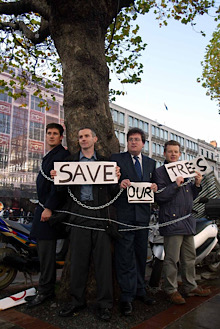
The action is a last-ditch attempt to save Dublin’s heritage from redevelopment plans. The Green Party, a relatively new political force in Ireland at the time, uses the protest to draw public attention to the cultural and historical value of the city’s landmarks, arguing that they should be preserved rather than replaced with modern structures.
The protest involves chain‑linking themselves to trees in the street, a symbolic act meant to physically block demolition work and to make the issue impossible to ignore. This tactic is designed to create a visible, media‑friendly demonstration that will pressure the government and developers to reconsider the plans.
The 2002 Irish general election has just seen the Green Party win six seats, marking a significant political breakthrough for the party. The O’Connell Street protest is part of a broader campaign to assert the party’s role in protecting Ireland’s heritage and environment, themes central to its platform.
While the immediate outcome of the protest is not detailed in the provided sources, such symbolic actions are common in Irish political history to highlight environmental and heritage concerns, and they help cement the Green Party’s image as a defender of Ireland’s cultural identity.
(Pictured: Green Party TDs Ciaran Cuffe, Dan Boyle, party leader Trevor Sargent and Eamon Ryan in Dublin’s O’Connell Street where they have chained themselves to highlight the council’s proposed plan to chop down all the trees in the capital’s main street. Picture credit: Billy Higgins)
Cuffe joins the Green Party in 1982, and campaigns with Students Against the Destruction of Dublin (SADD) in the 1980s. He is twice elected to Dublin City Council, in 1991 and 1999, for the South Inner City electoral area. In 1996, he launches a free bikes scheme in which bicycles are placed around Dublin city centre for use by the public.
In June 2003, Cuffe steps down as the Green Party’s environment spokesperson after it is revealed that he held shares worth $70,000 in a number of oil exploration companies which he had inherited when his late mother had left him $1.3 million in her will. He is re-elected at the 2007 Irish general election.
Following the 2007 election, the Green Party forms a coalition government with two other political parties and a number of independent TDs. Just after the election, on May 28, 2007, Cuffe writes in his blog: “A deal with Fianna Fáil would be a deal with the Devil. We would be spat out after 5 years and decimated as a party.” He loses his seat at the 2011 Irish general election.
While Cuffe is minister, the Oireachtas enacts the Planning and Development (Amendment) Act 2010 to address land-use planning failures and over-zoning of development land. The legislation reforms the way development plans and local area plans are made and, for the first time in Irish legislation, includes a definition of Anthropogenic Climate Change and required energy use to be taken into account in planning decisions. He publishes the Climate Change Response Bill 2010, and an update of the National Spatial Strategy. He is head of the Irish delegation at the 2010 United Nations Climate Change Conference in Cancún, Mexico.
Cuffe promotes healthy eating for children, school gardens and local markets. He publishes bills to address climate change, noise pollution, and heritage protection. In January 2011, he launches a new policy of allowing bicycles on off-peak Dublin Area Rapid Transit (DART) trains.
Cuffe resigns as Minister of State on January 23, 2011, when the Green Party withdraws from government.
At the 2014 Irish local elections, Cuffe is elected to Dublin City Council for Dublin North Inner City area, on the 13th count. He is appointed chairperson for the Dublin City Council Transportation Committee in 2014. As a member of the Central Area Committee for Dublin City Council, he works to provide a site for the Gaelscoil Choláiste Mhuire primary school on Dominick Street in 2017. He introduces 30 km/h speed limits to residential and school areas of Dublin and also advocates for a car-free College Green. He calls for an increase in affordable housing in Dublin, specifically for people with different incomes. Speaking on the Strategic Development Zone in the Dublin Docklands, he states, “We have seen a lot of cranes in the Docklands but not a lot of homes. Particularly affordable homes.” He proposes a Motion declaring a Climate Emergency which is approved at a meeting of the Council on May 13, 2019.
Cuffe is selected as the Green Party candidate for the Dublin constituency at the 2019 European Parliament elections. He tops the poll, receiving 63,849 votes and is elected as an MEP on the 13th count, with 17.54% first preference votes. He is also re-elected to Dublin City Council, but due to the prohibition on a dual mandate, this seat is co-opted to fellow Green Party member Janet Horner.
Cuffe is President of the European Forum for Renewable Energy Sources (EUFORES), a cross-party European parliamentary network gathering members of European, regional and national parliaments of the EU, and works to promote renewable energy and energy efficiency.
Boyd Barrett is adopted as a baby and is raised as a Roman Catholic in Glenageary, County Dublin, by his parents, David Boyd Barrett, an accountant, and his wife, Valerie. He attends St. Michael’s College in Dublin. He holds a master’s degree in English literature from University College Dublin (UCD). His birth mother is Sinéad Cusack, with whom he is later reunited in public. Since their reunion, he has had a good relationship with Cusack, her husband Jeremy Irons, and his half-brothers, Sam and Max. In May 2013, he reveals that theatre director Vincent Dowling is his biological father.
Boyd Barrett again contests the Dún Laoghaire constituency at the 2011 Irish general election as part of the United Left Alliance. On the ballot paper, he is named a member of People Before Profit, because the United Left Alliance had not yet been registered as a political party. Following a “nail-biting two days” of counting and recounting votes, he is elected on the 10th count without reaching the quota.
As a TD, Boyd Barrett, supports protests against cuts to Dublin Bus services. In Dáil Éireann, he condemns the 2011 murder of PSNI officer Ronan Kerr as “an utterly brutal action, which leads back down a road which has failed.” Marie O’Halloran in The Irish Times describes his “consistently passionate outrage and opposition to the Government’s handling of the financial and banking crisis.”
Boyd Barrett speaks at the Dublin location of the October 15, 2011 global protests, inspired by the Spanish “Indignants” and the Occupy Wall Street movements. The same month he says Enda Kenny‘s government is engaging in “spin and disingenuity” to cover up its austerity policies, decrying the closure of hospital emergency departments around the country for “health and safety” reasons.
On November 2, 2011, Boyd Barrett leads the United Left Alliance TDs out of the Dáil, in protest against the government’s decision not to hold a debate on the payment of more than €700 million to Anglo Irish Bank bondholders. On December 15, 2011, he helps launch a nationwide campaign against a proposed household charge being brought in as part of the 2012 Irish budget. He is part of an Oireachtas delegation that meets the Bundestag‘s Budgetary and European Affairs committees in Berlin in late January 2012.