seamus dubhghaill

Promoting Irish Culture and History from Little Rock, Arkansas, USA


Leave a comment

Founding of the Auxiliaries Division of the Royal Irish Constabulary

The Auxiliary Division, generally known as the Auxiliaries or Auxies, a paramilitary unit of the Royal Irish Constabulary (RIC) during the Irish War of Independence (1919-21), is founded on July 27, 1920, by Major-General Henry Hugh Tudor. It is made up of former British Army officers, most of whom come from Great Britain and had fought in World War I.

In September 1919, the Commander-in-Chief, Ireland, Sir Frederick Shaw, suggests that the police force in Ireland be expanded via the recruitment of a special force of volunteer British ex-servicemen. During a Cabinet meeting on May 11, 1920, the Secretary of State for War, Winston Churchill, suggests the formation of a “Special Emergency Gendarmerie, which would become a branch of the Royal Irish Constabulary.” Churchill’s proposal is referred to a committee chaired by General Sir Nevil Macready, Commander-in-Chief of the British forces in Ireland. Macready’s committee rejects Churchill’s proposal, but it is revived two months later, in July, by the Police Adviser to the Dublin Castle administration in Ireland, Major-General Henry Hugh Tudor. In a memo dated July 6, 1920, Tudor justifies the scheme on the grounds that it will take too long to reinforce the Royal Irish Constabulary (RIC) with ordinary recruits. Tudor’s new “Auxiliary Force” is to be strictly temporary with its members enlisting for a year. Their pay is to be £7 per week (twice what a constable is paid), plus a sergeant’s allowances, and are to be known as “Temporary Cadets.” At that time, one of high unemployment, a London advertisement for ex-officers to manage coffee stalls at two pounds ten shillings a week receives five thousand applicants.

The Auxiliary Division is recruited in Great Britain from among ex-officers who had served in World War I, especially those who had served in the British Army (including the Royal Flying Corps). Most recruits are from Britain, although some are from Ireland, and others come from other parts of the British Empire. Many have been highly decorated in the war and three, James Leach, James Johnson, and George Onions, have been awarded the Victoria Cross (VC). Enlisted men who had been commissioned as officers during the war often find it difficult to adjust to their loss of status and pay in civilian life, and some historians have concluded that the Auxiliary Division recruited large numbers of these “temporary gentlemen.”

Piaras Béaslaí, a former senior member of the Irish Republican Army (IRA) who supports the Anglo-Irish Treaty, while paying tribute to the bravery of the Auxiliaries, notes that the force is not composed exclusively of ex-officers but contains “criminal elements,” some of whom robbed people on the streets of Dublin and in their homes.

Recruiting began in July 1920, and by November 1921, the division is 1,900 strong. The Auxiliaries are nominally part of the RIC, but actually operate more or less independently in rural areas. Divided into companies, each about one hundred strong, heavily armed and highly mobile, they operate in ten counties, mostly in the south and west, where IRA activity is greatest. They wear either RIC uniforms or their old army uniforms with appropriate police badges, along with distinctive tam o’ shanter caps. They are commanded by Brigadier-General Frank Percy Crozier.

The elite ex-officer division proves to be much more effective than the Black and Tans especially in the key area of gathering intelligence. Auxiliary companies are intended as mobile striking and raiding forces, and they score some notable successes against the IRA. On November 20, the night before Bloody Sunday, they capture Dick McKee and Peadar Clancy, the commandant and vice-commandant of the IRA’s Dublin Brigade, and murder them in Dublin Castle. That same night, they catch Liam Pilkington, commandant of the Sligo IRA, in a separate raid. A month later, in December, they catch Ernie O’Malley completely by surprise in County Kilkenny. He is reading in his room when a Temporary Cadet opens the door and walks in. “He was as unexpected as death,” says O’Malley. In his memoirs, the commandant of the Clare IRA, Michael Brennan, describes how the Auxiliaries nearly capture him three nights in a row.

IRA commanders become concerned about the morale of their units as to many Volunteers the Auxiliaries seem to be “super fighters and all but invincible.” Those victories which are won over the Auxiliaries are among the most celebrated in the Irish War of Independence. On November 28, 1920, for example, a platoon of Auxiliaries is ambushed and wiped out in the Kilmichael Ambush by Tom Barry and the 3rd Cork Brigade. A little more than two months later, on February 2, 1921, another platoon of Auxiliaries is ambushed by Seán Mac Eoin and the North Longford Flying Column in the Clonfin Ambush. On March 19, 1921, the 3rd Cork Brigade of the IRA defeats a large-scale attempt by the British Army and Auxiliary Division to encircle and trap them at Crossbarry. On April 15, 1921, Captain Roy Mackinnon, commanding officer of H Company of the Auxiliary Division, is assassinated by the Kerry IRA.

Successes require reliable intelligence and raids often bring no result — or sometimes worse. In one case, they arrest a Castle official, Law Adviser W. E. Wylie, by mistake. In another, more notorious case, on April 19, 1921, they raid the Shannon Hotel in Castleconnell, County Limerick, on a tip that there are suspicious characters drinking therein. The “suspicious characters” turn out to be three off-duty members of the RIC. Both sides mistake the other for insurgents and open fire. Three people, an RIC man, an Auxiliary Cadet and a civilian, are killed in the shootout that follows.

The Auxiliary Division is disbanded along with the RIC in 1922. Although the 1921 Anglo-Irish Treaty requires the Irish Free State to assume responsibility for the pensions of RIC members, the Auxiliaries are explicitly excluded from this provision. Following their disbandment, many of its former personnel join the Palestine Police Force in the British-controlled territory.

The anti-insurgency activities of the Auxiliaries Division have become interchangeable with those conducted by the Black and Tans, leading to many atrocities committed by them being attributed to the Black and Tans. Nevertheless, both British units remain equally reviled in Ireland.

The Auxiliaries are featured in historical drama films like Michael Collins, The Last September, and The Wind That Shakes the Barley.

(Pictured: Cap badge design for F Company of the Auxiliary Division of the Royal Irish Constabulary)

Leave a comment

The Clonfin Ambush

The Clonfin Ambush is carried out by the Irish Republican Army (IRA) on February 2, 1921, during the Irish War of Independence. It takes place in the townland of Clonfin between Ballinalee and Granard in County Longford. The IRA ambushes two lorries carrying members of the British Auxiliary Division, sparking a lengthy gun battle in which four Auxiliaries are killed and eight wounded. The Auxiliaries eventually surrender, and their weapons are seized. The IRA commander, Seán Mac Eoin, wins some praise for helping the wounded Auxiliaries. Following the ambush, British forces burn a number of houses and farms in the area, and shoot dead an elderly farmer.

The IRA’s North Longford Flying Column, twenty-one strong and led by Seán Mac Eoin, is formed in late 1920. In that year they kill four Royal Irish Constabulary (RIC) constables. In November, a company of the Auxiliary Division – a paramilitary police force made up of ex-military officers – has been stationed in the county to put down the local IRA and are reinforced in January 1921. Whereas previously the IRA had tried to operate in relatively large numbers, often attacking police barracks, from this point forward, their GHQ in Dublin orders smaller but more frequent attacks to be made.

The ambush site, on the road between Granard and Ballinalee, is well chosen. Mac Eoin selects a position where the ambushers have excellent cover and are barely visible to the British. The plan is to explode a mine as the lorries pass. The British assessment is that “the ambush was most cleverly laid.”

The IRA detonates the roadside improvised explosive device (IED) as two British lorries are passing a bridge, killing the driver of the first lorry instantly. The IRA unit then opens fire on the lorries, triggering a firefight lasting two hours. One of the Auxiliaries gets away and manages to summon reinforcements.

During the fighting, four members of the IRA party work their way around the flank of the Auxiliaries, killing their commander, Lt. Commander Francis Craven. After his death, the remaining policemen surrender. A total of four Auxiliaries are killed and eight wounded.

MacEoin’s treatment of his prisoners is humane. He congratulates them on the fight they had put up and prevents his fighters from assaulting the Auxiliaries. He also has water brought from nearby houses for the British wounded. When he is later captured by the British, three Auxiliaries testify at his court-martial to his generous treatment of them at Clonfin. Mac Eoin’s humane treatment reportedly delays the IRA’s getaway, and they are almost caught by 14 lorries of British reinforcements as they escape across Clonfin Wood. The IRA had captured 18 rifles, 20 revolvers ammunition, a Lewis gun and 800 rounds of ammunition.

In the aftermath of the ambush, British forces raid the nearby towns of Killoe, Ballinamuck, Drumlish, Ballinalee, Edgeworthstown, Granard and Ardagh. A number of houses and farms are burned. They shoot dead an elderly farmer, Michael Farrell, in reprisal for the ambush.

The IRA flying column lays low after the ambush and does not attempt any more attacks until the end of the month. MacEoin, the Longford IRA leader, is captured at Mullingar railway station in early March and charged with the murder of RIC DI MGrath. He is released in July under the terms of the Truce which ends hostilities. In his absence, the Longford IRA are not able to sustain the intensity of their campaign.

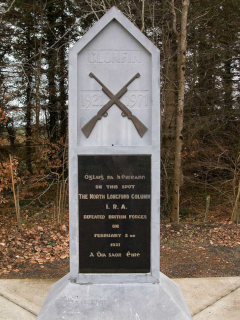
A stone monument is erected at the site of the ambush in 1971 to mark the 50th anniversary of the event. The IRA combatants are MacEoin (Ballinalee), Sean Duffy (Ballinalee), James J. Brady (Ballinamuck), Tom Brady (Cartronmarkey), Paddy Callaghan (Clonbroney), Seamus Conway (Clonbroney), Pat Cooke (Tubber), Seamus Farrelly (Purth), Paddy Finnegan (Molly), Larry Geraghty (Ballymore), Mick Gormley (Killoe), Hugh Hourican (Clonbroney), Jack Hughes (Scrabby), Mick Kenny (Clonbroney), Paddy Lynch (Colmcille), John McDowell (Clonbroney), Jack Moore (Streete), Mick Mulligan (Willsbrook), Michael F. Reynolds (Killoe), Sean Sexton (Ballinalee) and Jim Sheeran (Killoe).

(Pictured: The stone monument located at Clonfin, near the village of Ballinalee, County Longford, marking the site of the ambush. Erected in 1971 to mark the 50th anniversary of the event, the limestone monument features strong military, anti-British language and symbolism.)


Leave a comment

IRA Commander Seán Mac Eoin Captured at Mullingar

Seán Mac Eoin, Irish Republican Army (IRA) North Longford commander, is captured at Mullingar, County Westmeath, on March 1, 1921, and charged with the murder of a Royal Irish Constabulary (RIC) detective, dealing a severe blow to the IRA in that area.

Mac Eoin is born John Joseph McKeon on September 30, 1893, at Bunlahy, Granard, County Longford, the eldest son of Andrew McKeon and Catherine Treacy. After a national school education, he trains as a blacksmith at his father’s forge and, on his father’s death in February 1913, he takes over the running of the forge and the maintenance of the McKeon family. He moves to Kilinshley in the Ballinalee district of County Longford to set up a new forge.

Having joined the United Irish League in 1908, Mac Eoin’s Irish nationalist activities begin in earnest in 1913, when he joins the Clonbroney Company of the Irish Volunteers. Late that year he is sworn into the Irish Republican Brotherhood (IRB) and joins the Granard circle of the organization.

Mac Eoin comes to prominence in the Irish War of Independence as leader of an Irish Republican Army (IRA) flying column. In November 1920, he leads the Longford brigade in attacking Crown forces in Granard during one of the periodic government reprisals, forcing them to retreat to their barracks. On October 31, Inspector Philip St. John Howlett Kelleher of the RIC is shot dead in the Greville Arms Hotel in Granard. Members of the British Auxiliary Division set fire to parts of the town. The following day, Mac Eoin holds the village of Ballinalee situated on the Longford Road between Longford and Granard. They stand against superior British forces, forcing them to retreat and abandon their ammunition. In a separate attack on November 8, he leads his men against the RIC at Ballinalee. One constable is killed, and two others are wounded.

On the afternoon of January 7, 1921, a joint RIC and British Army patrol consisting of ten policemen appears on Anne Martin’s street. According to Mac Eoin’s own testimony at his trial he is in the house in partial uniform, wearing Sam Browne belt and revolver with two Mills No. 4 bombs in his pocket. Owing to some females being in the house, he has to get out as to not endanger them. He steps out on the street and opens fire with his revolver. The leading file falls and the second file brings their rifles to the ready. He then throws a bomb, after which he sees that the entire force has cleared away, save the officer who was dead or dying on the street.

On February 2, 1921, the Longford IRA ambushes a force of the Auxiliaries on the road at Clonfin, using a mine it had planted. Two lorries are involved, the first blown up, and the second strafed by rapid rifle fire. Four auxiliaries and a driver are killed and eight wounded. The IRA volunteers capture 18 rifles, 20 revolvers and a Lewis gun. At the Clonfin Ambush, Mac Eoin orders his men to care for the wounded British, at the expense of captured weaponry, earning him both praise and criticism. He is admired by many within the IRA for leading practically the only effective column in the midlands.

Mac Eoin is captured at Mullingar railway station on March 1, 1921, imprisoned and sentenced to death for the murder of an RIC district inspector in the shooting at Anne Martin’s street in January 1921.

In June 1921, Henry Wilson, the British Chief of the General Staff (CIGS), is petitioned for clemency by Mac Eoin’s mother, his brother Jemmy, and the local Church of Ireland vicar, but passes on the appeals out of respect for the latter two individuals. Three auxiliaries had already given character references on his behalf after he had treated them chivalrously at the Clonfin Ambush in February 1921. However, Nevil Macready, British Commander-in-Chief, Ireland, confirms the death sentence describing Mac Eoin as “nothing more than a murderer.”

While imprisoned Mac Eoin is elected to Dáil Éireann at the 1921 Irish elections, as a TD for Longford–Westmeath. He is eventually released from prison, along with all other members of the Dáil, after Michael Collins threatens to break off treaty negotiations with the British government unless they are freed.

Mac Eoin joins the National Army and is appointed GOC Western Command in June 1922. His military career soars after the Irish Civil War. He is appointed GOC Curragh Training Camp in August 1925, Quartermaster General in March 1927, and Chief of Staff in February 1929.

Mac Eoin resigns from the Army in 1929 and is elected at a by-election to Dáil Éireann for the Leitrim–Sligo constituency, representing Cumann na nGaedheal. At the 1932 Irish general election, he returns to the constituency of Longford–Westmeath and continues to serve the Longford area as TD until he is defeated at the 1965 Irish general election.

During a long political career Mac Eoin serves as Minister for Justice (February 1948 – March 1951) and Minister for Defence (March–June 1951) in the First Inter-Party Government, and again as Minister for Defence (June 1954 – March 1957) in the Second Inter-Party Government. He unsuccessfully stands twice as candidate for the office of President of Ireland, against Seán T. O’Kelly in 1945 and Éamon de Valera in 1959.

Mac Eoin retires from public life after the 1965 general election and dies in Dublin on July 7, 1973.