
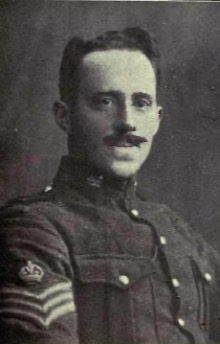
Frederick William Hall, VC, a Canadian recipient of the Victoria Cross, the highest and most prestigious award for gallantry in the face of the enemy that can be awarded to British and Commonwealth forces, is born in Kilkenny, County Kilkenny, on February 21, 1885.
Hall’s father is a British Army soldier from London. Hall emigrates to Canada approximately 1910, and lives in Winnipeg, Manitoba.
Hall is working as a clerk in Winnipeg when World War I starts. He enlists in the 8th Canadian Infantry Battalion (90th Winnipeg Rifles) at Valcartier Camp, Quebec, on September 26, 1914. He already has military experience. In addition to serving in the 106th Winnipeg Light Infantry of the Canadian Militia, he spends over 12 years in the British Army’s Cameronians (Scottish Rifles). He sees service in India and is awarded the Army Long Service and Good Conduct Medal. A teetotaller, He is a member of the British Army’s Temperance Association while with the Cameronians.
Hall is 30 years old, and a company sergeant major in the 8th Battalion (90th Winnipeg Rifles), Canadian Expeditionary Force, during World War I when he performs a deed for which he is awarded the Victoria Cross. The citation in The London Gazette reads:
“No. 1539 Colour Serjeant Frederick William Hall, 8th Canadian Battalion. On 24th April, 1915, in the neighbourhood of Ypres, when a wounded man who was lying some 15 yards from the trench called for help, Company Serjeant Major Hall endeavoured to reach him in the face of a very heavy enfilade fire which was being poured in by the enemy. The first attempt failed, and a Non-commissioned Officer and private soldier who were attempting to give assistance were both wounded. Company Serjeant Major Hall then made a second most gallant attempt, and was in the act of lifting up the wounded man to bring him in when he fell mortally wounded in the head.”
During the Second Battle of Ypres in Belgium, Hall discovers a number of men are missing. On the ridge above he can hear moans from the wounded men. Under cover of darkness, he goes to the top of the ridge on two separate occasions and returns each time with a wounded man.
By nine o’clock on the morning of April 24 there are still men missing. In full daylight and under sustained and intense enemy fire, Hall, Corporal Payne and Private Rogerson crawl out toward the wounded. Payne and Rogerson are both wounded, but return to the shelter of the front line. When a wounded man who is lying some 15 yards from the trench calls for help, Hall endeavours to reach him in the face of heavy fire by the enemy but is shot in the head. The soldier he was attempting to help, Private Arthur Edwin Clarkson, is also killed.
Hall has no known grave. His name is on the Menin Gate Memorial to the Missing in Ypres, Belgium, honouring 56,000 troops from Britain, Australia, Canada and India whose final resting place in the Ypres Salient is unknown. The Commonwealth War Graves Commission records that he is the son of Mary Hall, of Leytonstone, London, and the late Bombardier F. Hall.
Hall lives on Pine Street in Winnipeg. In 1925, Pine Street is renamed Valour Road because three Victoria Cross recipients resided on the same 700 block of that street: Hall, Leo Clarke and Robert Shankland. It is believed to be the only street in the Commonwealth of Nations to have three Victoria Cross recipients live on it. A bronze plaque is mounted on a street lamp at the corner of Portage Avenue and Valour Road to tell the tale of the three men.
Hill is also remembered in St. Helens, Merseyside, where he lives at the time of the 1891 United Kingdom census and uses as his home address until he leaves for Canada in 1910.
Hill’s medals are in the Canadian War Museum. The museum has acquired all three Valour Road Victoria Cross medals and they are on permanent display in Ottawa.

 seamus dubhghaill