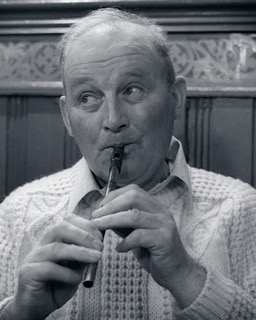
Russell is born in Doonagore, Doolin, County Clare, on March 25, 1915. He comes from a musically renowned family. His mother plays the concertina, and his father is a sean-nós singer. He has two brothers, Packie and Gussie, who are also musicians. He also has two sisters. He never marries.
Russell teaches himself to play the tin whistle by ear, beginning at the age of eleven. The 1960s revival of Irish traditional music brings him attention and performance opportunities. In 1973, he wins the All-Ireland tin whistle competition, which further increases demand for his performances. Like Séamus Ennis, he is also known for his spoken introductions to tunes in his live performances, which incorporate folklore and legend. His knowledge of tradition extends past music to language, stories, dance, herbal lore, and old country cures.
“Micho Russell’s Reel,” Russell’s only known composition, is a variant of an older tune he calls “Carthy’s Reel.” He tells Charlie Piggott, “…So Carthy was beyond anyway, and he heard the old tune from a piper playing it, and he had the first part but only three-quarters of the second part. So when Séamus Ennis came around collecting music, I put in the last bit. That’s roughly the story of the tune.” The reel has been recorded by other artists such as Mary Bergin. His best-known songs are John Phillip Holland and The Well of Spring Water.
Russell dies in a car accident on February 19, 1994, in Kilcolgan, County Galway, on his way home from a gig just prior to going back into the studio to record another CD.
Patrick J. Killoran, Irish traditional fiddle player, bandleader and recording artist is born on September 21, 1903, in Emlaghgissan (also spelled “Emlagation”), a townland in the civil parish of Emlaghfad near the town of Ballymote, County Sligo. He is regarded, along with James Morrison and Michael Coleman, as one of the finest exponents of the south Sligo fiddle style in the “golden age” of the ethnic recording industry of the 1920s and 1930s.
Killoran’s father Patrick plays the flute and his mother Mary the concertina, but he is also influenced by local fiddle master Philip O’Beirne, who had earlier tutored Michael Coleman. As a teenager, he is a volunteer with the Ballymote-based 3rd Battalion of the south Sligo Brigade of the Irish Republican Army (IRA) during the Irish War of Independence.
In 1925, Killoran emigrates to New York City, arriving on May 19 on the Cunard liner Scythia. Within a few months, he officially declares his intention to become a citizen of the United States, listing his address as 227 East 126th Street in east Harlem and his occupation as “laborer.” He later lodges with fellow Sligo fiddler James Morrison in a Columbus Avenue apartment on Manhattan‘s Upper West Side. A 1927 newspaper ad for “Morrison’s Orchestra” offers “Irish music by P. Killoran and J. Morrison, celebrated violinists,” giving 507 West 133d Street in west Harlem as the contact address. He soon launches his own career as a soloist and bandleader. A publicity photo of his quartet c. 1928 includes button accordionist D. Casey, tenor banjo player Richard Curran and second fiddler Denis Murphy. By the next year, he is performing on a weekly radio program sponsored by the Pride of Erin Ballrooms, located at the corner of Bedford and Atlantic Avenues in Brooklyn. He also tries another side occupation as his 1931 naturalization petition lists his occupation as “Music store owner.”
At the Pride of Erin, and later at the Sligo Ballroom at 125th Street and St. Nicholas Avenue in Harlem, Killoran’s “Irish Orchestra” provides music for Irish dancing, while Jack Healy, another Ballymote native, leads a group for “American” dancing. Healy, as a singer and tenor saxophone player, also performs and records with Killoran’s group, the membership of which over the course of the 1930s includes fiddler Paddy Sweeney, another Sligo native, fiddle and clarinet player Paul Ryan, Ryan’s brother Jim on the C Melody saxophone, pianists Eileen O’Shea, Edmund Tucker and Jim McGinn, drummer Mickey Murphy, button accordionists Tommy Flanagan and William McElligott and tenor banjo/tenor guitar player Michael “Whitey” Andrews.
Killoran’s band is variously billed as his “Pride of Erin Orchestra,” “Radio Dance Orchestra,” “Sligo Ballroom Orchestra,” “Lakes of Sligo Orchestra” and “Irish Barn Dance Boys.” The group is a popular choice for county association functions, particularly those of Sligo and Roscommon. In 1932, he leads a band that accompanies CardinalWilliam Henry O’Connell of Boston to the Eucharistic Congress in Ireland and briefly bills his group as the “Pride of Erin Eucharistic Congress Orchestra.” He regularly performs at Irish beach resorts on the Rockaway peninsula and in East Durham in the Catskill Mountains.
Uniquely among the major New York Irish musicians of the pre-World War II era, Killoran continues his musical career through the 1950s. He issues new recordings, including duets with flute player Mike Flynn and some fiddle-and-viola sides with Paul Ryan, and leads an active dance band. Age and illness eventually force him to retire, and in 1962 he turns over leadership of the band, a fixture at the City Center Ballroom, to button accordionist Joe Madden, father of Cherish the Ladies flute player Joanie Madden.
In 1956, Killoran is a co-founder of the Dublin Recording Company, later better known simply as Dublin Records, which is organized to record new Irish discs in New York.
Killoran is a founding member of the Emerald Irish Musicians Benevolent Society, a group that stages “Night of Shamrocks” concerts to raise money for the benefit of sick and deceased Irish musicians in New York. He is also a member of the Irish Musicians Association of America, and a New York branch of that organization, which later merges with Comhaltas Ceoltóirí Eireann, is named for him.
In addition to the 1932 trip to the Eucharistic Congress, Killoran returns to Ireland at least twice. In 1949, he plays on a Radio Éireann program hosted by piper and folklorist Séamus Ennis. Some selections from that broadcast are recorded on a private disc and are later released on CD. On a 1960 visit, he visits Sligo and Clare and performs at a concert in County Longford.
Killoran is married twice. His first wife, Anna Gorman, a native of County Roscommon, dies in 1935. His second wife is Betty (Bridget) Hayes, an immigrant from Shanaway West, County Clare, who survives him. He dies in New York City on April 24, 1965.
A “Paddy Killoran Traditional Festival” is celebrated in the third week of June in Ballymote, where a monument in Killoran’s honor is erected in 2012.
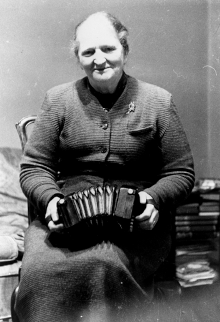
Markham is born on January 8, 1886, at Gower, Cooraclare, County Clare, the youngest in the large family of Michael Markham, farmer, and Margaret Markham (née Keane). She attends national school in Cooraclare from 1893 to 1899. Although she does not speak or understand the Irish language, as do her father and likely her mother, the Rosary is recited in Irish at home. She and a sister are the only siblings not to emigrate. Her mother plays the fiddle, while her older sister Margaret (Maggie) plays the concertina and probably influences her to do likewise. She has no single teacher and acquires tunes and her style of playing from neighbours and family friends. She begins to play a two-row German-type concertina at house dances throughout west Clare and becomes very much in demand.
In 1914, Markham marries Michael (Miko) Crotty from Gowerhass, the townland next to Gower. Miko had been in the United States for a couple of years and uses the money earned there to buy a public house on the Market Square in Kilrush, now known as “Crotty’s Pub.” They live in the Square in Kilrush and Miko bottles his own whiskey. The pub is an important venue for Irish traditional music, especially for those who wish to hear Crotty play. She remains relatively unknown outside of Clare until the early 1950s, and there are a relatively small number of recordings of her playing the concertina. The broadcaster Ciarán Mac Mathúna conducts recording sessions in her house in 1955 and she is to be heard on A Job of Journeywork, his programme on Radio Éireann. She possesses a number of concertinas, but the Lachenal that she purchases in the 1950s is her favourite and the one with which she is most closely identified. In 1954, she is a founder member and the first president of the Clare branch of Comhaltas Ceoltóirí Éireann. During her time as president, the All Ireland Fleadh is held in Ennis in 1956.
Crotty often sings the traditional song “An draighneán donn,” which is one of her favourites. Among tunes she enjoys playing are the “Ewe reel,” the “Dublin reel,” and “The maid of Mount Cisco,” along with “The wind that shakes the barley.” Her straight style of playing for dancing and dancers increases her popularity. Seán Ó Riada regards her as one of the finest concertina players he ever heard. Although she does not read or write staff notation, she creates a written code for herself by giving the concertina keys a number and by using a symbol for the press or draw movement on the concertina keys.
Crotty suffers from severe angina which necessitates visits for medical treatment to Dublin, where she becomes friends with fiddle player Kathleen Harrington (née Gardiner). They attend the Pipers’ Club in Thomas Street, play together on Radio Éireann, and travel together to fleadhanna.
Crotty dies on December 27, 1960, of an anginal attack while at her home. She is buried in (old) Shanakyle cemetery. She loses her first three children, and a son drowns in the River Shannon in 1945. Another son, Thomas, becomes a priest. A festival, ‘Éigse Mrs Crotty’, is held in her memory each summer in Kilrush. Her son Paddy gives three perpetual trophies for presentation at the All-Ireland Fleadh Cheoil.
(From: “Crotty, Elizabeth (‘Lizzie’)” by Ríonach uí Ógáin, Dictionary of Irish Biography, http://www.dib.ie, October 2009)
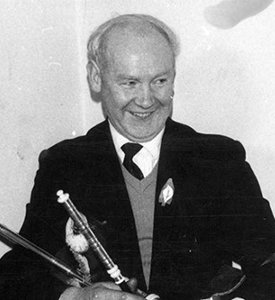
Clancy is born into a musical family in the outskirts of Milltown Malbay, County Clare on December 24, 1918. His parents, Gilbert Clancy and Ellen Killeen, both sing and play concertina, and his father also plays the flute. Clancy’s father has been heavily influenced by local blind piper Garret Barry and passes much of Barry’s music on to Willie.
Clancy starts playing the tin whistle at age five, and later takes up the flute. He first sees a set of pipes in 1936 when he sees Johnny Doran playing locally. He obtains his first set of pipes two years later. His influences include Leo Rowsome, Séamus Ennis, John Potts and Andy Conroy. Clancy wins the Oireachtas competition in 1947. Unable to earn a living from music he emigrates to London where he works as a carpenter.
Returning to Milltown Malbay in 1957 he records some influential 78 rpm recordings for the Gael Linn label, among them the classic reel selection “The Old Bush/The Ravelled Hank of Yarn.” The next decades he stayed in Milltown Malbay. He marries Dóirín Healy in 1962.
Willie Clancy dies suddenly at the early age of 55 on January 24, 1973, leaving a great void. Cór Cúl Aodha sings at his funeral mass, just as Clancy had played at Seán Ó Riada’s funeral only a year earlier. Others who take part include Seán Ach Donnchadha, John Kelly and Séamus Ennis. His funeral cortege to Ballard Cemetery is led by pipers from the Tulla Pipe Band.
The Willie Clancy Summer School is established in his honour in 1973, by Clancy’s friends Junior Crehan, Martin Talty, Seán Reid, Paddy Malone, Paddy McMahon, Frankie McMahon, Jimmy Ward, JC Talty, Harry Hughes, Michael O Friel, Séamus Mac Mathúna and Muiris Ó Rócháin. He is also the subject of a major television documentary “Cérbh É? Willie Clancy” on TG4, first broadcast in November 2009. In this programme, one of a series in which major figures in contemporary traditional music, profile and pay homage to a master of their craft from a bygone age, Peter Browne traces the life and legacy of Clancy.
(Photo courtesy of Mick O’Connor, flute player and friend of Willie Clancy)
Clancy’s parents, Gilbert Clancy and Ellen Killeen, both sing and play concertina, and his father also plays the flute. Clancy’s father has been heavily influenced by local blind piper Garret Barry and passes much of Barry’s music on to his son.
Clancy starts playing the whistle at age five, and later takes up the flute. He first lays eyes on a set of pipes in 1936 when he sees Johnny Doran playing locally. He obtains his first set of pipes two years later. His influences include Leo Rowsome, Séamus Ennis, John Potts, and Andy Conroy. Clancy wins the Oireachtas competition in 1947. Unable to earn a living from music he emigrates to London where he works as a carpenter.
Returning to Milltown Malbay shortly after the death of his father in 1957, Clancy records some influential 78 rpm recordings for the Gael Linn label, among them the classic reel selection “The Old Bush/The Ravelled Hank of Yarn.” He develops a highly distinctive and individual style of piping. From 1957 until 1972 the Summer music sessions in the West Clare town become widely renowned, with Clancy as one of the main attractions. Pipe-making, reed-making, and all things connected with the instrument are explored and advanced by the Clancy influence. He gives many performances on both radio and television as well as live sessions in his local area.
He lives out the remainder of his life in Milltown Malbay. Clancy marries Dóirín Healy in 1962. He dies suddenly in a hospital in Galway on January 24, 1973, and is widely mourned among friends and musicians alike. He is buried in Ballard Cemetary just outside Miltown Malbay.
Later that year the Willie Clancy Summer School is established in his honour by his friends Junior Crehan, Martin Talty, Sean Reid, Paddy Malone, Paddy McMahon, Frankie McMahon, Jimmy Ward, JC Talty, Harry Hughes, Michael O Friel, Séamus Mac Mathúna, and Muiris Ó Rócháin. He is also the subject of a major television documentary “Cérbh É? Willie Clancy” on TG4, first broadcast in November 2009. In this programme, one of a series in which major figures in contemporary traditional music, profile and pay homage to a master of their craft from a bygone age, Peter Browne traces the life and legacy of Clancy.
A statue of Clancy is unveiled on November 9, 2013 on the Main Street in Miltown Malbay.



 seamus dubhghaill