O’Donovan is born in County Kilkenny on July 25, 1806 and is the fourth son of Edmond O’Donovan and Eleanor Hoberlin of Rochestown. His early career is likely inspired by his uncle, Parick O’Donovan. He works for antiquarian James Hardiman researching state papers and traditional sources at the Public Records Office. He also teaches Irish to Thomas Larcom for a short period in 1828 and works for Myles John O’Reilly, a collector of Irish manuscripts.
Following the death of Edward O’Reilly in August 1830, O’Donovan is recruited to the Topographical Department of the first Ordnance Survey Ireland under George Petrie in October 1830. Apart from a brief period in 1833, he works steadily for the Survey on place-name researches until 1842, unearthing and preserving many manuscripts. After that date, O’Donovan’s work with the Survey tails off, although he is called upon from time to time to undertake place-name research on a day-to-day basis. He researches maps and manuscripts at many libraries and archives in Ireland and England, with the intent to establish the correct origin of as many of Ireland’s 63,000 townland names as possible. His letters to Larcom are regarded as an important record of the ancient lore of Ireland for those counties he documents during his years of travel throughout much of Ireland.
By 1845, O’Donovan is corresponding with the younger scholar William Reeves, and much of their correspondence to 1860 survives.
Never in great health, he dies shortly after midnight on December 10, 1861 at his residence in Dublin. He is buried on December 13, 1861 in Glasnevin Cemetery, where his tombstone inscription has slightly incorrect dates of both birth and death.
Mallet is born in Dublin on June 3, 1810, the son of factory owner John Mallet. He is educated at Trinity College, Dublin, entering it at the age of 16 and graduating in science and mathematics in 1830 at the age of 20.
Following his graduation, he joins his father’s iron foundry business and helps build the firm into one of the most important engineering works in Ireland, supplying ironwork for railway companies, the Fastnet Rock lighthouse, and a swing bridge over the River Shannon at Athlone. He also helps manufacture the characteristic iron railings that surround Trinity College, and which bear his family name at the base.
In 1838 he becomes a life member of the Royal Geological Society of Ireland and serves as its President from 1846–1848. From 1848–1849 he constructs the Fastnet Rock lighthouse, southwest of Cape Clear.
On February 9, 1846, he presents to the Royal Irish Academy his paper On the Dynamics of Earthquakes, which is considered to be one of the foundations of modern seismology. He is also credited with coining the word “seismology” and other related words which he uses in his research. He also coins the term epicentre.
From 1852 to 1858, he is engaged in the preparation of his work, The Earthquake Catalogue of the British Association (1858) and carries out blasting experiments to determine the speed of seismic propagation in sand and solid rock.
On December 16, 1857, the area around Padula, Italy is devastated by the Great Neapolitan earthquake which causes 11,000 deaths. At the time it is the third largest known earthquake in the world and has been estimated to have been of magnitude 6.9 on the Richter Scale. Mallet, with letters of support from Charles Lyell and Charles Darwin, petitions the Royal Society of London and receives a grant of £150 to go to Padula and record at first hand the devastation. The resulting report is presented to the Royal Society as the Report on the Great Neapolitan Earthquake of 1857. It is a major scientific work and makes great use of the then new research tool of photography to record the devastation caused by the earthquake. In 1862, he publishes the Great Neapolitan Earthquake of 1857: The First Principles of Observational Seismology in two volumes. He brings forward evidence to show that the depth below the Earth’s surface, from where the impulse of the Neapolitan earthquake originated, is about 8–9 geographical miles.
One of Mallet’s papers is Volcanic Energy: An Attempt to develop its True Origin and Cosmical Relations, in which he seeks to show that volcanic heat may be attributed to the effects of crushing, contortion, and other disturbances in the crust of the earth. The disturbances leading to the formation of lines of fracture, more or less vertical, down which water would find its way, and if the temperature generated be sufficient volcanic eruptions of steam or lava would follow.

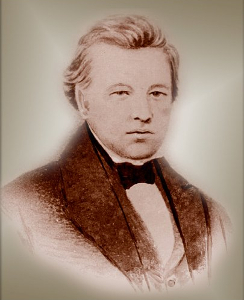 John O’Donovan, Irish language scholar, dies at his residence at 36 Upper Buckingham Street in Dublin on December 10, 1861.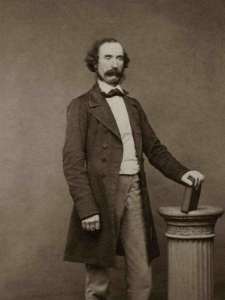
 seamus dubhghaill