seamus dubhghaill

Promoting Irish Culture and History from Little Rock, Arkansas, USA


Leave a comment

The Lansdowne Road Football Riot

The Lansdowne Road football riot occurs during a friendly football match between the Republic of Ireland and England in Lansdowne Road Stadium in Dublin on February 15, 1995.

The last time England had played Ireland at Lansdowne Road was a UEFA Euro 1992 qualifying Group 7 match on November 14, 1990. After that match, there were clashes between some Irish and English fans and the Gardaí on O’Connell Street in Dublin. Before the 1995 friendly match, the Football Association of Ireland (FAI) holds talks with The Football Association (The FA) to review security arrangements to avoid a similar episode. The FA is offered 4,000 out of approximately 40,000 tickets, for English fans.

In pubs near Lansdowne Road stadium some English fans chant “No surrender to the IRA,” “Fuck the Pope” and “Clegg is innocent.” Irish fans are goaded, spat on and attacked. Pub staff find British National Party (BNP) literature left behind and, in some cases, pro-Loyalist graffiti in toilets.

The match begins at 6:15 p.m., and after 22 minutes, David Kelly scores a goal for Ireland. When a David Platt goal is disallowed for England in the 26th minute due to Platt being offside, some of the English fans begin throwing debris down into the lower stands, including parts of benches which they had ripped out earlier in the match. When this happens, the referee immediately stops the game, and brings the players off the pitch. When Jack Charlton, the Irish manager and former England player, walks off the pitch, the mobs “Judas, Judas.” The fans in the lower stands then spill out onto the pitch to escape the missiles from the English fans. Some Irish fans had mistakenly been put into the area where the English fans are when the FA returned a number of tickets to the FAI.

After the teams leave the pitch, the frequency of missiles intensifies, and after 12 minutes, the game is called off, and the fans are evacuated, with the exception of 4,500 English fans, who are kept in the stadium until the Garda Public Order Unit attempts to escort them out, at which time more violence breaks out. The Gardaí are slow to reach the area where the rioters are, and there is some confusion as to the exact location of the English fans between the Gardaí and the stewards. Twenty people are injured during the rioting, and forty are arrested.

The rioting is condemned on both sides of the Irish Sea. England manager Terry Venables says, “It was terrible. I have no words strong enough to describe how we feel about this. There could be repercussions.” Jack Charlton says, “I have seen a lot in football but nothing like this. It is a disaster for Irish football, but I didn’t want the game abandoned because what do you do with 2,000 English fans running around the town? The English fans were being bombarded by some of their own. And they brought out the worst in some of ours.” The rioting brings into question England’s hosting of UEFA Euro 1996, with Ireland’s Minister of State for Youth and Sport, Bernard Allen asking, “How can people from Ireland and from other countries go to England and expect to be safe watching matches in the presence of people like those who were here tonight?” The Garda handling of the match is criticised in the press when it is revealed that the Gardaí had been informed of the plans of some of the English fans to cause trouble by the British National Criminal Intelligence Service (NCIS). The decision to seat the English fans in an upper tier is also questioned in the press.

After questions are raised about the conduct of the Gardaí, former Chief Justice of Ireland, Thomas Finlay, is appointed to investigate the events. He finds that the rioting was entirely caused by the English fans without any provocation. The investigation finds that the head of the NCIS had offered help to the Gardaí in dealing with the hooligans, an offer which the Gardaí refused. Gardaí failed to act on a warning that 20 supporters of the England team who wore insignia of Combat 18 were travelling to the match. The segregation of the fans was also found to be insufficient, and this was found to be a contributory factor to the incident.

The next meeting between the two sides does not take place until Wednesday, May 29, 2013, a friendly at Wembley Stadium, and the next meeting in the Republic of Ireland is on Sunday, June 7, 2015, at Dublin’s Aviva Stadium. Both games pass without major disturbances.

Leave a comment

Death of David Kelly, Film & Television Actor

David Kelly, Irish actor who has regular roles in several film and television works from the 1950s onwards, dies on February 12, 2012, in Goatstown, Dublin, following a short illness. One of the most recognisable voices and faces of Irish stage and screen, he is known for his roles as Rashers Tierney in Strumpet City, Cousin Enda in Me Mammy, the builder Mr. O’Reilly in Fawlty Towers, Albert Riddle in Robin’s Nest, and Grandpa Joe in the film Charlie and the Chocolate Factory (2005). Another notable role is as Michael O’Sullivan in Waking Ned.

Kelly is born on July 11, 1929, in Dublin, and educated at Dublin’s Synge Street CBS Christian Brothers school. He begins acting at the age of eight at the city’s Gaiety Theatre, encouraged by a teacher at school. He also performs with the Rathmines and Rathgar Musical Society and goes on to train at the Abbey School of Acting. As a backup career, he additionally trains as a draughtsman and calligrapher, and also learns watercolour painting. He appears onstage in the original production of Brendan Behan‘s The Quare Fellow, and gains his first major career attention in Samuel Beckett‘s Krapp’s Last Tape at Dublin’s Abbey Theatre in 1959. By then he has made his screen debut in a small part in director John Pomeroy’s 1958 film noir Dublin Nightmare.

One of Kelly’s first television appearances is on RTÉ in O’Dea’s Your Man (1964) in which he plays the part of Ignatius opposite Jimmy O’Dea. He goes on to become a familiar face on British television with the BBC comedy Me Mammy, opposite Milo O’Shea and Anna Manahan. He goes on to often-memorable guest roles on such series as Oh, Father! and Never Mind the Quality, Feel the Width, and particularly during the 1970s with a long-running role as the one-armed dishwasher Albert Riddle in the Man About the House spin-off Robin’s Nest. He also has a regular long running role alongside Bruce Forsyth in both series of the comedy Slinger’s Day from 1986 to 1987, and, in 1991, he appears in the first series of the BBC sitcom 2point4 Children as the cafe-owner Paddy.

Kelly gains some of his greatest recognition in 1975, playing inept builder Mr. O’Reilly on the second episode of Fawlty Towers (“The Builders”).

Kelly is in the voice cast of The Light Princess, a partly animated, hour-long family fantasy that airs on the BBC in 1978.

In Ireland, Kelly may be most famous for his portrayal of the character “Rashers” Tierney in the 1980 RTÉ miniseries Strumpet City, which stars Peter O’Toole, Cyril Cusack and Peter Ustinov. He goes on to have starring roles in television shows such as Emmerdale Farm in the 1980s and Glenroe in the 1990s, as well as playing the grandfather in Mike Newell‘s film Into the West (1992).

Following his appearance as Michael O’Sullivan in the 1998 film Waking Ned, Kelly plays roles in such films as Tim Burton‘s Charlie and the Chocolate Factory (2005), in which he plays Grandpa Joe, and Agent Cody Banks 2: Destination London (2004). He plays title character Frank Kovak in the mystery film The Kovak Box, in a rare villainous role. In 2007, he appears in Stardust, which features Robert De Niro and Michelle Pfeiffer, and which is also his final film. He also does extensive radio work, including a guest appearance on the BBC Radio 4 series Baldi.

Kelly is married to actress Laurie Morton, who survives him, along with children David and Miriam. He dies at age 82 after a short illness on February 12, 2012. The Irish Times refers to him as the “grand old man of Irish acting.” A Catholic funeral mass takes place on February 16, 2012, at the Church of the Miraculous Medal, in his hometown of Dublin. He is cremated at Mount Jerome Cemetery and Crematorium.

Kelly wins a 1991 Helen Hayes Award for Outstanding Supporting Performer, Non-Resident Production, for a Kennedy Center revival of The Playboy of the Western World. As well, he earns a Screen Actors Guild Awards nomination for the 1998 film Waking Ned. In 2005, he wins the Irish Film & Television Academy‘s Lifetime Achievement Award, in addition to earning a nomination for Best Supporting Actor for the film Charlie and the Chocolate Factory.


Leave a comment

Birth of Brian Hutton, Lord Chief Justice of Northern Ireland

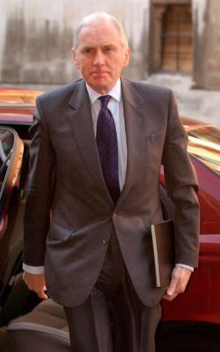
James Brian Edward Hutton, Baron Hutton, PC, a British Lord Chief Justice of Northern Ireland and Lord of Appeal in Ordinary, is born in Belfast, Northern Ireland, on June 29, 1932.

Hutton is the son of a railways executive. He wins a scholarship to Shrewsbury School and Balliol College, Oxford (BA jurisprudence, 1953) before returning to Belfast to study at Queen’s University Belfast and becoming a barrister, being called to the Bar of Northern Ireland in 1954. He begins working as junior counsel to the Attorney General for Northern Ireland in 1969.

Hutton becomes a Queen’s Counsel in 1970. From 1979 to 1989, as Sir Brian Hutton, he is a High Court judge. In 1989, he becomes Lord Chief Justice of Northern Ireland, becoming a member of the Privy Council of Northern Ireland, before moving to England to become a Lord of Appeal in Ordinary on January 6, 1997. He is consequently granted a life peerage as Baron Hutton, of Bresagh in the County of Down.

On March 30, 1994, as Lord Chief Justice of Northern Ireland, Hutton dismisses Private Lee Clegg‘s appeal against his controversial murder conviction. On March 21, 2002 he is one of four Law Lords to reject David Shayler‘s application to use a “public interest” defence as defined in section 1 of the Official Secrets Act 1989 at his trial.

Hutton represents the Ministry of Defence at the inquest into the killing of civil rights marchers on “Bloody Sunday.” Later, he publicly reprimands Major Hubert O’Neil, the coroner presiding over the inquest, when the coroner accuses the British Army of murder, as this contradicts the findings of the Widgery Tribunal.

Hutton also comes to public attention in 1999 during the extradition proceedings of former Chilean dictator General Augusto Pinochet. Pinochet had been arrested in London on torture allegations by request of a Spanish judge. Five Law Lords, the UK’s highest court, decide by a 3-2 majority that Pinochet is to be extradited to Spain. The verdict is then overturned by a panel of seven Law Lords, including Hutton, on the grounds that Lord Lennie Hoffmann, one of the five Law Lords, has links to human rights group Amnesty International which had campaigned for Pinochet’s extradition.

In 1978, Hutton defends the UK at the European Court of Human Rights in the case of Ireland v United Kingdom, when the court decides that the interrogation techniques used were “inhuman and degrading” and breached the European Convention on Human Rights, but do not amount to “torture.” The court also finds that the practice of internment in Northern Ireland had not breached the Convention. He sentences ten men to 1,001 years in prison on the word of “supergrass” informer Robert Quigley, who is granted immunity in 1984.

Hutton is appointed by Tony Blair‘s government to chair the inquiry on the circumstances surrounding the death of scientist David Kelly. The inquiry commences on August 11, 2003. Many observers are surprised when he delivers his report on January 28, 2004 and clears the British Government in large part. His criticism of the BBC is regarded by some as unduly harsh with one critic commenting that Hutton had given the “benefit of judgement to virtually everyone in the government and no-one in the BBC.” In response to the verdict, the front page of The Independent newspaper consists of one word, “Whitewash?”

Peter Oborne writes in The Spectator in January 2004: “Legal opinion in Northern Ireland, where Lord Hutton practised for most of his career, emphasises the caution of his judgments. He is said to have been habitually chary of making precedents. But few people seriously doubt Hutton’s fairness or independence. Though [he is] a dour Presbyterian, there were spectacular acquittals of some very grisly IRA terrorist suspects when he was a judge in the Diplock era.”

Hutton retires as a Law Lord on January 11, 2004. He remains a member of the House of Lords until retiring under the House of Lords Reform Act 2014 on April 23, 2018.

Hutton dies at the age of 88 on July 14, 2020.


Leave a comment

Birth of Actor David Kelly

David Kelly, Irish actor who has regular roles in several film and television works from the 1950s onwards, is born in Dublin on July 11, 1929. One of the most recognisable voices and faces of Irish stage and screen, Kelly is known to Irish audiences for his role as Rashers Tierney in Strumpet City, to British audiences for his roles as Cousin Enda in Me Mammy and as the builder Mr. O’Reilly in Fawlty Towers, and to American audiences for his role as Grandpa Joe in the film Charlie and the Chocolate Factory. Another notable role is as Michael O’Sullivan in Waking Ned.

Kelly is educated at Dublin’s Synge Street CBS Christian Brothers school. He begins acting at the age of eight at the city’s Gaiety Theatre, and trains at The Abbey School of Acting. As a backup career, he additionally trains as a draughtsman and calligrapher, and also learns watercolor painting. He appears onstage in the original production of Brendan Behan‘s The Quare Fellow, and gains his first major career attention in Samuel Beckett‘s Krapp’s Last Tape at the Dublin’s Abbey Theatre in 1959. By then he has made his screen debut in a small part in director John Pomeroy’s 1958 film noir Dublin Nightmare.

He becomes a familiar face on British television beginning in the 1960s with the BBC comedy Me Mammy, opposite Milo O’Shea and Anna Manahan. He goes on to often-memorable guest roles on such series as Oh Father!, Never Mind the Quality, Feel the Width, and On the Buses, and particularly during the 1970s with a long-running role as the one-armed dishwasher Albert Riddle in the Man About the House spin-off Robin’s Nest. He also has a regular long running role alongside Bruce Forsyth in both series of the comedy Slingers Day from 1986 to 1987.

He gains some of his greatest recognition in 1975, playing inept builder Mr. O’Reilly on the second episode of Fawlty Towers. He is in the voice cast of The Light Princess, a partly animated, hour-long family fantasy that airs on the BBC in 1978.

In Ireland, he may be most famous for his portrayal of the character “Rashers” Tierney in the 1980 RTÉ miniseries Strumpet City, which stars Peter O’Toole, Cyril Cusack and Peter Ustinov. He goes on to have starring roles in television shows such as Emmerdale Farm in the 1980s and Glenroe in the 1990s, as well as playing the grandfather in Mike Newell‘s film Into the West (1992).

Following his appearance as Michael O’Sullivan in the 1998 film Waking Ned, Kelly plays roles in such films as Tim Burton‘s Charlie and the Chocolate Factory, in which he plays Grandpa Joe and Agent Cody Banks 2: Destination London. He plays title character Frank Kovak in the mystery film The Kovak Box, in a rare villainous role. Stardust, released in 2007, is his final film. He also does extensive radio work, including a guest appearance on the BBC Radio 4 series Baldi.

Kelly wins a 1991 Helen Hayes Award for Outstanding Supporting Performer, Non-Resident Production, for a Kennedy Center revival of The Playboy of the Western World. As well, he earns a Screen Actors Guild Award nomination for the 1998 film Waking Ned. In 2005, he wins the Irish Film & Television Academy‘s Lifetime Achievement Award, in addition to earning a nomination for Best Supporting Actor for the film Charlie and the Chocolate Factory.

David Kelly dies after a short illness on February 12, 2012 at age of 82. The Irish Times refers to him as the “grand old man of Irish acting.” A Catholic funeral mass takes place on February 16, 2012 at the Church of the Miraculous Medal, in his hometown of Dublin. He is cremated at Mount Jerome Cemetery and Crematorium.