seamus dubhghaill

Promoting Irish Culture and History from Little Rock, Arkansas, USA


Leave a comment

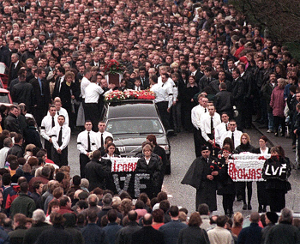
Funeral of Loyalist Billy Wright

billy-wright-funeral

Thousands of Ulster loyalists pack the streets of Portadown, County Armagh, on December 30, 1997, for the funeral of Loyalist Volunteer Force (LVF) commander William Stephen “Billy” Wright.

Wright, born in Wolverhampton, England on July 7, 1960, is a prominent Ulster loyalist paramilitary during the ethno-nationalist conflict in Northern Ireland known as The Troubles. He joins the Ulster Volunteer Force (UVF) in 1975 and becomes commander of its Mid-Ulster Brigade in the early 1990s, taking over from Robin “The Jackal” Jackson. According to the Royal Ulster Constabulary, Wright is involved in the sectarian killings of up to 20 Catholics, although he is never convicted for any. It is alleged that Wright, like his predecessor, serves as a double agent of the British security forces.

Wright attracts considerable media attention at the Drumcree standoff, where he supports the Orange Order‘s desire to march its traditional route through the Catholic/Irish nationalist area of Portadown. In 1994, the UVF and other paramilitary groups call ceasefires. However, in July 1996, Wright’s unit breaks the ceasefire and carries out a number of attacks, including a sectarian killing. For this, Wright and his Portadown unit of the Mid-Ulster Brigade are stood down by the UVF leadership. He is expelled from the UVF and threatened with execution if he does not leave Northern Ireland. Wright ignores the threats and, along with many of his followers, defiantly forms the breakaway Loyalist Volunteer Force (LVF).

In March 1997 Wright is sent to the HM Maze Prison for having threatened the life of a woman. While imprisoned, Wright continues to direct the LVF’s activities. On December 27 of that year, he is assassinated at the prison by Irish National Liberation Army (INLA) prisoners as he is led out to a van for a visit with his girlfriend. The LVF carries out a wave of sectarian attacks in retaliation.

Owing to his uncompromising stance as an upholder of Ulster loyalism and opposition to the Northern Ireland peace process, Wright is regarded as a cult hero, cultural icon, and martyr figure by hardline loyalists. His image adorns murals in loyalist housing estates and many of his devotees have tattoos bearing his likeness.

Wright’s funeral procession moves at a snail’s pace on a grey and windy day. Groups of mourners take turns carrying the coffin. Women carry a wreath that simply says “Billy.” Twenty men with tight haircuts and white shirts with black armbands flank the cortège. There is heavy security. Troops stand guard on bridges and Royal Ulster Constabulary (RUC) Land Rovers prowl the housing estates. A spotter plane flies overhead. A lone piper plays “Abide with Me” before a banner bearing the letters “LVF.”

Wright is buried at Seagoe Cemetery, Portadown, Northern Ireland.

Leave a comment

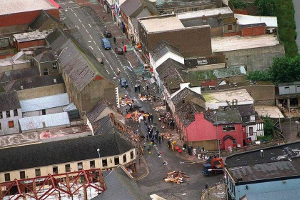
The Omagh Car Bombing

The Omagh bombing, a car bombing in Omagh, County Tyrone, Northern Ireland, takes place on August 15, 1998. It is carried out by a group calling themselves the Real Irish Republican Army, a Provisional Irish Republican Army (IRA) splinter group who opposes the IRA’s ceasefire and the Good Friday Agreement.

On the day of the bombing, the bombers drive a car, loaded with 230 kilograms (510 lb) of fertiliser-based explosives, across the Irish border. At approximately 2:19 PM they park the vehicle outside S.D. Kells’ clothes shop in Omagh’s Lower Market Street, on the southern side of the town centre, near the crossroads with Dublin Road. They are unable to find a parking space near the intended target, the Omagh courthouse. The two male occupants arm the bomb and, upon exiting the car, walk east down Market Street towards Campsie Road.

Three telephone calls are made warning of a bomb in Omagh, using the same codeword that had been used in the Real IRA’s bomb attack in Banbridge two weeks earlier. At 2:32 PM, a warning is telephoned to Ulster Television saying, “There’s a bomb, courthouse, Omagh, Main Street, 500 lb., explosion 30 minutes.” One minute later, the office receives a second warning saying, “Martha Pope (which is the RIRA’s code word), bomb, Omagh town, 15 minutes.” The caller claims the warning on behalf of “Óglaigh na hÉireann.” One minute later, the Coleraine office of the Samaritans receives a call stating that a bomb will go off on “Main Street” about 200 yards (180 m) from the courthouse. The recipients pass the information on to the Royal Ulster Constabulary (RUC) but are claimed to be inaccurate and police inadvertently move people towards the bomb.

The car bomb detonates at 3:10 PM in the crowded shopping area. The bombing kills 29 people, including a woman pregnant with twins, and injures some 220 others. Twenty-one people who are in the vicinity of the vehicle die at the scene. Eight more people die on the way to or in the hospital. The death toll is higher than that of any single incident during what are considered “the Troubles.”

The bombing causes outrage both locally and internationally, spurs on the Northern Ireland peace process, and deals a severe blow to the Dissident republican campaign. The Real IRA apologises and declares a ceasefire shortly afterwards. The victims include people from many backgrounds: Protestants, Catholics, a Mormon teenager, five other teenagers, six children, a mother pregnant with twins, two Spanish tourists, and others on a day trip from the Republic of Ireland. Both unionists and Irish nationalists are killed and injured.

It is alleged that the British, Irish and U.S. intelligence agencies have information which could have prevented the bombing, most of which comes from double agents inside the Real IRA. This information is not given to the local police, the Royal Ulster Constabulary (RUC). In 2008 it is revealed that British intelligence agency, Government Communications Headquarters, was monitoring conversations between the bombers as the bomb was being driven into Omagh.

A 2001 report by the Police Ombudsman says that the RUC Special Branch failed to act on prior warnings and slammed the RUC’s investigation of the bombing. The RUC has obtained circumstantial and coincidental evidence against some suspects, but it has not come up with anything to convict anyone of the bombing. Colm Murphy is tried, convicted, and then released after it is revealed that Garda Síochána forged interview notes used in the case. Murphy’s nephew, Sean Hoey, is also tried and found not guilty.

In June 2009, the victims’ families win a GB£1.6 million civil action against four defendants. In April 2014, Seamus Daly is charged with the murders of those killed, however, the case against him is withdrawn in February 2016.


Leave a comment

The La Mon Entertainment Complex Bombing

la-mon-bombing

A Provisional Irish Republican Army (PIRA) incendiary device explodes at the La Mon entertainment complex in Comber, County Down, on February 17, 1978, killing twelve people and injuring thirty others. The blast has been described as “one of the worst atrocities” of the Troubles.

Since the beginning of its campaign, the IRA has carried out numerous attacks on economic targets, killing many members of the public in the process. The IRA’s goal is to harm the economy and cause disruption, which will put pressure on the British government to withdraw from Northern Ireland.

On February 17, 1978, an IRA unit plants an incendiary device attached to petrol-filled canisters on meat hooks outside the window of the Peacock Room in the restaurant of the La Mon House Hotel. The IRA often give bomb warnings in advance of destroying property but never when targeting the police or military. After planting the bomb, the IRA members attempt to send a warning from the nearest public telephone but find that it has been vandalised. On the way to another telephone, they are delayed again when forced to stop at an Ulster Defence Regiment (UDR) checkpoint. By the time they are able to send the warning, only nine minutes remain before the bomb detonates at 21:00. The blast creates a fireball, killing twelve people and injuring thirty more, many of whom are severely burned. Many of the injured are treated in the Ulster Hospital in nearby Dundonald. A 2012 news article claims that the IRA were targeting Royal Ulster Constabulary (RUC) officers they believed were meeting in the restaurant that night. The article claims that the IRA had gotten the wrong date and that the meeting of RUC officers had taken place exactly one week earlier.

The day after the explosion, the IRA admits responsibility and apologises for the inadequate warning. The hotel had allegedly been targeted by the IRA as part of its firebomb campaign against commercial targets. However, the resulting carnage brings quick condemnation from other Irish nationalists, with one popular newspaper comparing the attack to the 1971 McGurk’s Bar bombing. Sinn Féin president Ruairí Ó Brádaigh also strongly criticises the operation. In consequence of the botched attack, the IRA Army Council gives strict instructions to all units not to bomb buses, trains, or hotels.

A team of 100 RUC detectives is deployed in the investigation. As part of the investigation, 25 people are arrested in Belfast, including Gerry Adams. Adams is released from custody in July 1978. Two prosecutions follow. One Belfast man is charged with twelve murders but is acquitted. He is convicted of IRA membership but successfully appeals. In September 1981, another Belfast man, Robert Murphy, is given twelve life sentences for the manslaughter of those who died. Murphy is freed on licence in 1995. As part of their bid to catch the bombers, the RUC passes out leaflets which display a graphic photograph of a victim’s charred remains.

In 2012, a news article claims that two members of the IRA bombing team, including the getaway driver, are British double agents working for MI5. According to the article, one of the agents is Denis Donaldson. That year, Northern Ireland’s Historical Enquiries Team (HET) completes a report on the bombing. It reveals that important police documents, including interviews with IRA members, have been lost. A number of the victims’ families slam the report and call for a public inquiry. They claim the documents had been removed to protect certain IRA members. Unionist politician Jim Allister, who has been supporting the families, says, “There is a prevalent belief that someone involved was an agent and that is an issue around which we need clarity.”