seamus dubhghaill

Promoting Irish Culture and History from Little Rock, Arkansas, USA


Leave a comment

Oliver Plunkett Beatified by Pope Benedict XV

oliver-plunkett

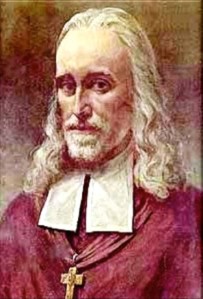
Oliver Plunkett, Roman Catholic Archbishop of Armagh and Primate of All Ireland, is beatified by Pope Benedict XV on May 23, 1920.

Plunkett is born on November 1, 1625, in Loughcrew, County Meath, to well-to-do parents with Hiberno-Norman ancestors. He is ordained a priest in 1654 and deputed by the Irish bishops to act as their representative in Rome. Meanwhile, the Cromwellian conquest of Ireland (1649–1653) has defeated the Roman Catholic cause in Ireland. In the aftermath, the public practice of Roman Catholicism is banned, and Roman Catholic clergy are executed. As a result, it is impossible for Plunkett to return to Ireland for many years.

He eventually sets foot on Irish soil again on March 7, 1670, as the English Restoration of 1660 has begun on a basis of toleration. After arriving back in Ireland, he sets about reorganising the ravaged Roman Church and builds schools both for the young and for clergy, whom he finds “ignorant in moral theology and controversies.” The Penal Laws have been relaxed in line with the Declaration of Breda in 1660 and Plunkett is able to establish a Jesuit College in Drogheda in 1670.

On the enactment of the Test Act in 1673, to which Plunkett does not agree for doctrinal reasons, the college is closed and demolished. Plunkett goes into hiding, traveling only in disguise, and refusing a government edict to register at a seaport to await passage into exile. In 1678, the so-called Popish Plot, concocted in England by clergyman Titus Oates, leads to further anti-Roman Catholic action. Archbishop Peter Talbot of Dublin is arrested, and Plunkett again goes into hiding.

Despite being on the run and with a price on his head, Plunkett refuses to leave his flock. At some point before his final incarceration, he takes refuge in a church that once stood in the townland of Killartry, in the parish of Clogherhead in County Louth, seven miles outside Drogheda. He is arrested in Dublin in December 1679 and imprisoned in Dublin Castle. Plunkett is tried at Dundalk for conspiring against the state by allegedly plotting to bring 20,000 French soldiers into the country, and for levying a tax on his clergy to support 70,000 men for rebellion.

Plunkett is found guilty of high treason in June 1681 “for promoting the Roman faith” and is condemned to death. He is hanged, drawn, and quartered at Tyburn on July 1, 1681, the last Roman Catholic martyr to die in England.

Oliver Plunkett is beatified on May 23, 1920, and canonised in 1975, the first new Irish saint for almost seven hundred years, and the first of the Irish martyrs to be beatified. For the canonisation, the customary second miracle is waived. Plunkett has since been followed by 17 other Irish martyrs who were beatified by Pope John Paul II in 1992. Among them are Archbishop Dermot O’Hurley, Margaret Ball, and the Wexford Martyrs.


Leave a comment

Postponement of the Easter Rising

general-post-office

On Saturday, April 22, 1916, the Easter Rising, originally planned for the following day, Easter Sunday, is postponed for one day.

At dawn a messenger from the Kerry Volunteers arrives in Dublin and informs James Connolly, Commandant of the Dublin Brigade, that Roger Casement had been arrested in County Kerry the previous day during a failed attempt to smuggle arms into Ireland on board the German ship Aud. A meeting of the Military Council is hastily organised, and the decision is made not to inform Chief-of-Staff of the Irish Volunteers, Eoin MacNeill, about Casement’s arrest.

Later in the morning, after attempting to escape the area, Karl Spindler, captain of the Aud, makes the decision to scuttle his ship after it is intercepted by the Royal Navy. Although Spindler and the crew are rescued, the armaments on board the Aud are lost. By early afternoon the Military Council is made aware of the loss of their arms shipment.

At 6:00 PM, Sean Fitzgibbon, Colm O’Loughlin, and Michael Joseph O’Rahilly arrive at Woodtown Park and inform MacNeill of the arrests and the loss of the Aud. After confronting Patrick Pearse at St. Enda’s School, a bilingual school for boys founded by Pearse, MacNeill and others, including O’Rahilly and Bulmer Hobson, gather at the house of Seumas O’Kelly on Rathgar Road and a decision is made to issue countermanding orders cancelling the Rising planned for Easter Sunday. To make sure that the countermanding order is received and understood, James Ryan is sent overnight to Cork, Colm O’Loughlin to Dundalk and Coalisland, Sean Fitzgibbon to Waterford, and Min Ryan to Wexford. O’Rahilly travels to Limerick, Kerry, Cork, and Tipperary. This succeeds in delaying the rising for only one day, although it greatly reduces the number of Volunteers who turn out.

During the evening, Major-General Sir Lovick Friend, General Officer Commanding of British forces in Ireland, travels to London on leave in wake of the capture of the Aud believing that any potential insurgency has been stopped. Chief Secretary Augustine Birrell is also in London having attended a Cabinet meeting. Both men remain in London through Easter, leaving Under Secretary Matthew Nathan as the most senior British official remaining in Dublin. Lord Lieutenant of Ireland, Ivor Churchill Guest, 1st Viscount Wimborne, urges Nathan to order the arrest of a large number of rebel leaders however he is unwilling to do so without the authorisation of Chief Secretary Birrell.