seamus dubhghaill

Promoting Irish Culture and History from Little Rock, Arkansas, USA


Leave a comment

Death of Hugh O’Neill, Earl of Tyrone

hugh-o-neill

Hugh O’Neill (Irish: Aodh Mór Ó Néill), the 3rd Baron Dungannon and 2nd Earl of Tyrone, dies in Rome on July 20, 1616. His career is played out against the background of the Tudor conquest of Ireland, and he is best known for leading the resistance during the Nine Years’ War, the strongest threat to Tudor authority in Ireland since the revolt of Silken Thomas. The defeat of O’Neill and the conquest of his province of Ulster is the final step in the subjugation of Ireland by the English.

Although born into the powerful O’Neill dynasty of Ulster, O’Neill is fostered as a ward of the Crown in County Dublin after the assassination of his father, Matthew, in 1558. His wardship ends in 1567 and, after a visit to the court in London, he returns to Ireland in 1568 and assumes his grandfather’s title of Earl of Tyrone. By initially cooperating with the government of Queen Elizabeth I, he establishes his base of power, and in 1593 he replaces Turlough Lynagh O’Neill as chieftain of the O’Neills. But his dominance in Ulster leads to a deterioration in his relations with the Crown, and skirmishes between his forces and the English in 1595 are followed by three years of fruitless negotiations between the two sides.

In 1598 O’Neill reopens hostilities. His victory over the English on August 14 in the Battle of the Yellow Ford on the River Blackwater, Ulster, the most serious defeat sustained by the English in the Irish wars, sparks a general revolt throughout the country. Pope Clement VIII lends moral support to his cause, and, in September 1601, four thousand Spanish troops arrive at Kinsale, Munster, to assist the insurrection. But those reinforcements are quickly surrounded at Kinsale, and O’Neill suffers a staggering defeat in December 1601 while attempting to break the siege. He continues to resist until forced to surrender on March 30, 1603, six days after the death of Queen Elizabeth.

Elizabeth’s successor, King James I, allows O’Neill to keep most of his lands, but the chieftain soon finds that he cannot bear the loss of his former independence and prestige. In September 1607 he, with Rory O’Donnell, 1st Earl of Tyrconnell, and their followers, secretly embark on a ship bound for Spain. The vessel is blown off course and lands in Normandy. From there the refugees make their way via the Spanish Netherlands to Rome, where they are acclaimed by Pope Paul V. This “Flight of the Earls” signals the end of Gaelic Ulster and thereafter the province is rapidly Anglicized. Outlawed by the English, O’Neill lives in Rome the rest of his life. He dies there at the age of 66 on July 20, 1616. He is interred in the Spanish church of San Pietro in Montorio.

3 Comments

The Retreat of Donal Cam O’Sullivan Beare

donall-cam-osullivan-beare

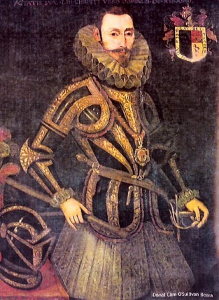
Donal Cam O’Sullivan Beare and his clan begin their epic march to Ulster on December 31, 1602. O’Sullivan has supported Hugh O’Neill, Earl of Tyrone, in his fight against Elizabethan England‘s attempts to destroy Gaelic Ireland once and for all. The cause O’Neill and O’Sullivan fight for is probably doomed after O’Neill’s defeat in the Battle of Kinsale in 1601, but the fight goes on, nonetheless.

O’Sullivan Beare conceals 300 of the women, children and aged of his community in a stronghold on Dursey Island, but this position is attacked, and the defenders hanged. In what is later termed the Dursey Massacre, Philip O’Sullivan Beare, nephew of O’Sullivan Beare, writes that the women and children of the Dursey stronghold are massacred by the English, who tie them back-to-back, throw them from the cliffs, and shoot at them with muskets.

After the fall of Dursey and Dunboy, O’Sullivan Beare, Lord of Beara and Bantry, gathers his remaining followers and sets off northwards on December 31, 1602, on a 500-kilometre march with 1,000 of his remaining people. He hopes to meet Hugh O’Neill on the shores of Lough Neagh.

O’Sullivan Beare fights a long rearguard action northwards through Ireland, through Munster, Connacht and Ulster, during which the much larger English force and their Irish allies fight him all the way. The march is marked by the suffering of the fleeing and starving O’Sullivans as they seek food from an already decimated Irish countryside in winter. They face equally desperate people in this, often resulting in hostility, such as from the Mac Egans at Redwood Castle in County Tipperary and at Donohill in O’Dwyer’s country, where they raid the Earl of Ormonde‘s foodstore.

O’Sullivan Beare marches through Aughrim, where he raids villages for food and meets local resistance. He is barred entrance to Glinsk Castle and leads his refugees further north. On their arrival at Brian Oge O’Rourke‘s castle in Leitrim on January 4, 1603, after a fortnight’s hard marching and fighting, only 35 of the original 1,000 remain. Many had died in battles or from exposure and hunger, and others had taken shelter or fled along the route. O’Sullivan Beare had marched over 500 kilometres, crossed the River Shannon in the dark of a midwinter night, having taken just two days to make a boat of skin and hazel rods to carry 28 at a time the half-kilometre across the river, fought battles and constant skirmishes, and lost almost all of his people during the hardships of the journey.

In Leitrim, O’Sullivan Beare seeks to join with other northern chiefs to fight the English, and organises a force to this end, but resistance ends when Hugh O’Neill, 2nd Earl of Tyrone signs the Treaty of Mellifont. O’Sullivan Beare, like other members of the Gaelic nobility of Ireland who flees and seeks exile, making his escape to Spain by ship. O’Sullivan Beare settles in Spain and continues to plead with the Spanish government to send another invasion force to Ireland. King Phillip III gives him a knighthood, pension, and the title Earl of Bearhaven, but never that which he desires most, another chance to free his homeland.

Many generations of O’Sullivan Beare’s family later achieve prominence in Spain. In 1618, Donal Cam O’Sullivan Beare is killed in Madrid by John Bathe, an Anglo-Irishman, but the legend of “O’Sullivan’s March” lives on.

The Beara-Breifne Way long-distance walking trail follows closely the line of the historical march.


Leave a comment

Birth of Irish Statesman John Beresford

john-beresford

John Beresford, Irish statesman, is born in Cork on March 14, 1738. He is a younger son of Sir Marcus Beresford who, having married Catherine, sole heiress of James Power, 3rd Earl of Tyrone, is created Earl of Tyrone in 1746. After the death of the earl in 1763, Beresford’s mother successfully asserts her claim suo jure to the barony of La Poer. John Beresford thus inherits powerful family connections. He is educated at Kilkenny College and Trinity College, Dublin and is called to the Irish bar.

Beresford enters the Irish House of Commons as member for County Waterford in 1761. In 1768, 1783, 1789 and finally in 1798, he stands also for Coleraine, however choosing each time to sit for Waterford.

His industry, added to the influence of his family, procures his admission to the Privy Council of Ireland in 1768, and his appointment as one of the commissioners of revenue two years later. In 1780 he becomes first commissioner of revenue, a position which gives him powerful influence in the Irish administration. He introduces some useful reforms in the machinery of taxation and is the author of many improvements in the architecture of the public buildings and streets of Dublin. He is first brought into conflict with Henry Grattan and the popular party in 1784, by his support of the proposal that the Irish parliament in return for the removal of restrictions on Irish trade should be bound to adopt the English navigation laws.

In 1786, Beresford is sworn a member of the Privy Council of Great Britain, and the power which he wields in Ireland through his numerous dependants and connections grows to be so extensive that a few years later he is spoken of as the “King of Ireland.” He is a vehement opponent of the increasing demand for Catholic Emancipation and when it becomes known that the Earl Fitzwilliam is to succeed John Fane, 10th Earl of Westmorland, as Lord Lieutenant of Ireland in 1795 for the purpose of carrying out a conciliatory policy, Beresford expresses strong hostility to the appointment. One of Fitzwilliam’s first acts is to dismiss Beresford from his employment for corruption, but with permission to retain his entire official salary for life, and with the assurance that no other member of his family will be removed. Fitzwilliam has been encouraged in this course of action by William Ponsonby. Beresford immediately exerts all his influence with his friends in England, to whom he describes himself as an injured and persecuted man. He appeals to William Pitt the Younger and goes to London to lay his complaint before the English ministers.

The recall of Fitzwilliam, which is followed by such momentous consequences in the history of Ireland is, as the viceroy himself believes, mainly due to Beresford’s dismissal. There has been a misunderstanding on the point between Pitt and Fitzwilliam. The latter, whose veracity is unimpeachable, asserts that previous to his coming to Ireland he had informed the prime minister of his intention to dismiss Beresford, and that Pitt had raised no objection. Pitt denies all recollection of any such communication, and on the contrary describes the dismissal as an open breach of the most solemn promise. In a letter to Frederick Howard, 5th Earl of Carlisle, justifying his action, Fitzwilliam mentions that malversation had been imputed to Beresford. Beresford sends a challenge to Fitzwilliam, but the combatants are interrupted on the field and Fitzwilliam then makes an apology.

When John Pratt, 1st Marquess Camden, replaces Fitzwilliam in the viceroyalty in March 1795, Beresford resumes his former position. On the eve of the Irish Rebellion of 1798 his letters to William Eden, 1st Baron Auckland, give an alarming description of the condition of Ireland and he counsels strong measures of repression. When first consulted by Pitt on the question of the union, Beresford appears to dislike the idea, but he soon becomes reconciled to the policy and warmly supports it. After the union Beresford continues to represent County Waterford in the Parliament of the United Kingdom, and he remains in office until 1802, taking an active part in settling the financial relations between Ireland and Great Britain.

In 1760, Beresford marries Constantia Ligondes, who dies in 1772. In 1774, he marries Barbara Montgomery, a celebrated beauty who figures in Sir Joshua Reynolds‘ picture of The Graces. He has large families by both marriages. His sons include Marcus Beresford, George Beresford, and John Claudius Beresford. John Beresford dies near Derry on November 5, 1805.