seamus dubhghaill

Promoting Irish Culture and History from Little Rock, Arkansas, USA


Leave a comment

Death of Brian O’Neill, High King of Ireland

Brian O’Neill (Irish: Brian Chatha an Dúna Ó Néill), the High King of Ireland from 1258 to 1260, is defeated and killed by the forces of Roger des Auters at the Battle of Down on May 14, 1260.

O’Neill is the son of Niall Roe O’Neill, and grandson of Áed in Macáem Tóinlesc. His wife is Nuala O’Connor (Ní Conchobair), a daughter of Rory O’Connor (Irish: Ruaidrí Ua Conchobair), the last High King of Ireland before the Norman invasion. Therefore, through his mother, he is descended from Brian Boru (Irish: Brian Bóramha).

In 1230, Hugh O’Neill (Irish: Aedh Ó Néill), king of Tyrone, dies and is succeeded by Donnell MacLaughlin. MacLaughlin, however, is removed in 1238 by the Justiciar of Ireland, Maurice FitzGerald, 2nd Lord of Offaly, and Hugh de Lacy, 1st Earl of Ulster, who install “the son of O’Neill”, presumed to have been Brian, and take the hostages of the Cenel Owen and Cenel Connell. However, it may have been Brian’s cousin Donnell, who afterwards is killed by MacLaughlin. After this, O’Neill claims the kingship of the O’Neill dynasty as well as Tyrone, possibly with the aid of Hugh de Lacy, 1st Earl of Ulster.

In revenge, O’Neill with the aid of Melaghlin O’Donnell, king of Tyrconnell, defeat MacLoughlin and ten of his closest kinsmen at the Battle of Camergi, somewhere within Tyrone north of Omagh, in 1241. This ends the long rivalry between the MacLoughlin’s and O’Neill’s, with the MacLoughlin’s afterwards excluded from the kingship of Tyrone and Ailech.

In 1244, Henry III of England sends letters to various Gaelic Irish lords, including O’Neill, requesting their aid in a military campaign against the Kingdom of Scotland. In the end the issue is sorted out diplomatically. Copies of the letter are also distributed to O’Neill’s sub-chiefs including his tánaiste, Hugh Boy O’Neill.

A consequence of this infighting between the rival factions of the Cenél Eoghain allows the Normans to advance deeper into Gaelic Ulster, however, in 1243 de Lacy dies. Thus the Earldom of Ulster reverts to the English Crown and is taken over by royal administrators. John FitzGeoffrey, the king’s chief governor in Ireland, erects a bridge across the River Bann and builds castles at Coleraine and Ballyroney in Iveagh. From here FitzGeoffrey is able to penetrate deeper into Tyrone.

Despite ending MacLoughlin aspirations to the kingship, O’Neill forms a marriage alliance with them, however, this results in a war with the O’Donnells of Tyrconnell. Subsequently in 1248 O’Neill backs the king of Tyrconnell, Rory O’Cannon (Irish: Ruaidri Ua Canannáin), against the claims of O’Donnell. O’Cannon had been set up in the kingship by FitzGerald, however, rather than backing him, enters Tyrconnell and removes him in favour of Gofraid O’Donnell.

O’Cannon, who had been expelled to Tyrone, and O’Neill once again lead their forces into Tyrconnell to confront O’Donnell, however they are defeated and O’Cannon is killed.

That same year, John FitzGeoffrey, who replaced FitzGerald as Justiciar in 1246, enters Tyrone and takes the submission and hostages of O’Neill. A resolution had been adopted at a meeting of the Cenel Owen that “since the power of the Foreigners was over the Gaeidhel of Erinn, to give hostages to the Foreigners, and to make peace with them, for the sake of their country.”

In 1249, the king of Connacht, Felim O’Connor, is given refuge from the Normans by O’Neill. In 1252, O’Neill and his brother give their submissions to the Justiciar of Ireland, who had marched to Armagh with a large force. A Rory O’Neill is given as hostage.

In 1253, as a sign of defiance against his vassal status with the Earldom of Ulster, O’Neill withholds his tribute to it and raids Iveagh, destroying the castle at Ballyroney. He also launches an offensive against the Normans in Leinster. That same year, the son of Maurice FitzGerald leads his forces into Tyrone to attack O’Neill, however he fails to take his submission or hostages and after battle suffers a heavy defeat at the hands of O’Neill.

In 1255, O’Neill makes a pact with Felim O’Connor’s son Hugh, whereby allowing Hugh free rein in the Kingdom of Breifne, he would aid O’Neill against the Normans of the earldom who are eroding his territory.

In 1257, the king of Tyrconnell, Gofraid O’Donnell, is mortally wounded in battle against the FitzGeralds and O’Neill uses this opportunity to try to exact Tyrconnell’s submission. As the Cenel Connell discuss what to do, Gofraid’s youngest brother, Donnell Óg, returns from fosterage and is conferred the chieftainship of Tyrconnell. He refuses to submit O’Neill stating the Scottish proverb “Every man should have his own world.”

FitzGerald in 1252 had built a castle at Caoluisce, on the banks of Lough Erne, near modern day Belleek, County Fermanagh, Northern Ireland, however, in 1258 it is the site where O’Neill, in the presence of his ally O’Connor, is inaugurated as “King of the Gael of Erin.” While he receives hostages from O’Connor and from O’Brien of Thomond, along with several other minor Kings from Meath and Munster, his claim is not recognised by those of the Irish closest to him including the other O’Neill factions, the O’Donnell’s of Tyrconnell, the MacMahon’s of Airgíalla, and the O’Rourkes of Breifne. The following year O’Donnell leads an attack into Tyrone.

In 1260, O’Neill, along with his O’Connor allies, launch an attack on the Normans of the Earldom of Ulster at Drumderg, near its capital at Downpatrick in modern County Down, Northern Ireland. The Normans levy the town, and with the aid of forces brought by Sir Roger des Auters, O’Neill and his allies are decisively defeated at the subsequent Battle of Down. The Annals of Inisfallen state that the forces recruited by the Normans consist mostly of native Irish and that the Normans play only a minor role.

In the battle, O’Neill is killed along with many other Irish nobles including over a dozen members of the O’Cahans. O’Neill’s head is cut off by the Normans and sent to King Henry III of England, a sign of how dangerous his coalition is believed to be.

After this battle, O’Neill becomes known in Irish as Brian Chatha an Dúna, meaning “Brian of the Battle of Down.”

After O’Neill’s death, the kingship of the Cenel Owen, and with it Tyrone, is taken by his cousin’s son, Hugh Boy O’Neill, ancestor of the Clandeboye O’Neill’s, who also has the support of the earldom of Ulster. Upon Hugh’s death in 1283 O’Neill’s son Donnell seizes the kingship, which until 1295 is highly contested between him and his second-cousin Niall Culanach O’Neill and Hugh Boy’s son Brian, until he wins outright control by killing his opponents.

Leave a comment

Passage of the Statutes of Kilkenny

lionel-of-antwerp

The Statutes of Kilkenny, a series of thirty-five acts aiming to curb the decline of the Hiberno-Norman Lordship of Ireland, are passed at Kilkenny on February 18, 1366.

By the middle decades of the 13th century, the Hiberno-Norman presence in Ireland is perceived to be under threat, mostly due to the dissolution of English laws and customs among English settlers. These English settlers are described as “more Irish than the Irish themselves,” referring to their taking up Irish law, custom, costume, and language.

The statutes attempt to prevent this “middle nation,” which is neither true English nor Irish, by reasserting English culture among the English settlers.

There are also military threats to the Norman presence, such as the failed invasion by Robert the Bruce‘s brother Edward Bruce in 1315, which is defended by the Irish chief Domhnall Ó Néill in his Remonstrance to Pope John XXII, complaining that “For the English inhabiting our land…are so different in character from the English of England…that with the greatest propriety they may be called a nation not of middle medium, but of utmost, perfidy.” Further, there was the de Burgh or Burke Civil War of 1333–1338, which leads to the disintegration of the estate of the Earldom of Ulster into three separate lordships, two of which are in outright rebellion against the crown.

The prime author of the statutes is Lionel of Antwerp, better known as the Duke of Clarence, and who is also the Earl of Ulster. In 1361, he has been sent as viceroy to Ireland by Edward III to recover his own lands in Ulster if possible and to turn back the advancing tide of the Irish. The statutes are enacted by a parliament that he summons in 1366. The following year, he leaves Ireland.

The statutes begin by recognizing that the English settlers have been influenced by Irish culture and customs. They forbid the intermarriage between the native Irish and the native English, the English fostering of Irish children, the English adoption of Irish children, and use of Irish names and dress. Those English colonists who do not know how to speak English are required to learn the language on pain of losing their land and belongings, along with many other English customs. The Irish pastimes of “hockie” and “coiting” are to be dropped and pursuits such as archery and lancing are to be taken up, so that the English colonists will be more able to defend against Irish aggression, using English military tactics.

Other statutes require that the English in Ireland be governed by English common law, instead of the Irish March law or Brehon law and ensures the separation of the Irish and English churches by requiring that “no Irishman of the nations of the Irish be admitted into any cathedral or collegiate church…amongst the English of the land.”

The mistrust the English have of the Irish is demonstrated by Statute XV, which forbids Irish minstrels or storytellers to come to English areas, guarding against “the Irish agents who come amongst the English, spy out the secrets, plans, and policies of the English, whereby great evils have often resulted.”

While the Statutes are sweeping in scope and aim, the English never have the resources to fully implement them. Clarence is forced to leave Ireland the following year, and Hiberno-Norman Ireland continues to gain a primarily Irish cultural identity. Only at the beginning of the 17th century would another attempt to colonise Ireland begin to make appreciable gains. The Statutes of Kilkenny ultimately help to create the complete estrangement of the two “races” in Ireland for almost three centuries.

(Pictured: Lionel of Antwerp, 1st Duke of Clarence)


Leave a comment

Hugh de Lacy Appointed 1st Earl of Ulster

1st-earl-of-ulster-coat-of-arms

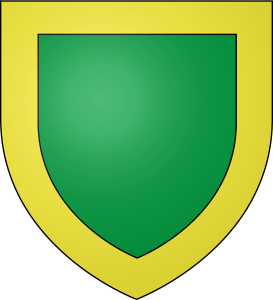
King John of England appoints Hugh de Lacy, a leading figure in the Norman invasion of Ireland in the 12th century, as the 1st Earl of Ulster on May 29, 1205.

Circa 1189 de Lacy is appointed Viceroy of Ireland, a position previously held by his father, Hugh de Lacy, Lord of Meath. He is replaced in 1190 by Guillaume le Petil. He is later reappointed to serve as viceroy from 1205 to 1210.

In 1199, King John authorises de Lacy to wage war on John de Courcy, who has conquered much of Ulster without help or permission from the King. Hugh captures de Courcy in 1204. An account of the capture appears in the Book of Howth.

After King John creates him Earl of Ulster in 1205, he makes what was de Courcy’s territory in Ulster the Earldom of Ulster. He grants Drogheda its charter and continues the conquest of the northeastern over-kingdom of Ulaid, building on de Courcy’s success, with the earldom spanning across the modern counties of Antrim and Down and parts of Londonderry.

In 1207, war breaks out between the Earl of Ulster and the justiciar. This brings King John to Ireland, where he expels the earl’s brother, Walter de Lacy, from Meath, and compels the earl himself to flee to Scotland.

For several years Ulster takes part in the wars in France, and de Lacy does not return to Ireland until 1221, when he allies himself with the O’Neills against the English. In 1226, his lands in Ulster are handed over to his brother Walter, but they are restored to him in the following year, after which date, he appears to loyally serve the king, being more than once summoned to England to give advice about Irish affairs.

De Lacy purportedly separates from his first wife and lives in adultery. He has legitimate and natural children. In 1226, his daughter by his first wife marries Alan, Lord of Galloway. He marries his second wife, Emmeline de Riddlesford, the daughter of Walter de Riddlesford around 1242. Hugh de Lacy dies shortly thereafter in 1242 or 1243. Emmeline’s second marriage takes place around 1243 with Stephen Longespee, grandson of Henry II of England, by whom she has two daughters, Ela Longespee, Lady of Ashby, and Emmeline Longespee, Lady of Offaly.

Left with no surviving legitimate children, the earldom of Ulster reverts to the crown upon de Lacy’s death.


Leave a comment

Passage of the Statutes of Kilkenny

Kilkenny Castle

The Statutes of Kilkenny, a series of thirty-five acts aiming to curb the decline of the Hiberno-Norman Lordship of Ireland, are passed on April 19, 1366.

By the middle decades of the 13th century, the Hiberno-Norman presence in Ireland is perceived to be under threat, mostly due to the dissolution of English laws and customs among English settlers. These English settlers are described as “more Irish than the Irish themselves,” referring to their taking up Irish law, custom, costume, and language.

The statutes attempt to prevent this “middle nation,” which is neither true English nor Irish, by reasserting English culture among the English settlers.

There are also military threats to the Norman presence, such as the failed invasion by Robert the Bruce‘s brother Edward Bruce in 1315. Further, there is the de Burgh or Burke Civil War of 1333–1338, which leads to the disintegration of the estate of the Earldom of Ulster into three separate lordships, two of which are in outright rebellion against the crown.

The prime author of the statutes is Lionel of Antwerp, better known as the Duke of Clarence, and who is also the Earl of Ulster. In 1361, he is sent as viceroy to Ireland by Edward III to recover his own lands in Ulster if possible and to turn back the advancing tide of the Irish. The statutes are enacted by a parliament that he summons in 1366. The following year, he leaves Ireland.

The statutes begin by recognizing that the English settlers have been influenced by Irish culture and customs. They forbid the intermarriage between the native Irish and the native English, the English fostering of Irish children, the English adoption of Irish children, and use of Irish names and dress. Those English colonists who do not know how to speak English are required to learn the language, along with many other English customs. The Irish pastimes of “hockie” and “coiting” are to be dropped and pursuits such as archery and lancing are to be taken up, so that the English colonists will be more able to defend against Irish aggression, using English military tactics.

Other statutes require that the English in Ireland are to be governed by English common law rather than the Irish March law or Brehon law. They also ensure the separation of the Irish and English churches.

The mistrust the English have of the Irish is demonstrated by Statute XV, which forbids Irish minstrels or storytellers to come to English areas, guarding against “the Irish agents who come amongst the English, spy out the secrets, plans, and policies of the English, whereby great evils have often resulted.”

While the Statutes are sweeping in scope and aim, the English never have the resources to fully implement them. Clarence is forced to leave Ireland the following year, and Hiberno-Norman Ireland continues to gain a primarily Irish cultural identity. The Statutes of Kilkenny ultimately help to create the complete estrangement of the two “races” in Ireland for almost three centuries. The Statutes of Kilkenny are repealed in 1983 by the Statute Law Revision Act.